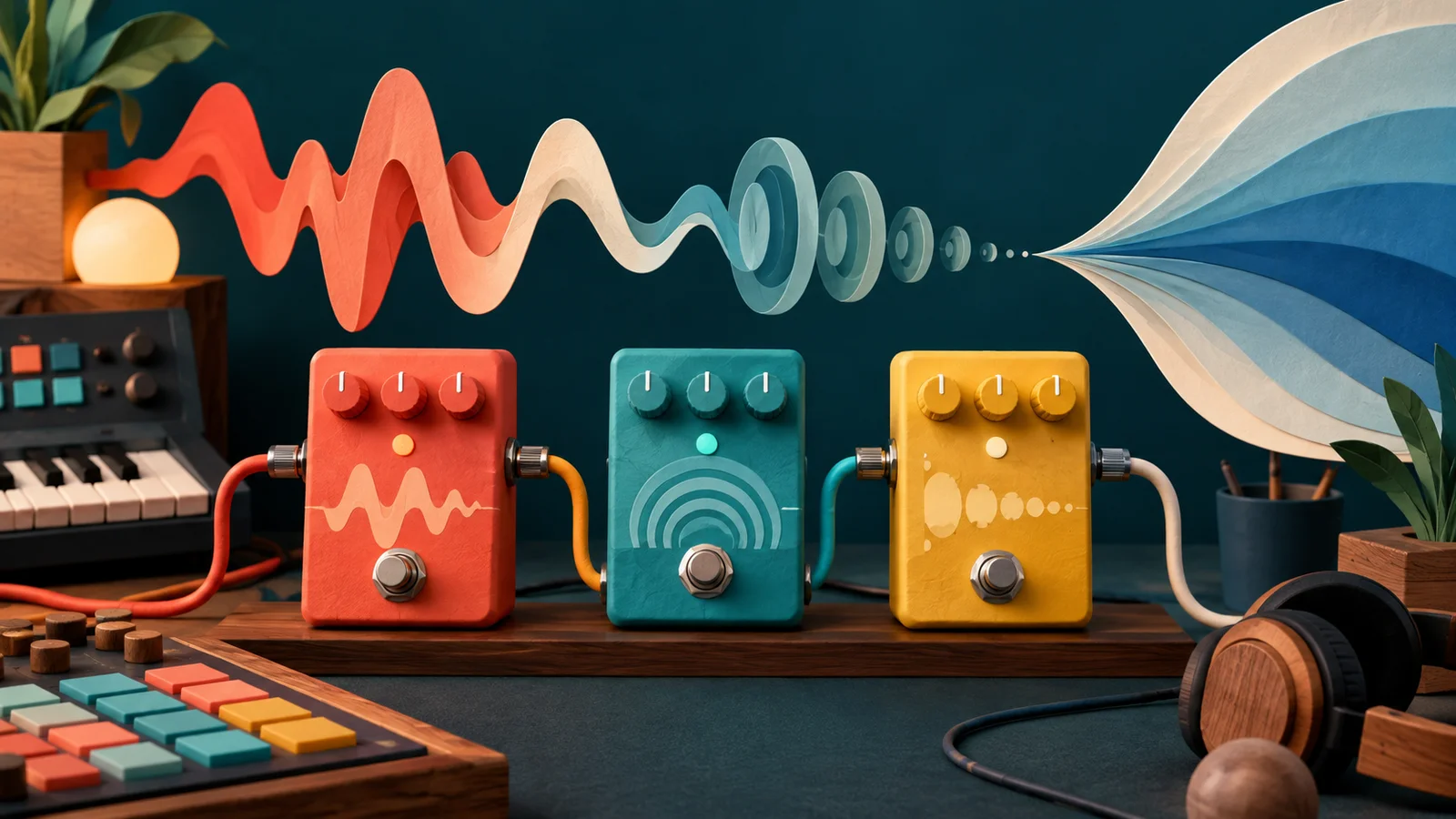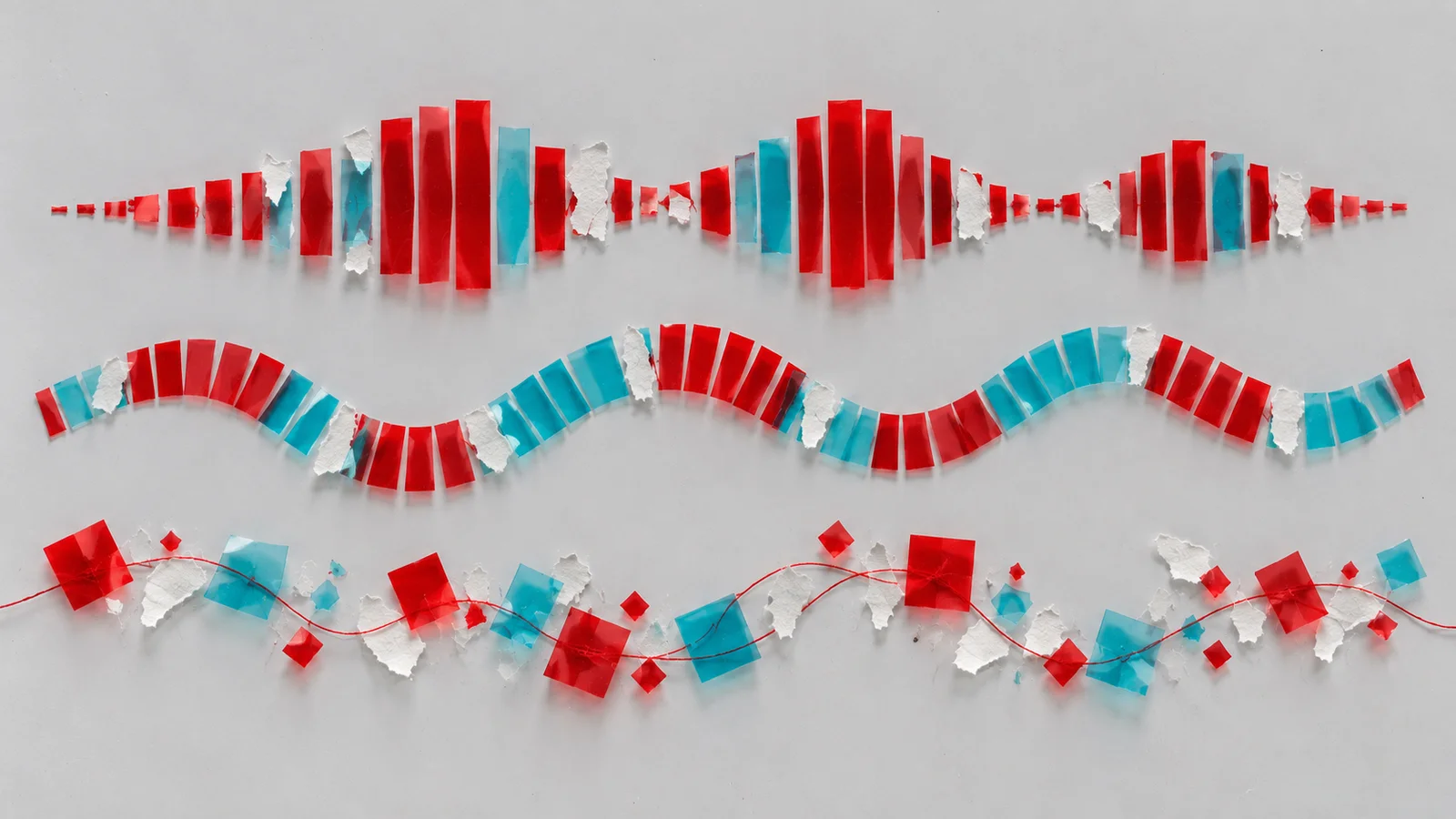
Here's a small piece of guitar history that has confused players for seventy years. Fender's amps had controls labelled "Vibrato" that made the volume pulse. Fender's Stratocaster had a "Synchronized Tremolo" arm that bent the pitch. Both names were the wrong way round, and they stuck.
So let's settle it by ear. Press play: a keys part with a slow, steady wobble on its volume. That's tremolo. Put on headphones, then before you touch anything predict this: if you make the left side pulse while the right side does the opposite, will you hear a stronger pulse, or something else?
Turn Spread from 0 to 180 degrees. Does the pulse get stronger, or does it start to travel?
One wobble, two ears
Solo Piano: Daniel Veesey, Public domain
Tremolo: the volume breathes
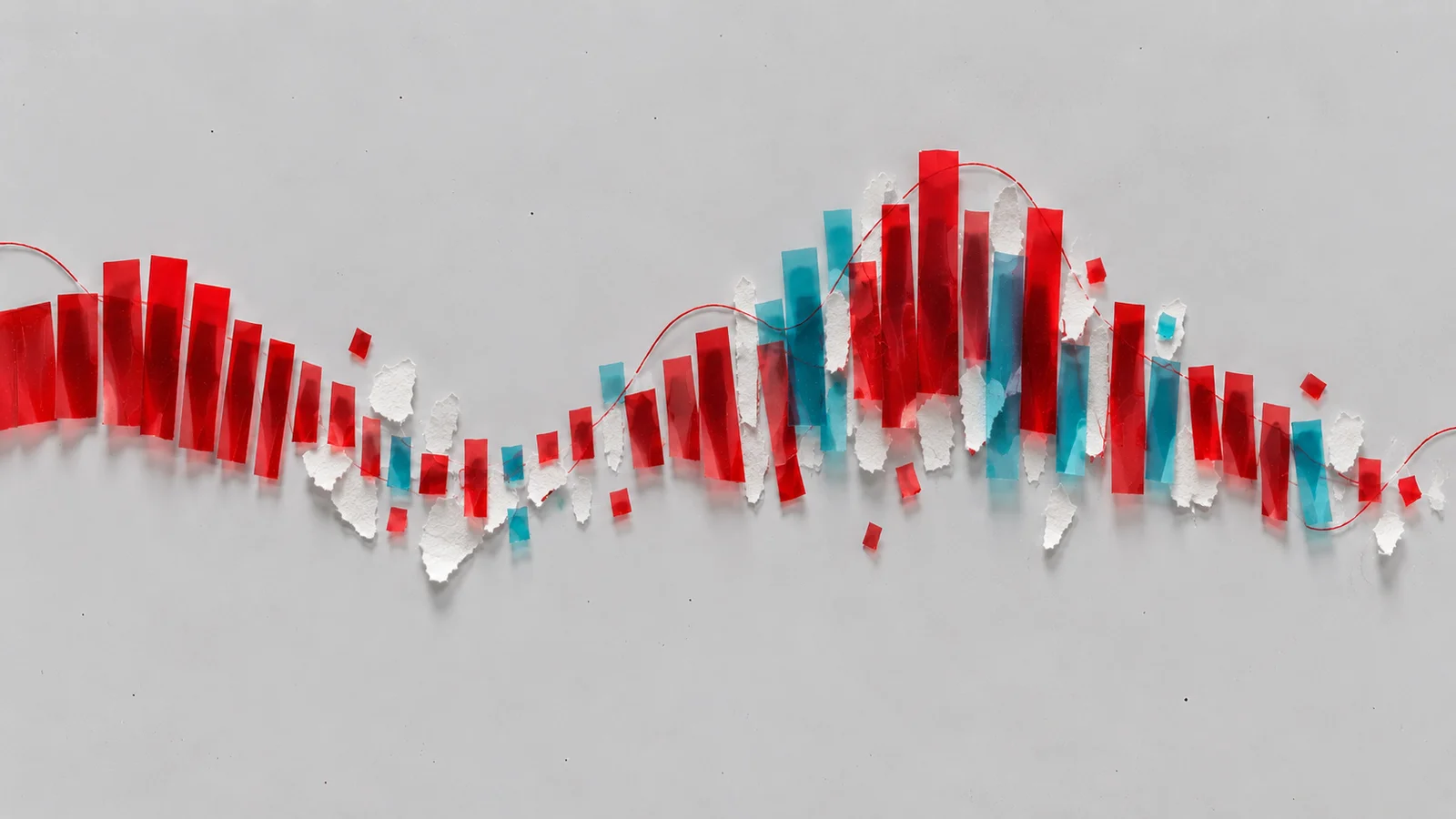
Tremolo turns the level up and down in a steady cycle. The note keeps sounding; only its loudness moves. At a gentle depth it feels like breathing. Deep and fast, it chops a held chord into a stuttering pulse, the throbbing guitar of Bo Diddley's records and of The Smiths' "How Soon Is Now?".
The cycle comes from an LFO, a low-frequency oscillator: a wave too slow to hear as a pitch, used to move something else. Two numbers describe it. Rate is how many cycles per second, in hertz. Depth is how far it moves the thing it's attached to. At Rate 4 and Depth 0.7, the keys dip to a fraction of their level four times every second.
Opposite sides turn a pulse into travel
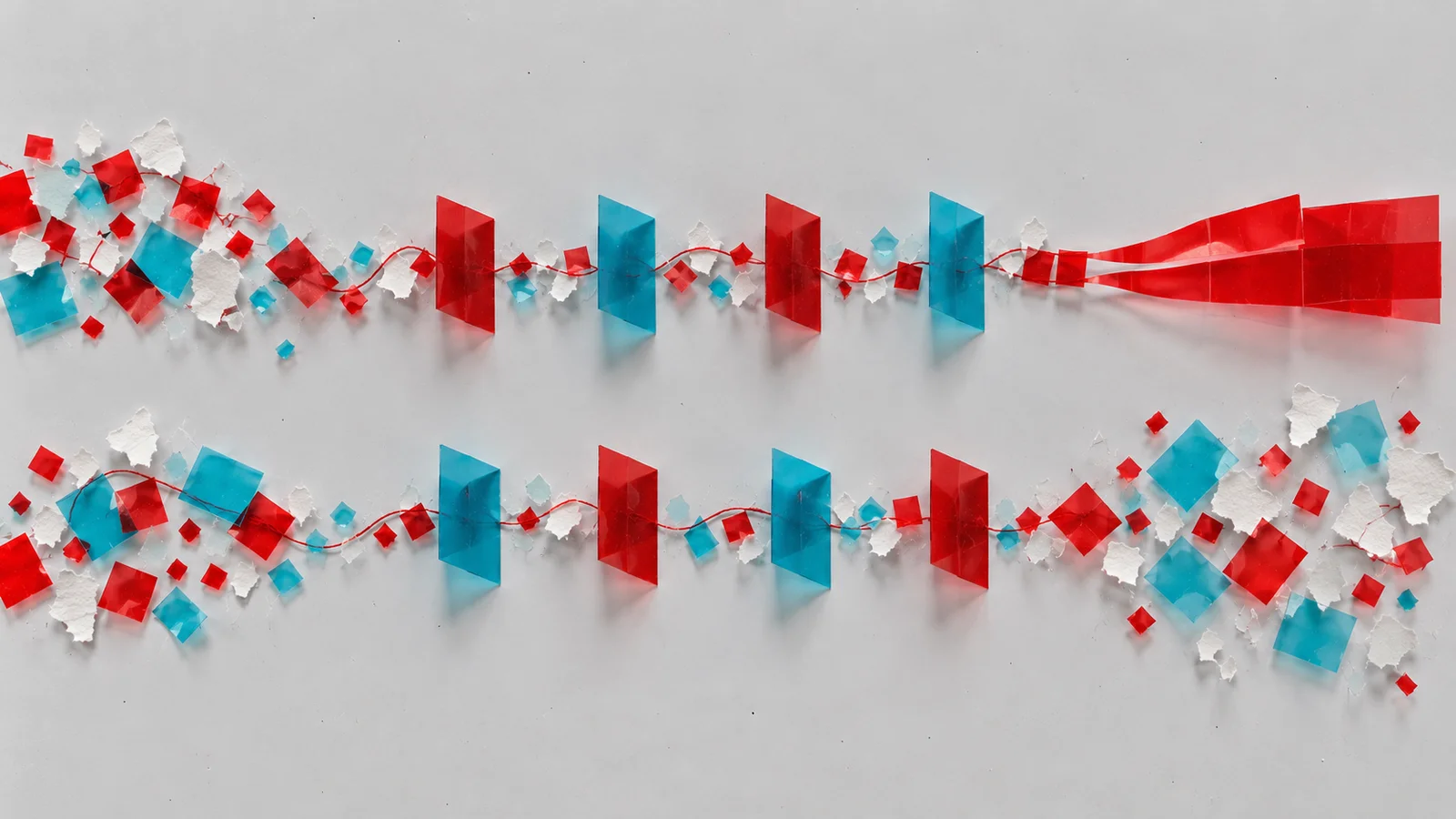
Set Spread to 180 and the two channels move in opposite directions: as the left gets louder, the right gets quieter. Your ear doesn't hear that as a pulse. It hears the sound moving from one side to the other and back. You've built an auto-pan out of a tremolo.
Tremolo with the sides opposite
Somewhere in the middle of the Spread range you get both at once: a pulse that also drifts. That in-between is often the most musical setting, because it moves without pulling the part away from its place in the mix.
Vibrato: the pitch sways
Vibrato moves the pitch instead: a little above the note, a little below, over and over. It's what singers and violinists do with their voice or their fingers to make a long note feel alive rather than frozen.
At what point does the sway stop sounding expressive and start sounding seasick?
A guitar that sways
Electric Guitar: Andy G. Cohen, CC BY
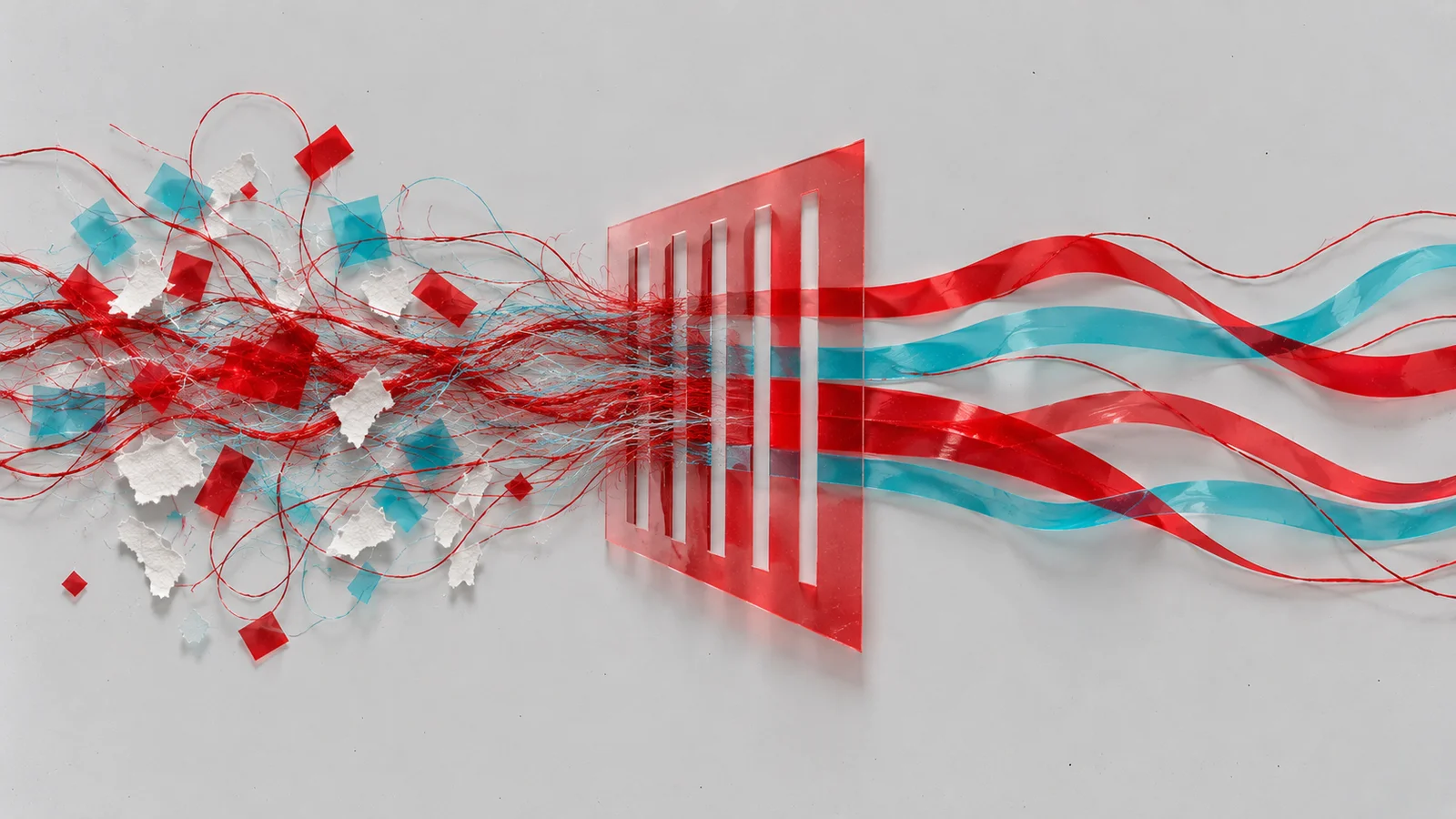
An effect can't reach inside a recording and retune the strings, so how does it bend the pitch? With a very short delay whose length keeps changing. While the delay is getting shorter, the sound is read out a little faster than it went in, so the pitch rises. While it gets longer, the pitch falls. A slow, steady sway in delay time becomes a sway in pitch.
Two side effects follow from that. First, a faster Rate makes the sway wider even at the same Depth, because the delay is changing faster. If you speed it up, you may need to pull Depth back. Second, try lowering Mix in the lab. With the original guitar back underneath, the wobbling copy beats against it and you're hearing a chorus. That's not a coincidence: a chorus is vibrato mixed with the dry sound.
Lock the wobble to the song
A tremolo that ignores the tempo can sound seasick against a beat. Lining it up is a little arithmetic. Divide the tempo by 60 to get beats per second, then multiply by how many pulses you want per beat:
- 120 BPM, one pulse per quarter note: 120 ÷ 60 = 2 Hz
- 120 BPM, eighth notes: 2 × 2 = 4 Hz
- 90 BPM, eighth-note triplets: 1.5 × 3 = 4.5 Hz
Type the number into Rate. The pulses will now repeat at the song's speed, though they may not start exactly on the beat, so nudge your playback start if a dip lands on an accent you wanted loud.
Where motion becomes roughness
Push the tremolo's Rate towards its top, 20 Hz. Somewhere above 10 Hz or so you stop hearing separate pulses and start hearing a rough, buzzy texture. Your ear can't follow the individual dips any more, so it hears them as a change of tone colour. Go fast enough and turning the volume up and down creates new frequencies on either side of every note, which is the doorway to ring modulation.
Vibrato breaks differently. On a single lead line it's expressive. On a full chord, or on a bass that's meant to hold the floor, every note swaying together can sound queasy, as if the tape were warped. If a part needs movement but must stay in tune, tremolo or auto-pan is often the better choice.
Sometimes that warped-tape feeling is the goal. Lo-fi keys combines a small pitch wobble with light grit and a softened top, then checks whether the chord changes still come through clearly.
Same idea, different place: a Leslie speaker, the spinning cabinet behind a Hammond organ, does all three at once. The rotating horn gets louder and quieter as it points towards you and away (tremolo), its motion shifts the pitch by the Doppler effect (vibrato), and it throws the sound around the room (auto-pan). The same LFO idea runs inside synths too; see LFOs and modulation.
Make it yours
Take a part of your own, a sustained guitar or keys line works best, and choose one destination for one job: a pulse locked to the tempo, a slow ear-to-ear drift for a breakdown, or a small sway on a held lead note. Work out the Rate from your tempo, start with a modest Depth and listen against the drums.
When it sits right, save it with its tempo and division in the name, like "Tremolo 8ths at 120". When the song's tempo changes, you'll know exactly which number to recalculate.
Quick check
- Your amp's "Vibrato" switch makes the chord pulse in volume. What is it really doing? Tremolo. The level moves, the pitch doesn't. The name is a historical mix-up; the destination is what tells you which effect it is.
- You set a stereo tremolo with the sides opposite. Will it sound like a stronger pulse? No. When one side dips the other peaks, so the total stays fairly even and the sound moves between your ears instead. That's auto-pan.
- You double a vibrato's Rate and the sway suddenly sounds much wider. Did Depth change? No. In a delay-based vibrato the delay is now changing twice as fast, which bends the pitch further. Pull Depth back to get the old width at the new speed.
Next steps
- Go deeper: Pitch shifting and correction. Vibrato bends pitch a little and gives it back. How do you move a voice up a whole octave and keep it there?
- Use it: Rhythm, meter and groove. Decide where the pulse should land in the bar.