Hold the note below. It's wobbling in pitch, about five times a second: a warm, slightly old-fashioned vibrato. Now change LFO Target from pitch to level, and leave everything else alone. Then try pan, with headphones on.
Before you switch: the wobble's speed hasn't changed. Will the new version sound faster, slower, or the same speed but a different kind of movement?
Switch the target from pitch to level to pan without touching the rate. What changes, and what stays the same?
One movement, three meanings
LFO Target
What just happened?
The speed stayed exactly the same. Five pulses a second on pitch, five on level, five side to side. But your ear filed them as three different effects with three different names: vibrato (pitch), tremolo (level) and auto-pan (stereo position).
That's the key idea of modulation. An LFO, a low-frequency oscillator, is an oscillator running too slowly to hear as a note. Instead of sending it to your speakers, you send it to a control, and it moves that control up and down for you. The LFO is the source. The control it moves is the destination. The destination gives the movement its meaning.
One LFO, four destinations
Even musicians mix these up. Many Fender amps have a channel labelled "Vibrato" that actually pulses the volume, which makes it tremolo, while the Stratocaster's "tremolo arm" bends the pitch, which makes it vibrato. That naming mix-up dates back to the 1950s, and it stuck. The movement is the same; the destination tells you which one you're hearing.
And the fourth destination is one you already know. Send a slow LFO to a filter's cutoff and lock its speed to the beat, and you have the wobble bass of dubstep: the same saw, opening and closing in rhythm.
Rate: how often
Rate is measured in hertz, cycles per second. At 1 Hz the movement completes once a second; at 5 Hz, five times.
Every destination has a range where it sounds natural. A singer's vibrato typically runs at about five to seven cycles a second; much slower sounds like seasickness, much faster like nerves. A slow pan of 0.1 Hz, ten seconds per sweep, makes a pad drift gently around the room. A tremolo at the speed of your song's eighth notes turns a held chord into a rhythm part.
Try it on the lab. With pitch as the target, set Rate to 1 Hz: the note now slides lazily up and down, closer to a siren than a vibrato. Bring it back to 5 or 6 Hz and it sounds like a singer again.
Depth: how far, in the destination's language
Depth is how big the movement is. Here's the trap: the same depth means very different things on different destinations.
On this synth, full depth on pitch moves the note 60 cents up and down, more than half a semitone each way. That's a lot. Set Depth to 0.35 on pitch and you get a lush vibrato; leave it at 0.35 and switch to level, and you get a fairly gentle tremolo; a small pan movement at the same depth is barely noticeable. Go the other way, from a deep tremolo to pitch, and a pleasant pulse turns into a wildly out-of-tune warble.
So whenever you change destination, turn depth down first, then bring it up until the effect is clear. Then back off a little. Movement that you notice on its own is often too much once the rest of the track is playing.
Shape: the path between high and low
Open LFO Wave and try each shape on each destination:
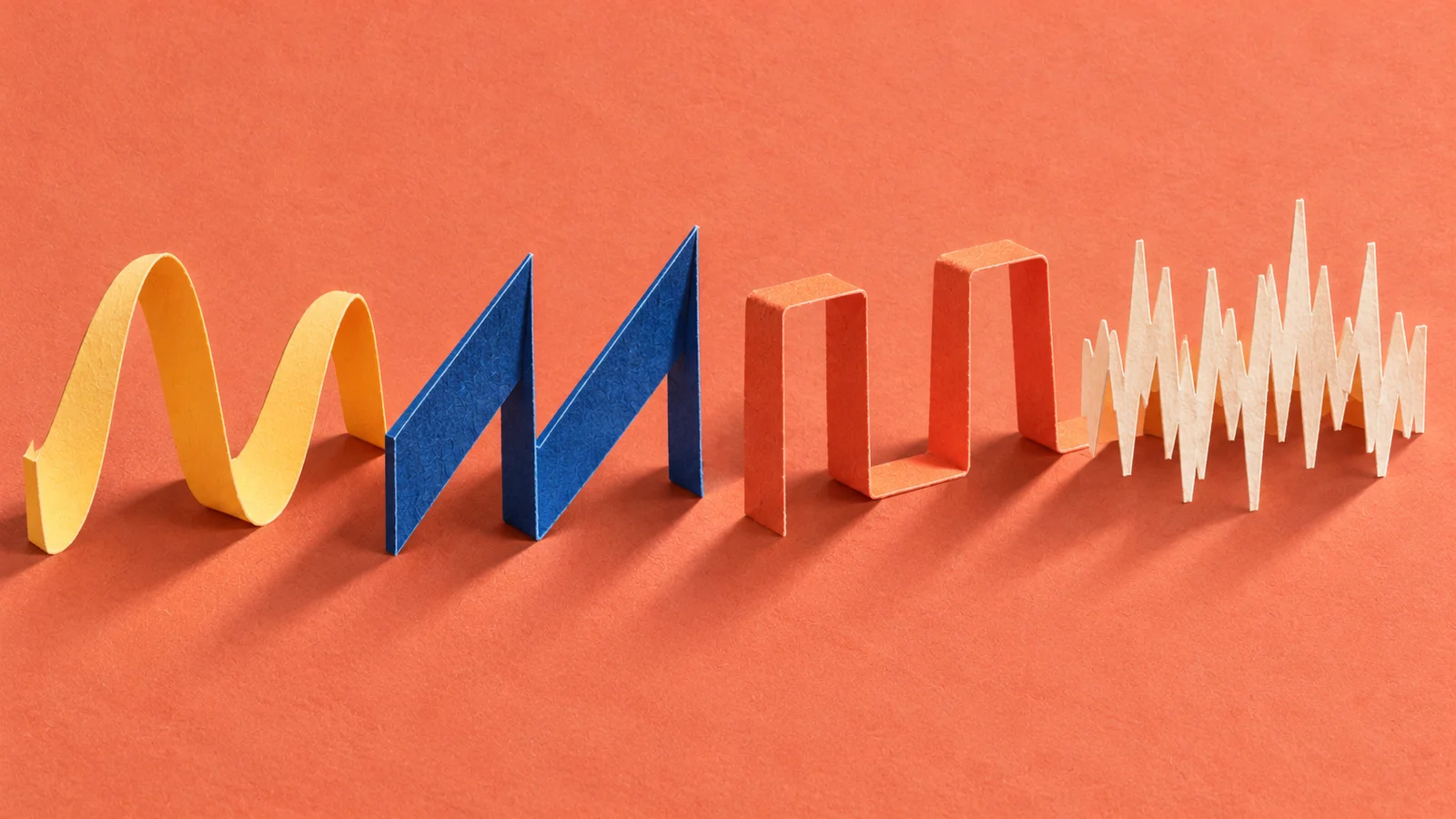
- Sine moves smoothly and lingers at the top and bottom. On pitch, it's the most natural vibrato.
- Triangle moves at a steady speed and turns sharply at the ends. Very similar to sine on most destinations, a little more mechanical on pitch.
- Saw ramps in one direction and snaps back. On pitch it becomes a repeated swoop, like a siren or a sci-fi alarm. On level it makes a swell that resets on every cycle.
- Square jumps between two states. On pitch it's a trill between two notes. On level it chops the sound into a hard stutter, the "trance gate" sound.
The smoother shapes suit expression; the hard-edged ones suit rhythm. A square on level at a fast rate can click at each jump, because the volume changes instantly. That can be exactly the hard edge a gated pad wants, or an irritation on a soft one.
Where it breaks
Drifting off the beat. The LFO here runs freely: it doesn't restart when you play a note, and it doesn't lock to a tempo. Play the same note twice and it may start on a crest one time and a trough the next. For vibrato and slow pans that's a good thing; it keeps the sound alive. For a rhythmic tremolo or gate, it means the pulses will slide against your drums. When you need movement locked to the groove, use a synth or effect with tempo sync.
Too fast to be a wobble. Set the target to pitch, Depth to full and Rate to the top, 20 Hz. Listen. It stops sounding like a note going up and down and starts sounding like a new, rougher tone, a buzz or a growl wrapped around the note. Your ear can no longer follow the movement, so it hears it as colour instead. Keep that sound in mind. It's the doorway to FM synthesis.
Same idea, different place: a chorus effect is an LFO moving a very short delay on a copy of the sound. Moving a delay time bends the copy's pitch slightly, so a chorus is really gentle vibrato on a copy, mixed with the original. The shimmer you hear is the two drifting in and out of tune. A Leslie speaker does something related with a spinning horn, moving pitch, level and direction at once. See Chorus, flanger and phaser.
Make it yours
Take the stab or pad you made in the envelopes guide, and give it one movement with a job. Some ideas:
- A slow pan (0.1 to 0.3 Hz) on a pad, so it drifts behind the lead instead of sitting dead centre.
- A gentle vibrato on a held lead note that starts only after the note has been held for a while: play the note with depth at zero, then bring depth up slowly while it rings, the way a singer adds vibrato late in a long note.
- A tremolo at the speed of your song's eighth or sixteenth notes on a held chord.
Try it on the lab first: set the shape and rate you want, and find the smallest depth where the movement is still clearly there. Then open Oscillo from the link at the top of the lab, which carries your settings, and save it with the movement in the name: "Pad, slow pan" tells your future self what it does. If you used pan, check it in mono too: a panned sound should still hold up when the sides fold together.
Quick check
- You've dialled in a nice 4 Hz filter wobble at 50% depth. You switch the same LFO to pitch. What do you expect, and what should you do first? The same speed, but probably a wildly out-of-tune wobble, because the pitch mapping covers a very different range. Turn depth right down first, then bring it up slowly.
- A rhythmic tremolo sounds great for the first bar and then starts to feel sloppy against the drums. The rate matches the tempo. What's going on? A free-running LFO drifts in phase: the pulses start wherever the cycle happens to be. Matching the rate isn't the same as locking to the beat. Use tempo sync, or retrigger the LFO on each note.
- Someone asks for "more vibrato" on a vocal-style lead. Rate, depth or shape? Usually depth, with a sine shape and a rate around five or six cycles a second. If it sounds nervous, the rate is too fast; if it sounds seasick, too slow.
Next steps
- Go deeper: FM synthesis. The LFO tops out at 20 Hz. What happens when a pitch wobble goes much faster than you can hear as a wobble?
- Sideways: Tremolo, vibrato and auto-pan. The same three movements as effects on recorded audio, guitar amps and all.