Music-making is changing.
Anyone can prompt a song or vibe code a music tool in an afternoon. Finishing it is still hard.
We’re building the open engine for that last mile, combining new AI tools with the workflows professionals already rely on. An open foundation, not another walled garden.
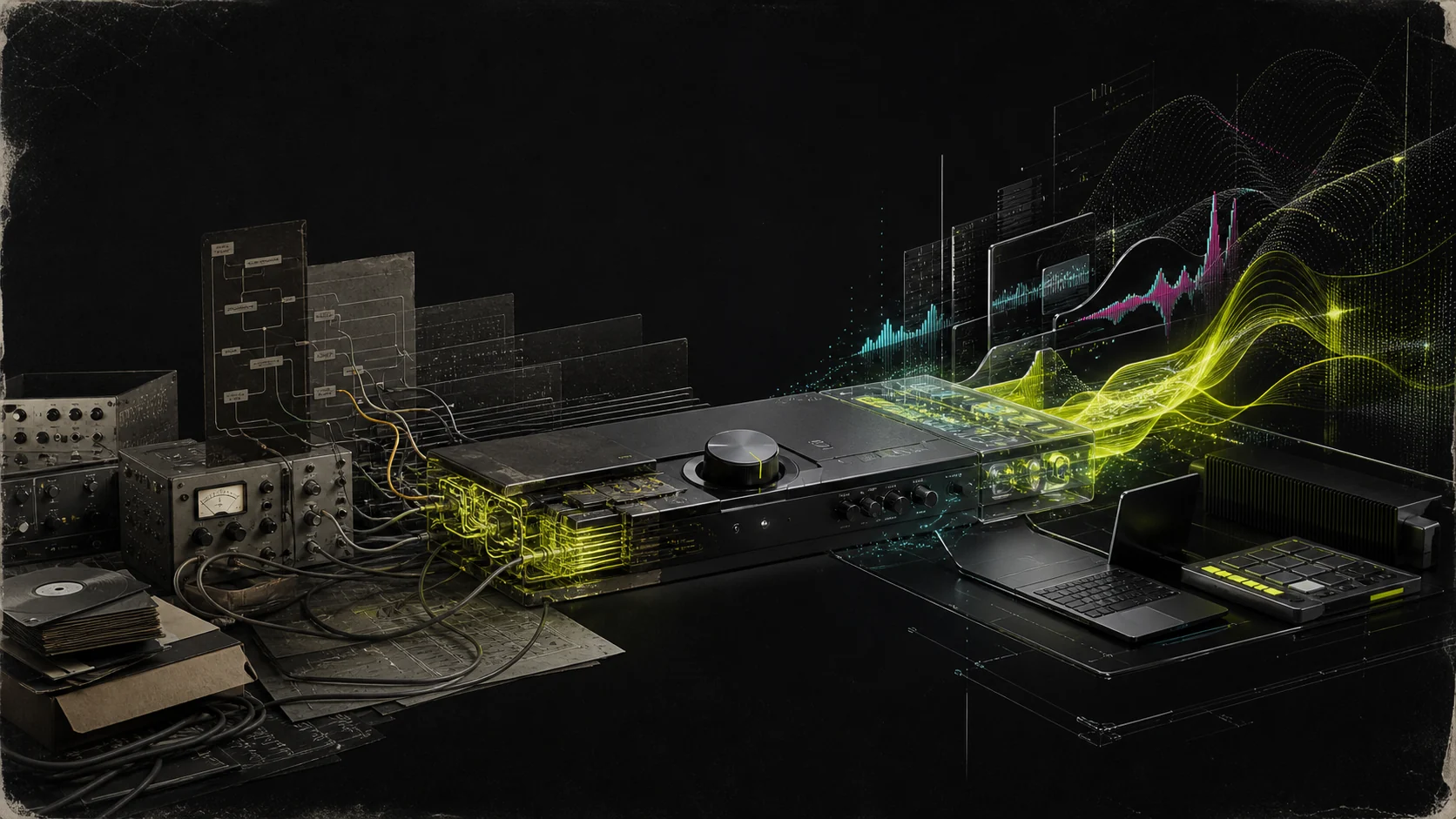
The cross-platform plugin ecosystem.
An open platform for audio creators
As AI makes audio tools cheap to build, the value moves to where they are made, shared and sold.
Creation
Producers and sound designers go from an idea to a tool that holds up in a professional session.
Marketplace
Creators share and sell their instruments, effects and sound banks.
Licensing
Audio companies and developers build their products on the Engine under commercial terms.
Maru Engine
One complete toolkit for effects, instruments and complex audio tools. DSP, interface, tests and packaging, designed to work as one.
- Compiler
- Audio SDK
- DSP library
- UI kit
- Runtimes
Browser
Web Audio, WebAssembly
Desktop plugin
VST3, CLAP, Audio Unit
Hardware
Experimental
Everything below exists to test, improve and prove the Engine.
Studio
Stress-tests the Engine with every agent-built instrument
The no-code front door: describe an instrument or bring sounds, and an agent builds a real Engine project.
First-party instruments
Proves the Engine on real, paid products
Our own plugins, built on the Engine to the standard we expect from every creator.
Research
Turns into Engine capabilities: sampler instruments, MIDI tools and the theory library
Drum-kit generation, symbolic music and musical agents.
| Layer | Maru | JUCE | Cmajor | RNBO | Faust | Elementary |
|---|---|---|---|---|---|---|
| DSP authoring | Covered | Covered | Covered | Covered | Covered | Covered |
| Plugin formats (VST3, AU, CLAP) | Partial or experimental. Native builds exist; supported formats and host qualification are specific to each release. Broad distribution remains in beta. | Covered | Partial or experimental | Covered | Covered | Partial or experimental |
| Plugin UI kit | Covered | Covered | Partial or experimental | Partial or experimental | Partial or experimental | Covered |
| Browser runtime | Covered | Partial or experimental | Covered | Covered | Covered | Covered |
| Hardware export | Partial or experimental. Builds and emulation for Pi 5, Pico 2, Daisy Seed and ESP32-S3; device qualification in progress. | Partial or experimental | Partial or experimental | Covered | Covered | Not covered |
| Sampler / instrument framework | Covered | Partial or experimental | Not covered | Partial or experimental | Not covered | Not covered |
| Composition and patterns | Covered | Not covered | Not covered | Partial or experimental | Not covered | Not covered |
| Agent tooling (MCP, skills) | Covered | Not covered | Not covered | Not covered | Not covered | Not covered |
| Examples and templates | Covered | Covered | Partial or experimental | Covered | Covered | Partial or experimental |
| Community and marketplace | Partial or experimental. Publishable bank format and sharing; marketplace planned. | Partial or experimental | Not covered | Partial or experimental | Partial or experimental | Not covered |
- Covered
- Partial or experimental
- Not covered
As of October 2026
Designed to work on physical hardware, in DAWs and browsers
- Soon
- Soon
- Soon
We created our audio engine from scratch. It's fast, powerful and cross-platform.
Compatible by design. Measured for realtime.
The same instrument renders identically across its builds, and every build is checked against one audio reference. Performance matters in audio, so we track it: every effect is benchmarked on every target, and we run experiments continuously to make the generated code faster.
- dropouts in 27,456 VST3 callbacks
- 0
- All 39 MultiFX effects in our plugin host.
- of one CPU core for a typical effect as a VST3
- ~1%
- 27.9 µs per block against a 2,667 µs realtime budget.
- faster than realtime for a typical effect in the browser
- 70×
- 37.6 µs per block, WebAssembly in a Chrome AudioWorklet.
MultiFX, 39 effects; “typical” is the median across effects. Measured on one Apple M4 Pro, 48 kHz stereo, 128-frame blocks, 30 September 2026. Browser figures are offline render throughput; plugin figures are per-callback processing time. They use different units and are not compared with each other.
Open by design
The cost of making software is falling fast. When anyone can build an instrument, the platforms that last will be the ones that are generous with creators. So we build on open standards, keep project source readable and avoid lock-in by design.
- Open standards: VST3, CLAP, Audio Units and Web Audio
- Readable source: Fully customizable DSP source. No graph sandbox
- Open libraries: Our adapters, UI library and music theory algorithms have permissive licenses.
For the Engine itself, we intend to offer a copyleft license alongside commercial terms, a proven model with audio developers.
LicensingWe’re building an ecosystem-level toolkit and platform, and we want to build it with the best.
Maru is agent-native from the ground up. We work in the open and collaborate with the brightest minds in music and audio technology.
Founder
Felix Menard
Collaborators
Jazz Calls Home · Spanish-Colombian experimental pop artist and sound sculptor
The Sparklizer bundle
Investors and partners: hello@maruaudio.com