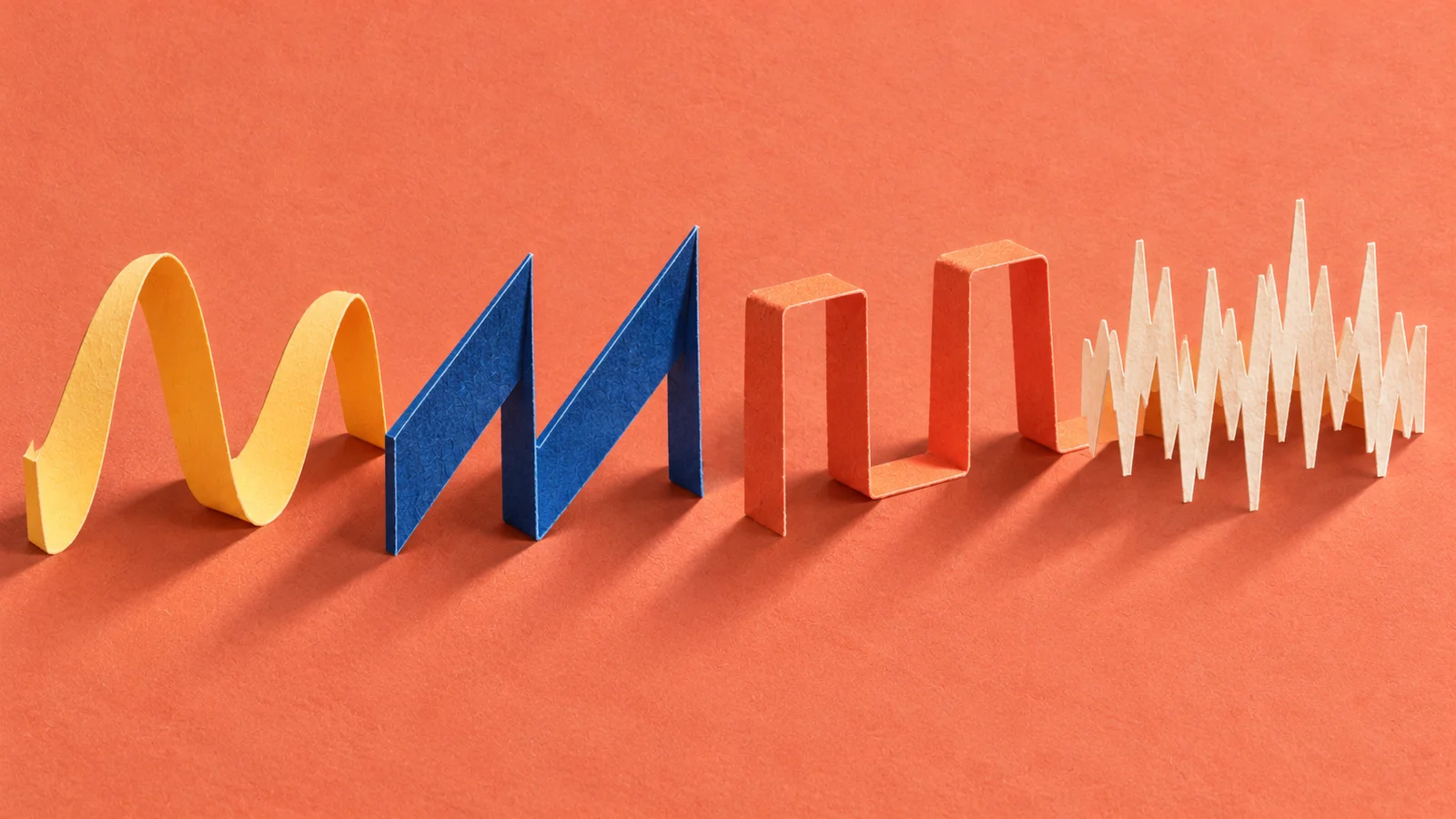
Press Square below: a square wave, hollow and a little reedy, like the low register of a clarinet or the melody channel of an old games console. Now press Triangle. Same note. And on paper, the same ingredients: both waves are built only from the odd-numbered harmonics of the note.
Yet the triangle sounds soft and round, closer to a flute or a whistle. Before you switch, make a guess: if two waves contain exactly the same harmonics, why would they sound different at all?
Both waves contain only odd harmonics. Why is one so much brighter?
Square or triangle?
Square at 220 Hz.
Same harmonics, different strengths
An oscillator makes a shape that repeats. How often it repeats sets the pitch: 220 times a second is the A below middle C. The shape inside each repetition sets the colour, and any repeating shape can be described as a stack of sine waves at whole-number multiples of the note, called harmonics.
The square and the triangle really do use the same list: the 1st, 3rd, 5th, 7th harmonics and so on. What differs is how loud each one is. In a square, the 3rd harmonic is a third as strong as the fundamental, the 5th is a fifth, the 9th a ninth. In a triangle, each one falls with the square of its number: the 3rd is a ninth as strong, the 9th an eighty-first. By the time you reach the upper harmonics, where brightness lives, the triangle has almost nothing left.
Same harmonics, different strengths
A list of ingredients doesn't tell you the recipe; the proportions do. "Both have odd harmonics" is true and leaves out the part you can hear.
Now switch the tone to saw. The saw adds the even harmonics too, every whole-number multiple, each one falling as 1/n like the square's. Listen for what changes. It isn't only brighter; it's fuller, buzzier, less hollow. That hollowness in the square was the sound of missing even harmonics, most of all the missing octave above the note. (At the same setting, the square and saw also come out louder than the triangle and sine, because they carry more energy. Try to listen past the level to the colour.)
Why sharp edges sound bright
Here's the rule that makes waveforms predictable: the sharper the shape, the slower its harmonics fade.
A sine is perfectly smooth, and it has exactly one component. A triangle has corners, points where the direction suddenly flips, and its harmonics fade fast. A square and a saw have jumps, places where the level leaps instantly from one value to another. To draw a jump out of smooth sine waves you need a lot of them, all the way up, and that long tail of upper harmonics is what your ear calls bright, edgy or buzzy.
Try building a saw from sines yourself. Start with a few harmonics, then drag the number up.
How many harmonics does it take before the ramp looks sharp?
Building a saw from sines
This rule travels well beyond synths. A guitar string pulled by a pick starts from a sharp kink; pulled by the soft pad of a thumb, the kink is rounder. That's a big part of why a pick sounds brighter. When you clip a waveform in a distortion pedal, you add corners and flat tops, and new harmonics appear to draw them.
Four characters, four jobs
Each basic wave became a habit for a reason. Here is where you've heard them, and what they're good at.
| Wave | Harmonics | Character | Where you've heard it |
|---|---|---|---|
| Sine | Just the note | Pure, smooth, felt more than heard in the low end | Sub basses under hip-hop and drum and bass; test tones |
| Triangle | Odd, fading fast | Soft, round, a little more texture than a sine | The bass lines of 8-bit consoles, whose sound chips had a triangle channel |
| Square | Odd, fading slowly | Hollow, reedy, woody | Chiptune melodies; clarinet-like leads |
| Saw | All, fading slowly | Bright, buzzy, full | Synth brass and strings, trance supersaws, the raw material for filter sweeps |
For a sound that has to sit low and stay out of the way, smoothness helps: a sine or triangle. For a sound you're going to shape with a filter, more harmonics give you more to work with, so start with a saw or square. Those are starting points, not rules. A square with a slow, soft fade-in can be gentle, and a sine pushed into distortion can snarl.
Play the tone at 110 Hz and then up near 880 Hz with the same wave. The pattern of harmonics moves with the note. A square that sounds pleasantly woody as a bass can turn shrill as a high lead, because its strong upper harmonics now land where your ear is most sensitive.
Noise: a sound with no note
Every wave so far repeats, which is why it has a pitch. Noise never repeats. It's random motion, energy spread across every frequency at once, so there's no note to hum along to. That's exactly what makes it useful: hi-hats, the rattle of a snare, breath in a flute patch, wind, surf, the whoosh of a riser.
Noise comes in colours, named by how the energy is spread:
- White noise has equal energy per hertz. Because each octave up contains twice as many hertz as the one below, it sounds hissy and bright, like an untuned radio.
- Pink noise has equal energy per octave. It sounds balanced and natural, like steady rain or a waterfall.
- Brown noise leans even further toward the lows: a deep rumble, like distant surf or wind against a window.
Play a short burst and a long one, and switch colours as you go.
Which colour makes the best hi-hat as a short burst, and which makes the best wash as a long one?
Three colours of noise
Type
The short white burst is most of a closed hi-hat already. The long brown wash is half of an ambient intro. Neither has a note; the length and colour do all the work.
Where it breaks: the top of the keyboard
A perfect saw or square needs harmonics that go up forever. Digital audio can't do forever. At 48 kHz, nothing above 24 kHz can exist, and if an oscillator tries to make harmonics up there anyway, they don't disappear: they fold back down as wrong, unrelated tones called aliases. On a high note they sound like a faint metallic whine, and they slide the opposite way when you bend the pitch up.
So a good digital oscillator cheats a little. It rounds each jump just enough to keep most of those impossible harmonics from being made. The saw you played above does this, which is why it stays clean high up. The full story of folding is in Digital audio.
Same idea, different place: clip a sine wave hard and its top flattens into something close to a square. A symmetrical clipper adds odd harmonics for the same reason a square has them: you made corners and near-jumps. See Distortion, where a guitar pedal turns out to be an oscillator designer in disguise.
Make it yours: a starting bass
Here's a classic trick: give a bass a soft core and a quiet bright layer. The synth below plays a triangle for the body, plus a square an octave higher, mixed low.
How quiet can the upper square be and still let the bass speak on small speakers?
A two-layer starting bass
Turn Osc 2 Level to zero and play the low note. On laptop speakers or earbuds, the triangle on its own almost vanishes, because small speakers can't reproduce much below 100 Hz and a triangle has very little above that. Bring the square back in and the bass line reappears: its harmonics land right where small speakers work, so you can follow the line even though the deepest part is just as quiet as before. Then try Osc 2 Detune a few cents off for a slow, warm beating.
When you like it, open the Oscillator from the link at the top of the lab, which carries your settings, and save it as your "Starting bass". The next guide hands that bass to a filter.
That small detune can also become the sound's main character. Reese bass builds a rolling growl from two detuned saws; Supersaw lead stacks more copies into a wide lead and finds how much detune the melody can take.
Quick check
- Your square-wave lead sounds great in the verse but shrill and piercing an octave higher in the chorus. Why, and what would you try? Its slowly fading upper harmonics now sit around 2 to 5 kHz, where the ear is most sensitive. A triangle, or a square with its top filtered off, keeps the line but loses the sting. If you said "turn it down", that helps too, but the colour problem stays.
- A friend says "square and triangle are basically the same, they're both odd harmonics." What would you play them to change their mind? The same note on each, back to back, at similar loudness. The square's 3rd harmonic is three times stronger than the triangle's, and the gap grows with every harmonic. Same list, different recipe.
- You need a hi-hat and you only have an oscillator and a noise source. Which do you reach for, and what matters most? The noise, played very short. A hat has no clear pitch, so a repeating wave won't sound like one, and the length of the burst matters more than anything else. White or bright pink noise gets you closest.
Next steps
- Go deeper: Subtractive synthesis. A saw has every harmonic. What happens if you start with all of them and take some away?
- Explanation: Timbre and harmonics. Why the balance of harmonics is what lets you tell a flute from a violin.