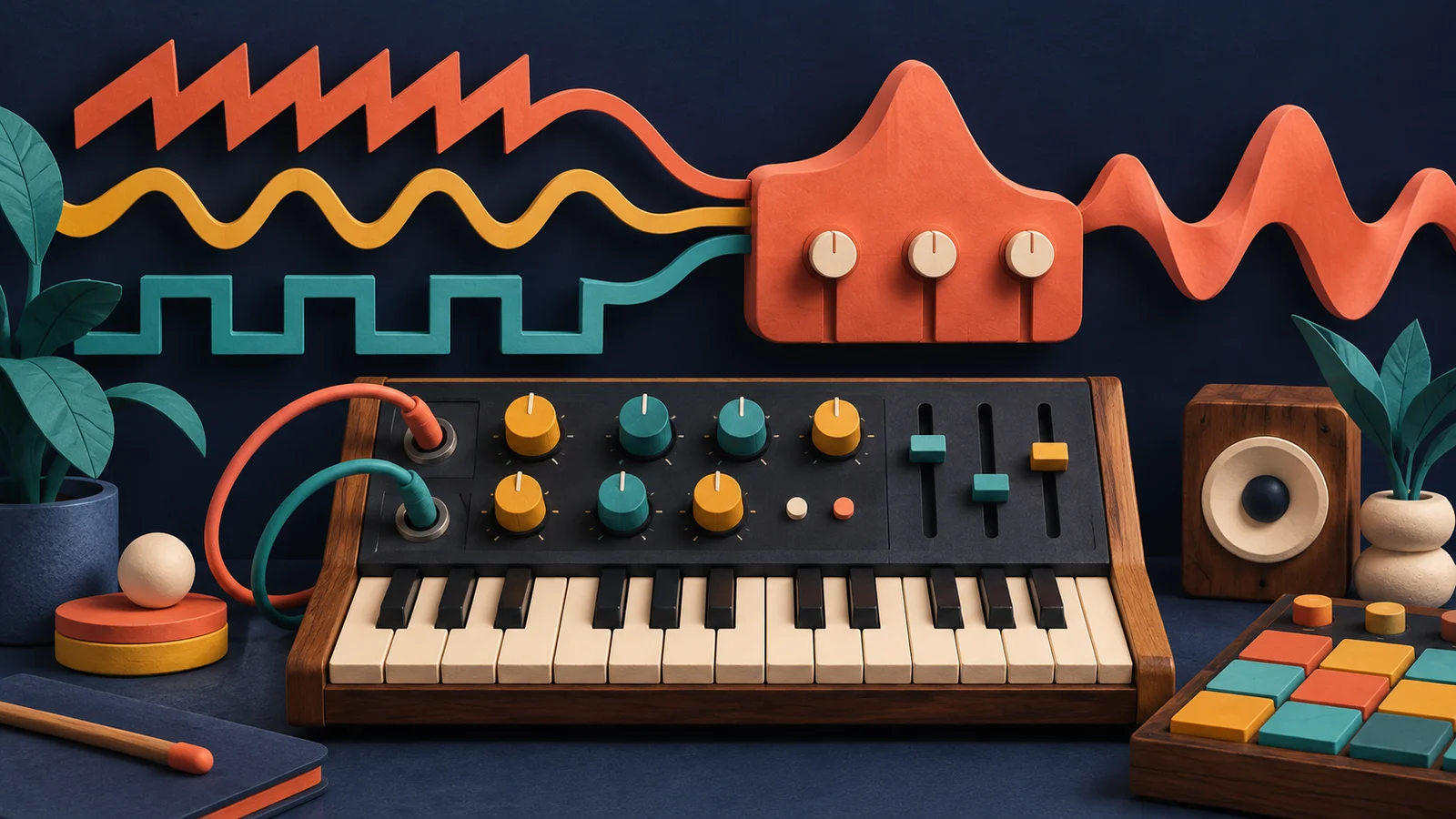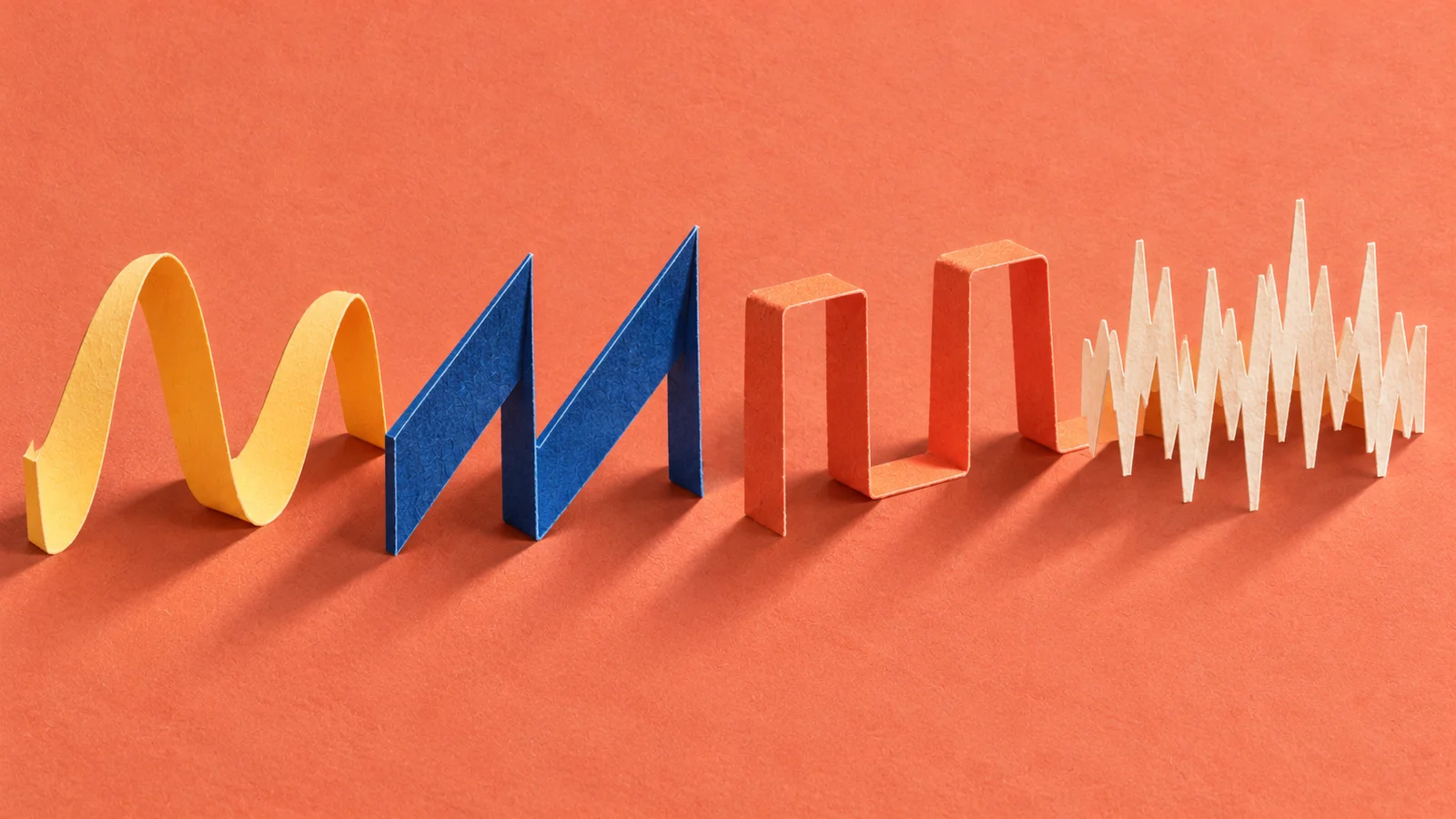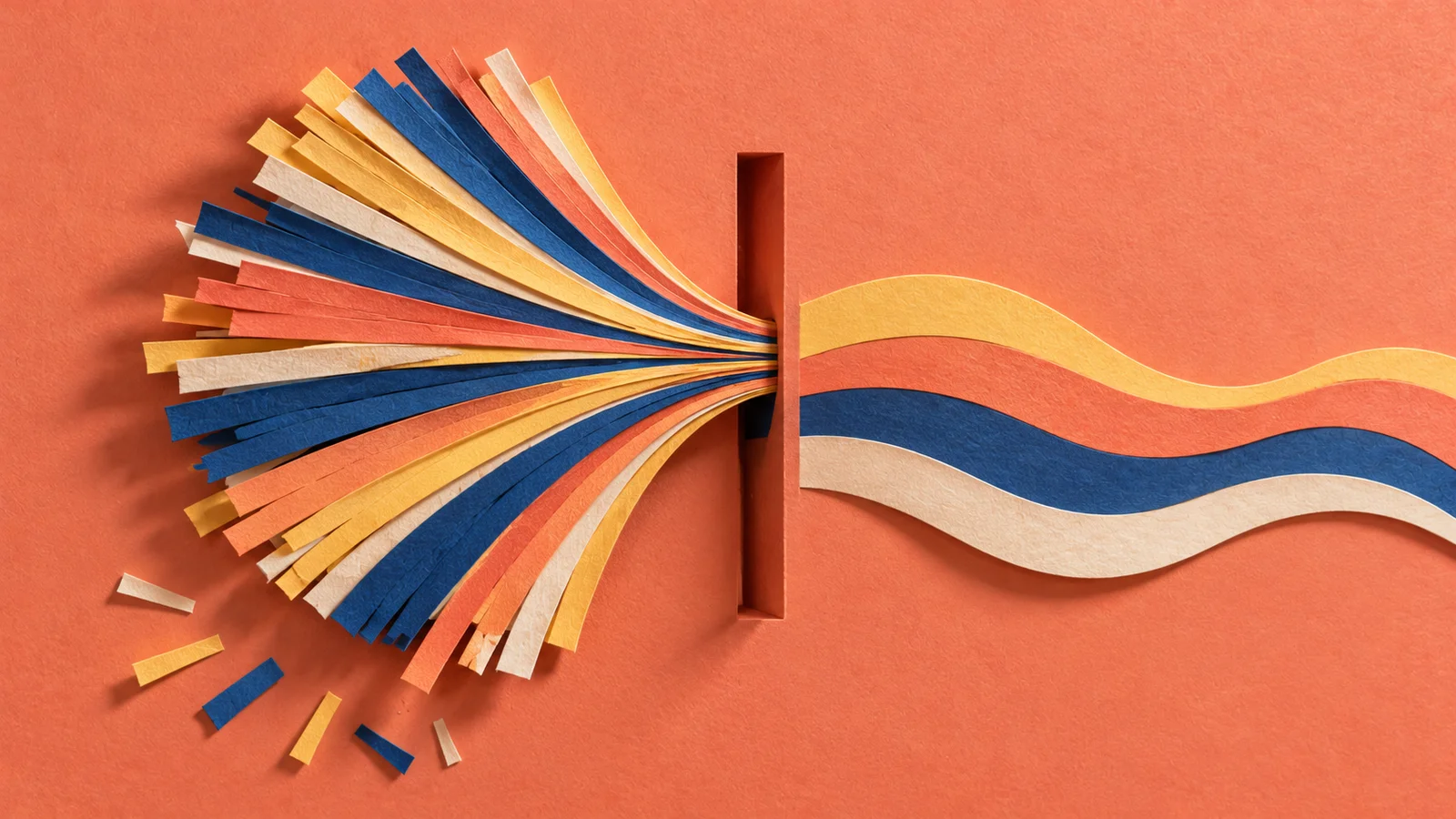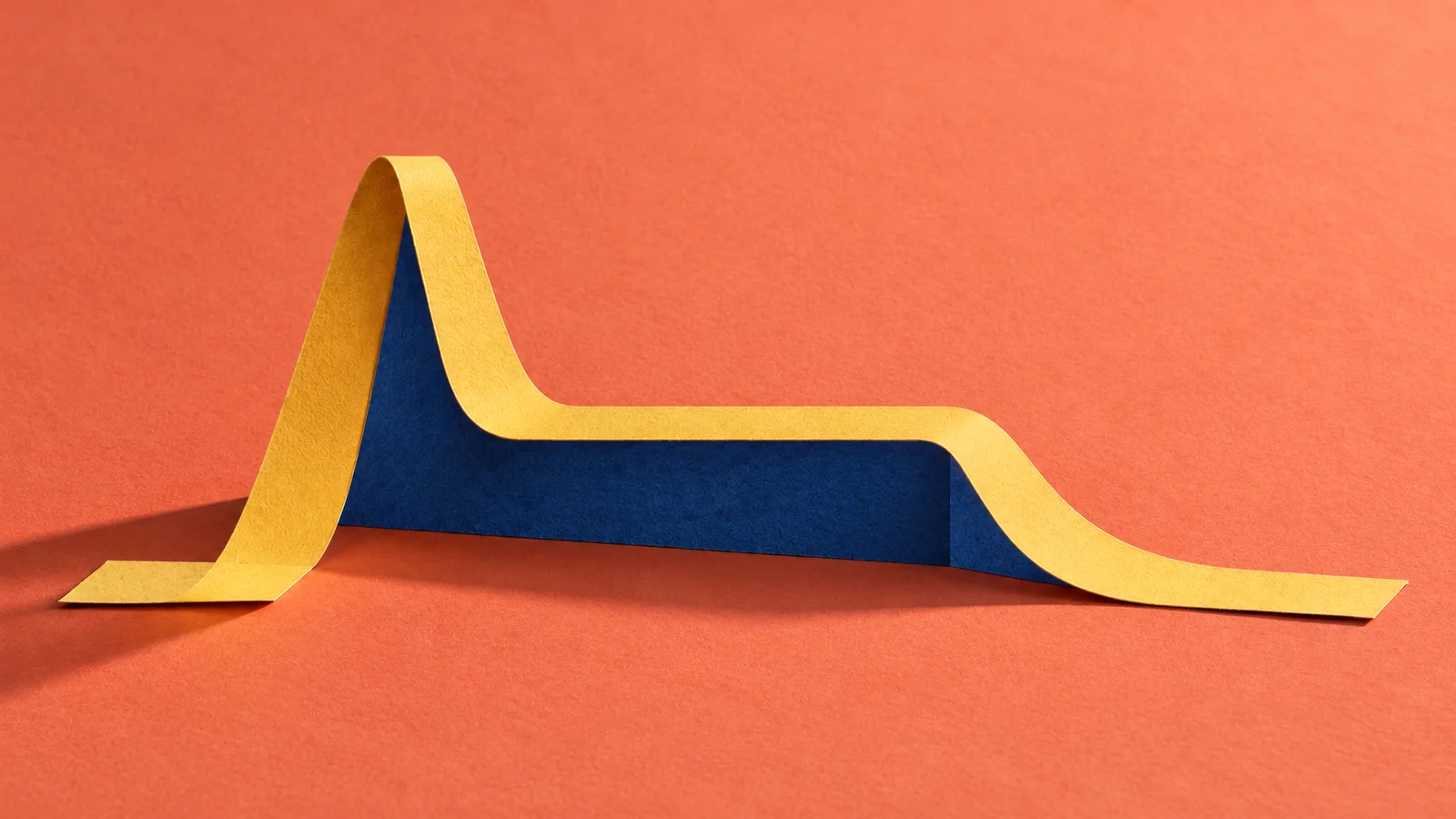
The organ below has one drawbar pulled out, the one marked 8′. Play a note: it's a plain, gentle, flute-like tone. Organists would write this sound as 008000000, one digit per drawbar.
Now pull out the first two bars, 16′ and 5⅓′, all the way to 8. You've just dialled in 888000000, the registration most associated with Jimmy Smith's jazz organ: thick, round, a little growly. Before you do: are those bars changing the tone of the note you hear, or adding new notes underneath it?
Start from 8′ alone, then pull 16′ and 5⅓′ to full. Are you changing one tone, or stacking new ones?
Build an organ sound from sines
What just happened?
Each drawbar is a single, nearly pure sine wave at a fixed pitch relative to the key you press. Pulling a bar out turns that sine up; pushing it in turns it down. The digits 0 to 8 say how far each bar is pulled. So "888000000" doesn't describe a melody or an effect. It's a recipe: three sines at full level, six at zero.
Watch the spectrum as you pull the bars. Each one adds its own line. Nothing gets carved away; everything is built up. That's additive synthesis: making a sound by adding simple components, instead of starting bright and filtering like a subtractive synth.
The organ that made this famous is the Hammond, introduced by Laurens Hammond in 1935. Inside, about ninety spinning metal tonewheels pass by magnetic pickups. Each wheel has a wavy edge and produces a near-sine at one pitch. The drawbars mix those sines for every key you press. Jazz, gospel, soul and rock organists turned that mixing desk into an instrument, and organ players still trade registrations as nine-digit numbers.
Reading the footage
The labels come from pipe organs, where an 8-foot pipe sounds the written note. Half the length, 4 feet, sounds an octave higher; double, 16 feet, an octave lower. The odd fractions are pipes that sound other harmonics of the note.
Where each drawbar lands
Play with the recipe. Reveal 4′ and pull it out: the tone brightens and gets more defined, like a flute that's started to sing. Add 1⅗′ on its own with 8′: the sound turns reedy and a little nasal, the colour pipe organists call a "tierce". More bars aren't always better. Each one needs a reason: weight below, definition on top, or a particular colour.
You'll also notice the volume rises as you add bars. When you compare two registrations, listen for the colour, not just the extra loudness, or turn the quieter one up to match before deciding.
The harmonic that isn't quite a harmonic
Here's something surprising hiding in that figure. The 1⅗′ bar is meant to be the fifth harmonic of the note: five times its frequency, two octaves and a major third up. But there are no special wheels for it. Like every drawbar, it borrows a pitch from the same set of wheels the keyboard uses, and those are tuned to very nearly the keyboard's equal temperament.
So the 1⅗′ bar plays an equal-tempered major third, two octaves up, instead of the true fifth harmonic. Calculated out, that's about 14 cents sharp, a seventh of a semitone. The fifths, 5⅓′ and 2⅔′, come out only about 2 cents flat, which is far too small to notice. The third is the odd one out.
Fourteen cents is small. On its own, the 1⅗′ bar just sounds like a reedy colour; you'd only hear the mistuning as a fast flutter if a purely tuned fifth harmonic were sounding right beside it, the way a singer or a string player might pitch that note. But it's a useful reminder that additive synthesis doesn't require mathematically perfect ingredients. A recipe can be harmonic, nearly harmonic or not harmonic at all; that's why we call each ingredient a partial, and save harmonic for the ones that land on exact whole-number multiples.
Same idea, different place: those 14 cents are exactly the gap between an equal-tempered major third and a pure 5:4 third, the one that makes barbershop quartets and a cappella choirs ring when they lock in. The same compromise that lets a piano play in every key gives the organ its slightly bright tierce. See Tuning systems.
Where it breaks
Foldback at the edges. There are only so many wheels. Play near the top of the keyboard with the high bars out and they run out of higher wheels, so the organ quietly folds them back down an octave. The sound stops getting brighter as you go up, and a registration that sparkled in the middle can sound thin and oddly flat at the top. The 16′ bar does the same at the bottom, folding up when there's no lower wheel. That's how the instrument was designed, not a fault, but it means a registration needs a listen across the whole range you'll play.
Only harmonic ingredients. Drawbars can only add partials at those nine fixed multiples. You can't make a bell or a gong with them, because bells need partials that don't fit the series. For those, look to FM synthesis or physical modeling.
The cost of realism. An organ gets away with nine sines because its notes are steady. A realistic piano note needs dozens of partials, each fading at its own rate and slightly out of tune with the series. Full additive synths can do this, but every partial is another thing to control, which is why most sound designers reach for other methods when they want something that evolves.
Make it yours
Pick a chord part you like and build a registration for it, one bar at a time. Start from 888000000 or from 8′ alone, and add a bar only when you can say what it's for: lower body (16′), a brighter edge (4′, 2′), a reedier colour (1⅗′), or sparkle (1′).
Then try Percussion. On a Hammond, percussion adds a short, decaying blip of the 2nd or 3rd harmonic at the start of each note, which gives the sustained tone a crisp attack, like a struck key. Turn it on and play the Short note: suddenly the organ has a "pop" that cuts through a band. Jimmy Smith's sound is usually described with percussion on the third harmonic.
Check your registration on the lowest and highest notes of the part. When you're happy, open Drawbars from the link at the top of the lab, which carries your settings, and save it with the nine digits as the name. Anyone who plays organ will know exactly what it is.
Quick check
- You see a registration written as 800000008. Without playing it, what do you expect it to sound like? Two sines: the 16′, an octave below the note, and the 1′, three octaves above it. A hollow, wide sound with a deep bottom and a high whistle, and nothing in the middle.
- Your registration sounds bright and lively in the middle of the keyboard but dull and flat at the top. What's happening? Foldback. The upper bars run out of higher wheels and fold back an octave, so the top notes lose their brightest ingredients. Try fewer high bars, or play the part lower.
- A friend says additive synthesis "just means adding perfect harmonics". What could you point to on this organ to complicate that? The 1⅗′ bar. It's labelled as the fifth harmonic but plays an equal-tempered third, about 14 cents sharp of the true one, and the organ sounds great anyway. Additive works with any partials; perfect harmonics are one choice, and bells, gongs and FM tones are built from partials that aren't harmonic at all.
Next steps
- Go deeper: Granular synthesis. Additive builds a sound from slices of frequency. What do you get if you build it from slices of time instead?
- Explanation: Timbre and harmonics. How the balance of partials makes one instrument sound different from another.