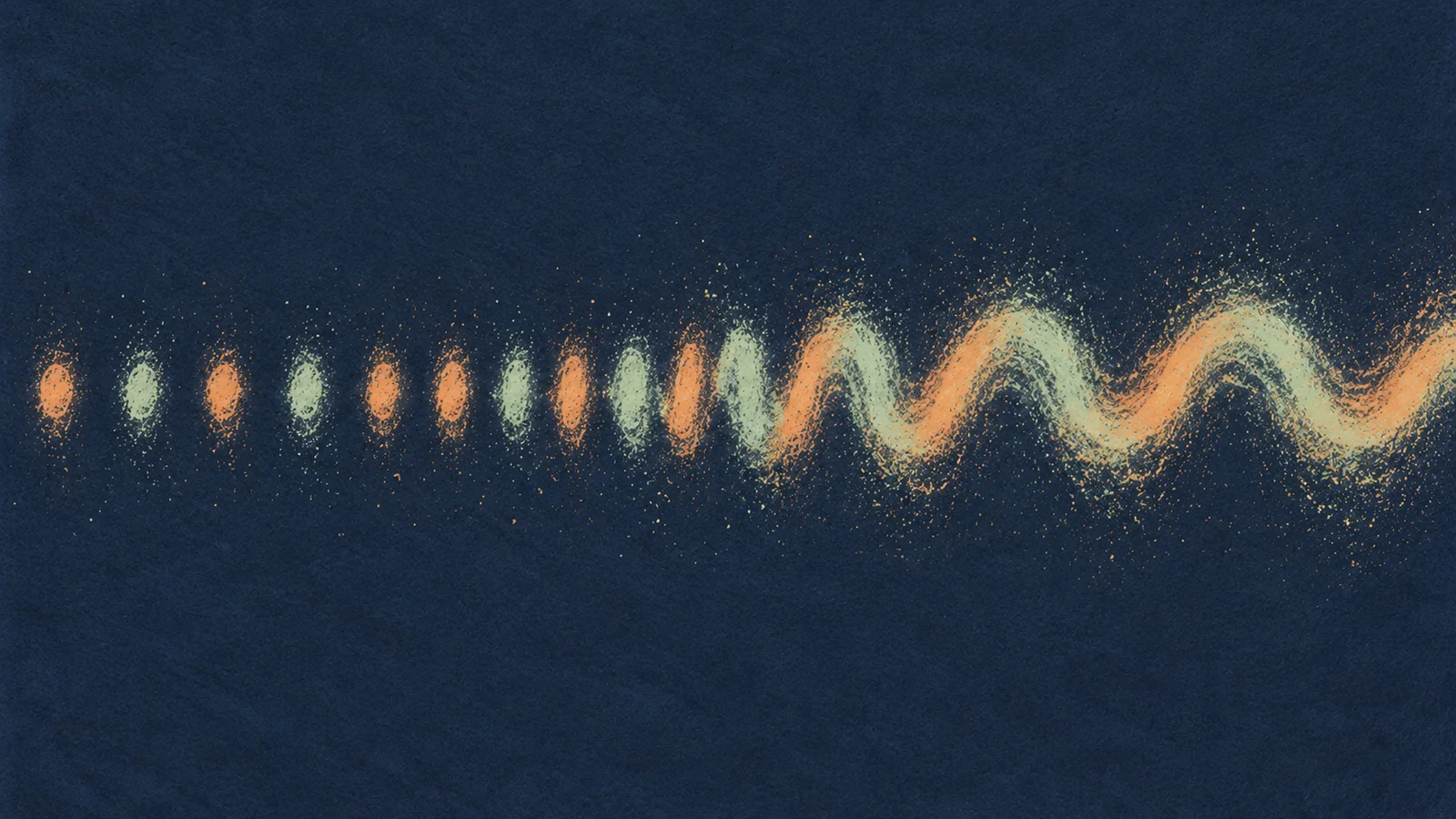
Play these two tones. Same note, same level, same speaker. One sounds like a hearing test. The other sounds like it wants to be a cello, or a brass section, or the bass in a synthwave track.
Both repeat 220 times a second. Look at the spectrum: what does the saw have that the sine doesn't?
Same note, two sounds
Sine at 220 Hz.
The sine shows one line on the spectrum. The saw shows a whole ladder of them. That ladder is the difference between a test tone and an instrument, and it holds a trick: you can take away the bottom rung, the very frequency that is the note, and still hear the same note.
What makes a sound itself
Timbre (say "tam-ber") is everything that lets you tell two sounds apart when they have the same pitch and loudness. It's why you can recognise a friend's voice from one word, or tell a Rhodes from a Wurlitzer before the second chord.
Try it with your own voice. Sing "ah" on one comfortable note, then slide to "ee" without changing pitch. The note stayed put. What changed was the shape of your mouth, which boosted some of the frequencies stacked above the note and softened others. That's the whole idea of timbre in one breath.
The ladder above every note
Most pitched sounds aren't one frequency. They're a stack. The lowest is the fundamental, the note you'd name. Above it sit harmonics at whole-number multiples: twice, three times, four times the fundamental, and so on.
| Harmonic | Frequency for A3 | Musical name |
|---|---|---|
| 1st (fundamental) | 220 Hz | A3 |
| 2nd | 440 Hz | A4, an octave up |
| 3rd | 660 Hz | about E5, an octave and a fifth |
| 4th | 880 Hz | A5, two octaves |
| 5th | 1,100 Hz | about C♯6, two octaves and a major third |
Look at the right-hand column. The ladder spells out a major chord. Every note a saw, a voice or a trumpet plays has a quiet chord built into it, which is part of why some intervals sound so sweet together: their ladders share rungs.
The balance of rungs is the timbre. A sine has only the first. A saw has all of them, each one weaker as you climb. A clarinet in its low register is strong on the odd rungs and weak on the even ones, which gives it that hollow, woody sound. A bright brass note pushes energy high up the ladder as it gets louder, which is why a trumpet played hard sounds like it's tearing the air.
Take away the note itself
Here's the experiment. The organ below plays A3 with four drawbars pulled out. Each drawbar adds one sine at a fixed step up the ladder: 8′ is the fundamental, 4′ is the 2nd harmonic, 2⅔′ the 3rd, 2′ the 4th. (The odd names come from the lengths of organ pipes.)
Before you play: if you push 8′ all the way in, removing the fundamental, what will happen to the note? Will it fall silent at the bottom, jump up an octave to the lowest bar left, or stay where it is?
Push 8′ to zero while the note plays. Does the pitch drop out, jump up, or stay?
Remove the fundamental
The 220 Hz line vanishes from the spectrum. The tone gets thinner, a little nasal. But the note you hear is still A3.
If you guessed it would jump up an octave, that's the sensible guess: the lowest thing left is 440 Hz. But your hearing doesn't read the bottom rung. It reads the spacing of the ladder. The rungs left over are at 440, 660 and 880 Hz, all 220 Hz apart, and the only note whose ladder fits that pattern is 220 Hz. So that's what you hear. The pitch is your brain's answer to a puzzle, not a frequency it found in the air.
This is called the missing fundamental, and it's working on you all the time. A phone speaker physically can't play the 55 Hz fundamental of a low bass note, yet you can hum the bass line along with the song. Organ builders used it centuries ago too: some pipe organs fake a huge 32-foot bass pitch by sounding two smaller pipes together, letting your ear supply the note that no pipe plays.
The ladder with its bottom rung gone
Now try breaking it. Pull 4′ and 2⅔′ down too, leaving only the 2′ rung at 880 Hz. With one lonely sine, there's no spacing to read, and the pitch leaps to A5. The illusion needs at least a few rungs.
The start of a note is half its name
Here's something the ladder doesn't tell you. Record a piano note, cut off the first tenth of a second, and many people can't name the instrument any more. The hammer's thump, a bow's scrape, the breath before a flute note: these first moments, the attack, carry a huge part of an instrument's identity.
And the ladder doesn't stand still. On a piano, the high rungs die away fast while the low ones ring on, so the note gets darker as it sustains. A violinist can push more bow and make the upper rungs bloom in the middle of a note. A single averaged spectrum hides all of that motion, which is why the next guide, on seeing sound, needs pictures that move through time.
Try it with your voice: sing "da" and then a sustained "ah" on the same note. Same ladder in the middle, different identity at the start.
Where the ladder stops working
Bells, gongs, vibraphone bars and kalimba tines don't follow the ladder. Their extra frequencies, called inharmonic partials, aren't whole-number multiples of anything. That's what makes a bell sound like a bell, and why its pitch can feel ambiguous, as if two notes are fighting. A partial is any single component of a sound; a harmonic is the special kind that sits exactly on the ladder.
Noise breaks it too. The breath in a flute or the hiss in a snare isn't a ladder at all, yet it's essential to the sound.
And brighter isn't better. A tone loaded with upper harmonics might be glorious as a solo lead and exhausting under a vocal. Choosing how much ladder a sound needs is a mixing decision as much as a sound-design one.
Same idea, different place: the missing fundamental you just heard is how a bass line survives on a phone. Low end turns it into a mixing tool: add upper harmonics so the notes come through on small speakers.
Make it yours
Open the Drawbars organ and make two registrations on the same note:
- Hollow: 8′ plus only odd rungs, such as 2⅔′ (3rd) and 1⅗′ (5th). Listen for the clarinet quality.
- Bright: the classic jazz organ setting, the first three bars all the way out (16′, 5⅓′ and 8′ at 8), then add 4′ and 2′ and hear it open up.
Save each one with a single honest line in the name, like "Hollow, good for slow chords". Then turn on Percussion for both and listen to how a click at the start changes what each one reminds you of. You've described a sound on two axes: what's in its ladder, and how it begins.
Quick check
- A synth plays A2 (110 Hz). You see strong lines at 220, 330 and 440 Hz but almost nothing at 110. What pitch will most people hear? A2. The lines are 110 Hz apart, so your hearing fills in the missing 110 Hz fundamental. Guessing 220 Hz follows the lowest line rather than the spacing.
- Two sounds have nearly identical sustained spectra, but one sounds like a plucked string and the other like a bowed one. How? The attack and the way the harmonics change over time. A spectrum averaged over the whole note throws that motion away.
- You want an organ sound that sits quietly under a vocal. Do you reach for more upper drawbars or fewer? Usually fewer. The upper rungs land in the range where voices are clearest, so a darker registration leaves more room for the words.
Next steps
- Go deeper: Seeing sound. You heard the ladder change. Now learn to see it, and to catch the attack the spectrum hides.
- Use it: Additive synthesis. Build sounds rung by rung on purpose.