Press Saw below and listen. That slow ticking is one synth note, slowed down so far that you can count it: eight clicks a second, like a playing card in bicycle spokes.
If you turn the frequency up slowly, will you keep hearing faster and faster ticks forever? Or will something else happen?
Raise the frequency slowly from 8 Hz. Where do the ticks stop being ticks?
From ticks to a note
Saw at 8.0 Hz.
The moment ticks become a note
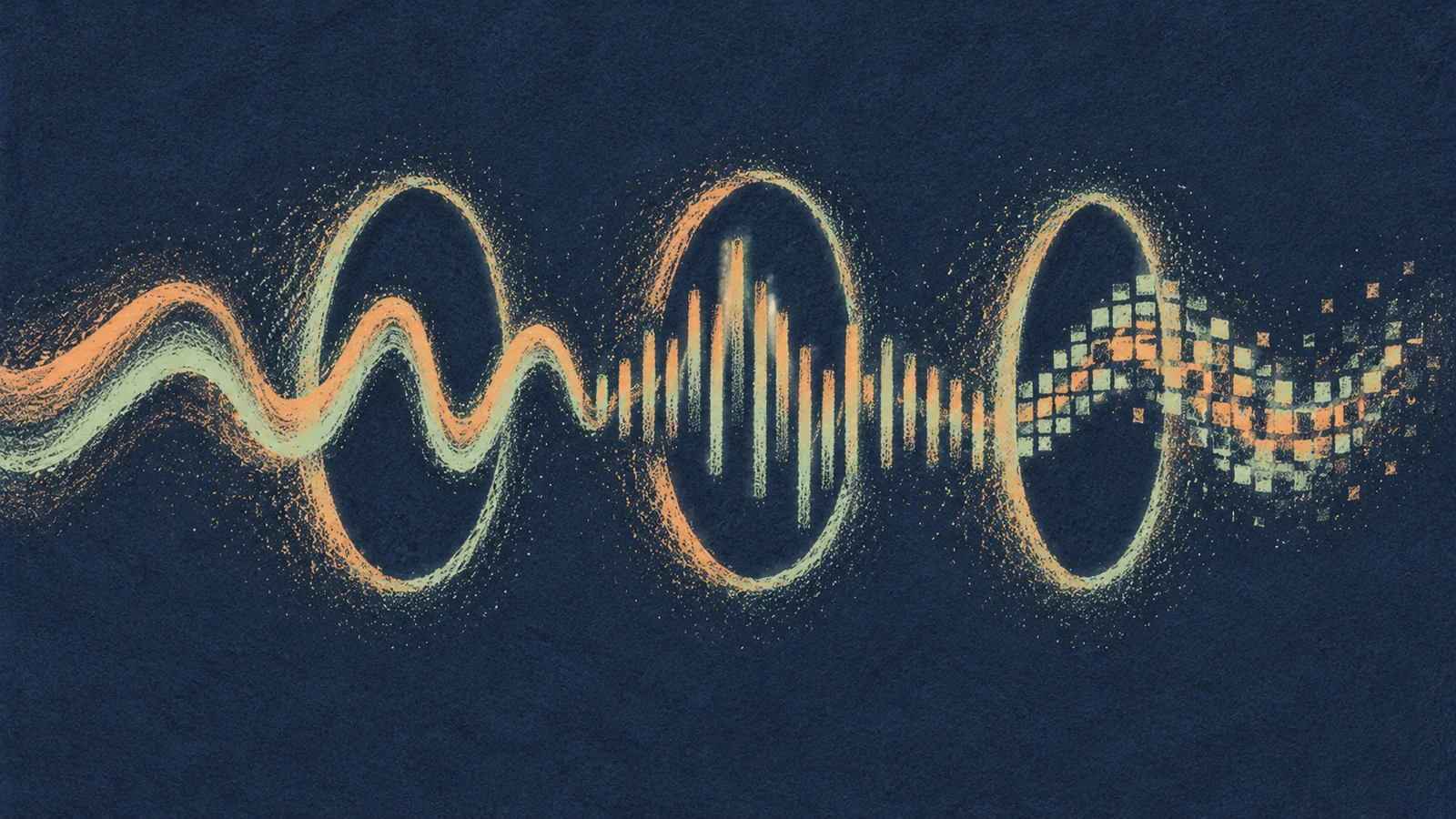
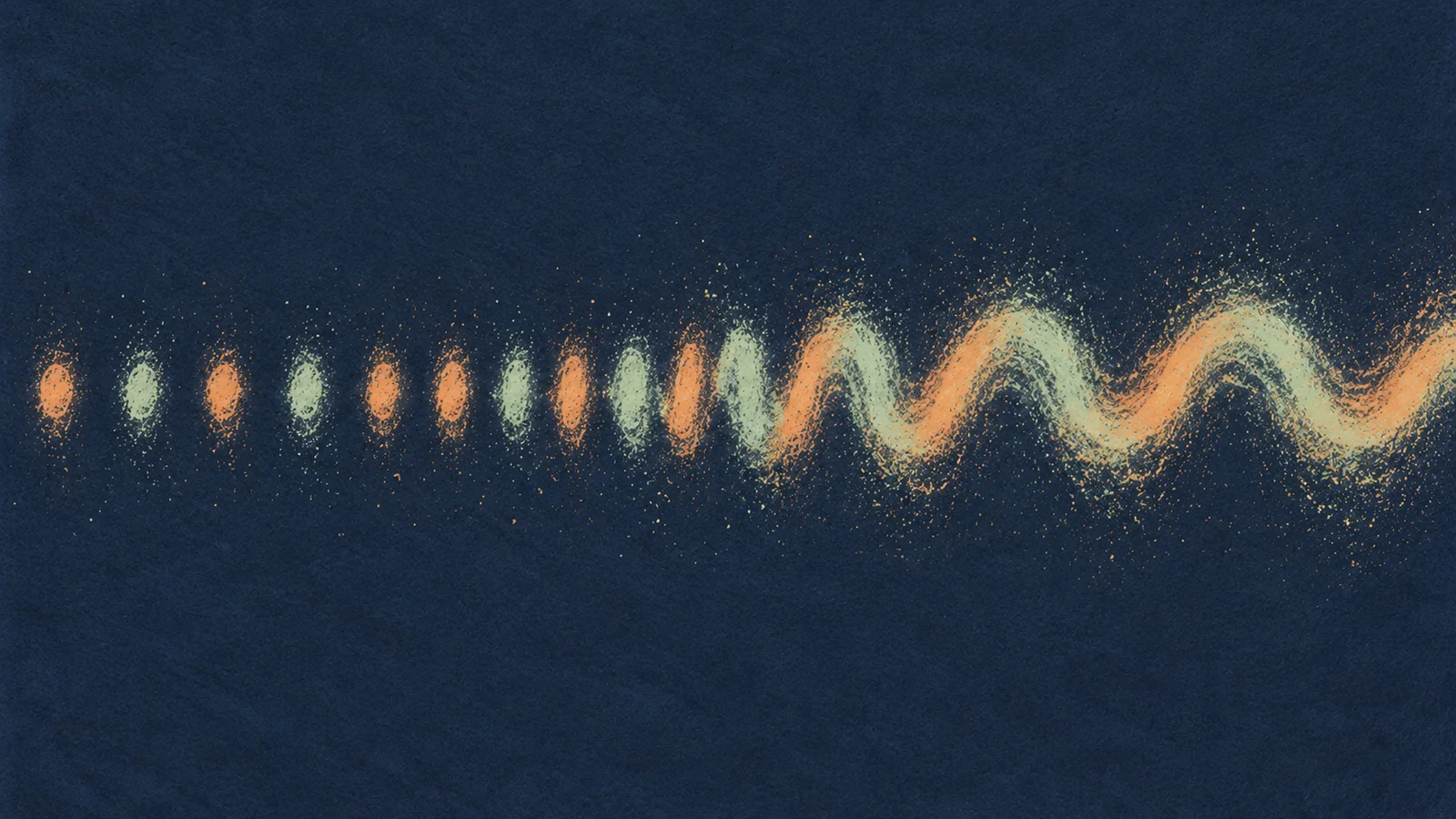
Somewhere on the way up, the clicks stop being events and become a thing. For most people that happens in the region of 20 to 30 repeats per second. Below it, you count. Above it, you hear a buzz, and the buzz has a pitch. Keep going and the buzz turns into a bass note, then a melody note, then a whistle.
Nothing new was added to the signal. The same shape repeated, only faster. Your ear decided that past a certain speed, repetition isn't rhythm any more. It's pitch.
A drum pattern and a synth note are made of the same stuff, repetition, at different speeds. A drummer playing a single-stroke roll faster and faster heads toward a hum. A motorbike revving up turns its separate engine firings into a rising tone. The composer Karlheinz Stockhausen built whole pieces on this idea; in Kontakte you can hear a pitched tone slow down until it falls apart into separate pulses.
You can feel it yourself without any equipment. Tap a table at a steady beat, then as fast as you can. You'll run out of speed long before 20 taps a second, which is exactly why your hands play rhythms and your voice plays notes.
What is actually repeating?
Every sound starts with something moving. A loudspeaker cone pushes forward and pulls back. A guitar string swings. Your vocal folds open and close. Each movement squeezes and stretches the air next to it, and that pattern of pressure travels outward to your ear.
The air itself doesn't fly across the room. Each bit of air only nudges its neighbour and moves back, the way a wave passes along a rope while the rope stays put. At your ear, the changing pressure moves your eardrum, and your hearing turns that motion into the sound you notice.
Frequency is how many times the pattern repeats each second, measured in hertz (Hz). The synth above started at 8 Hz: eight cycles a second, eight clicks. Concert A is 440 Hz.
Add cycles. What changes, and what stays the same?
More repeats in the same second
| Repeats per second | Time between repeats | What you hear |
|---|---|---|
| 2 | 500 ms | Two separate taps |
| 8 | 125 ms | A fast rhythm, still countable |
| 80 | 12.5 ms | A low buzzing note |
| 440 | about 2.3 ms | The A that orchestras tune to |
Double it and you get the same note, higher
Type 220 into the frequency field above and listen. Then 440. Then 880. Three different pitches, yet they sound like the same note at three heights. That's an octave, and an octave is always a doubling of frequency.
Here's the surprising part. From 220 to 440 Hz you added 220 Hz. From 440 to 880 Hz you added 440 Hz. The musical step felt identical, yet the hertz difference doubled. Your ear hears ratios, not differences. That's why frequency knobs on synths and EQs are spaced so that each octave takes the same distance, and why the low end of a keyboard covers so few hertz while the top covers thousands. Pitch and intervals builds the whole musical scale on this idea.
Bigger isn't always louder
Amplitude is how big the repeating movement is. A bigger swing of the speaker cone, a bigger change in air pressure, larger numbers in a digital file. Hum a note softly, then strongly, at the same pitch: same rate, bigger size.
Loudness is how strong the sound seems to you. Amplitude feeds into it, but it isn't the same thing, and here's a way to hear the difference.
Switch the synth above to sine and set it to 440 Hz. Leave the level alone. Now drag the frequency slowly down to 55 Hz. The meter says the size of the wave hasn't changed. Your ears say the note is fading away.
If you guessed it would stay just as loud, that's a reasonable guess: the number didn't move. But human hearing is far less sensitive to low frequencies than to the middle of the range, where voices live. In the 1930s, researchers at Bell Labs measured this and drew the famous equal-loudness curves. It's also why old hi-fi amplifiers had a Loudness button that added bass when you listened quietly: at low volume, the bass drops out of your hearing first. (Your speakers play a part too. Small ones can barely move enough air for a 55 Hz note.)
Now try the same sweep with saw. It holds its presence much better as it drops, because a saw contains many higher frequencies stacked above the note, and those land where your hearing is sharp. Same pitch, same level, very different strength. The next guide is entirely about why.
Same idea, different place: the reason a bass line can feel loud in the studio and vanish at low volume is this same curve. What mixing is for shows how it changes your balance decisions.
Where the neat picture gets messy
"Frequency is pitch" works beautifully for a steady, repeating tone. Plenty of sounds aren't like that.
Noise, like rain or a hi-hat, never repeats in a stable pattern, yet you can still hear it as low and rumbling or high and hissy. A bell rings with several vibrations that don't line up with one repeat rate, which is why its pitch can feel slippery. Speech changes its vibration from moment to moment.
And the tick-to-note boundary isn't one switch. It moves with the shape of each click, how loud it is and who's listening. That's fine: you don't need to find the exact line to use the idea. You need to know the line is there.
Make it yours
Go back to the synth and find your own fusion point: the lowest frequency where you stop hearing ticks and start hearing a note. Then hum, tap and play something, and describe each one in the same two words: rate and size. A soft high hum is fast and small. A hard slow tap is slow and big. You've started listening like an engineer.
Then open the Oscillator, set a saw just above your fusion point (somewhere around 30 to 40 Hz), and save it. That growling floor is where sub-bass and drones begin, and you now know exactly why it rumbles instead of ticking.
Quick check
- A synth note goes from 200 Hz to 400 Hz. Your friend says it got "twice as loud". What actually changed? It went up an octave: the repeat rate doubled. Its size may not have changed at all. If it seems louder, that may be because 400 Hz sits where your hearing is more sensitive, which is the trap this guide is about.
- You slow a buzzing synth note down until it becomes a rattle you can count. Did the sound change, or did your hearing? Both, in a way. The waveform only got slower. What changed is how your ear groups it: past roughly 20 to 30 repeats a second you hear a note, below it a rhythm.
- A sine at 60 Hz and a sine at 1 kHz show the same level on the meter. Which one will seem louder on laptop speakers? The 1 kHz tone, by a lot. Your ears are less sensitive down low, and small speakers struggle there too. Equal amplitude isn't equal loudness.
Next steps
- Go deeper: Timbre and harmonics. The saw and the sine you just played repeat at the same rate. So why does one sound like a cello and the other like a test tone?
- Use it: Rhythm, meter and groove. Come back down below the fusion point, to the repetition you can dance to.
- Sideways: Level and loudness. If the meter and your ears disagree, which one should you trust, and when?