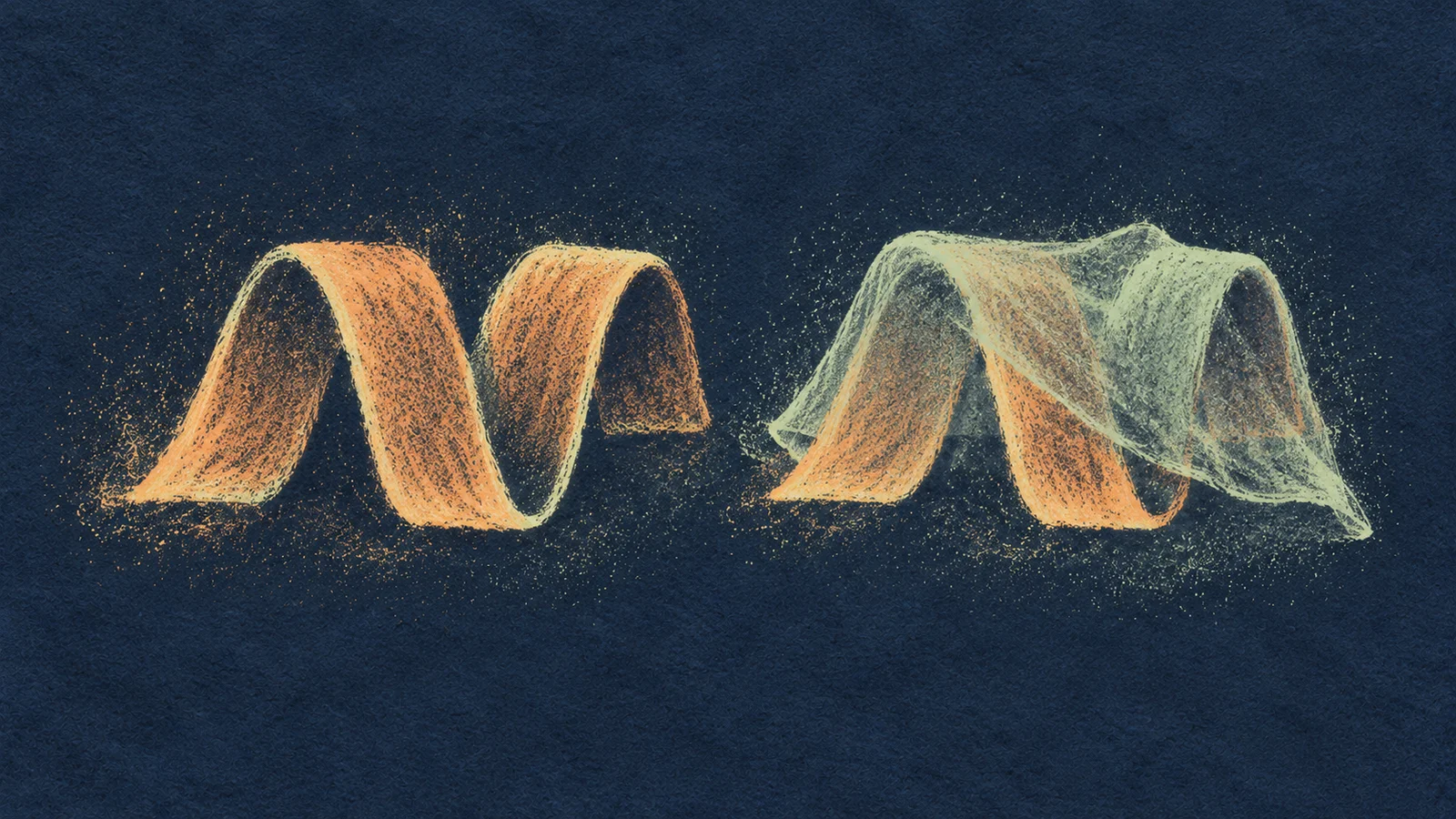
These two clips have been set so their loudest single moment is exactly the same height. A peak meter would call them equal. Press one clip, then the other, to switch between them.
Both clips hit exactly the same peak. Which one sounds louder, and which reading agrees with your ears?
Same peak, different loudness
RenderedReadings are measured from each file before any gain. Matched by sample peak over each whole clip: every version's highest sample lands at the same level.
Not even close, right? The track sounds like it's in the room and the piano sounds like it's next door. Yet the peak readings match.
Here's why. A piano's loudest moments are hammer strikes: a sharp spike, then a fast fall into a much quieter ring. A finished dance track has been compressed and limited so it sits near its ceiling almost all the time. The peak meter only remembers the single tallest instant, so it can't tell a lone spike from a wall of sound.
The tap test
You can feel this with your hands. Tap four soft beats and one hard one. Then tap five hard ones. Both patterns contain the same hardest tap. The second one simply has more sound in it.
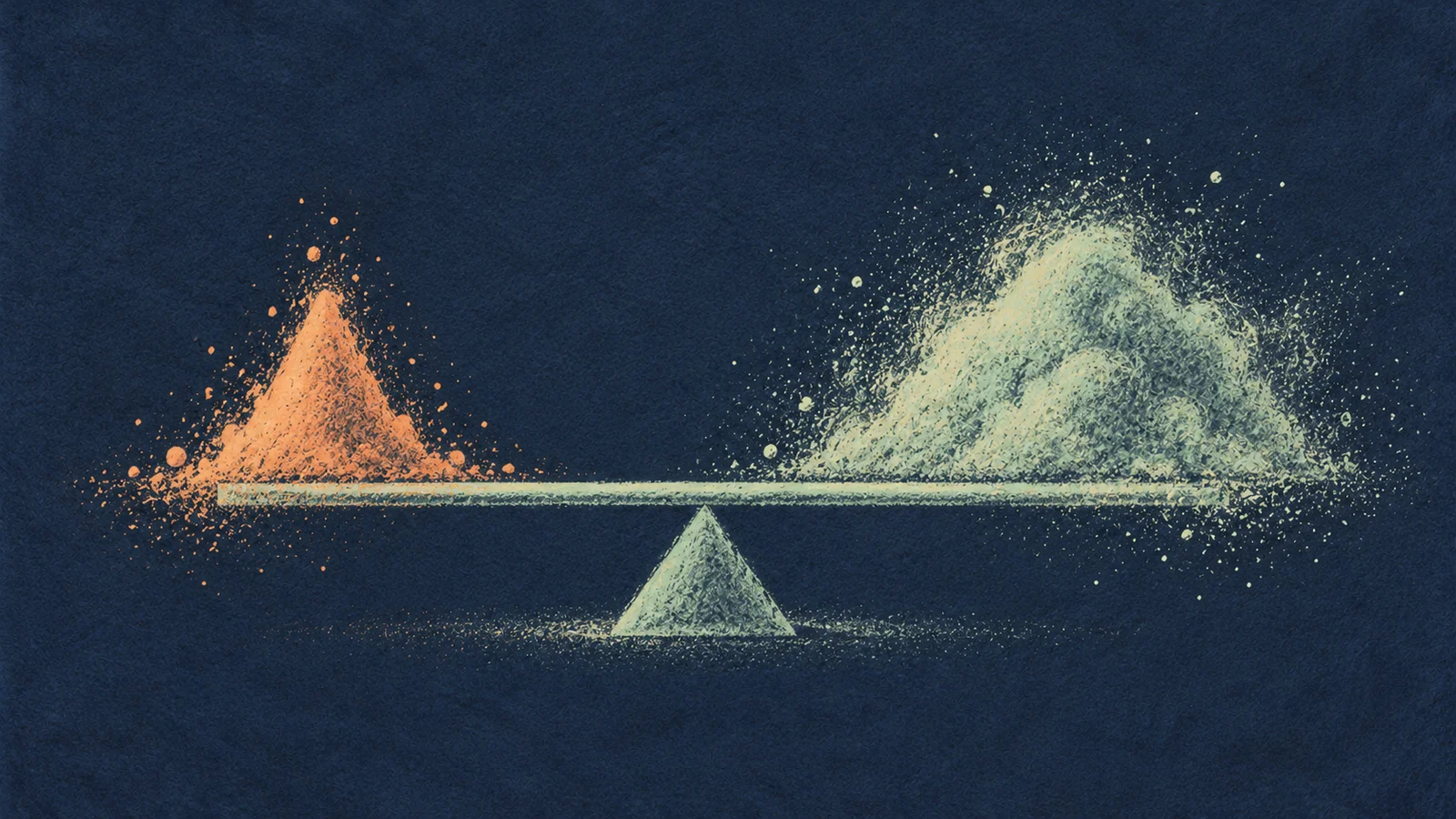
Same hardest tap, very different amount of sound
A peak is a ceiling, not a size. To know how strong something feels, you need a meter that pays attention to the whole phrase.
Decibels need a reference
A decibel (dB) is a ratio, written on a scale that matches how we hear: every step feels roughly as big as the last. A dB number on its own means nothing until you know what it's compared to.
- dB on a fader means "compared to where it was". +6 dB roughly doubles the signal's size.
- dBFS means "compared to digital full scale", the highest value a file can hold. 0 dBFS is the ceiling, so everything below it is negative. −6 dBFS isn't "missing" sound; it's half the ceiling.
Doubling the signal's size (+6 dB) doesn't make it sound twice as loud. Most people need something closer to +10 dB before a sound feels "twice as loud", and that varies with frequency, as you heard in Sound. A dBFS reading also can't tell you how loud it is in your room; that's up to your speakers and volume knob.
Peak, RMS and crest factor
Sample peak is the single highest value in the clip. It tells you how close you are to clipping: your headroom.
RMS (root mean square) is an average of the signal's strength over time. It's much closer to how strong something feels, because long sustained sound counts for a lot and a single spike counts for very little.
The gap between them is the crest factor. A worked example:
| Sound | Peak | RMS | Crest factor |
|---|---|---|---|
| Piano: strikes with quiet gaps | −3 dBFS | −21 dBFS | 18 dB |
| Heavily limited dance track | −3 dBFS | −9 dBFS | 6 dB |
A big crest factor means punchy, open, dynamic sound, with room for each hit to jump out. A small one means dense, constant, in-your-face. Neither is better. A jazz trio and a festival drop are supposed to feel different.
LUFS: an average that listens like you do
LUFS (loudness units relative to full scale) is an average designed to match human hearing more closely. Before averaging, it filters the signal: it turns down the deep bass and gives a gentle lift to the upper mids, roughly following the ear's sensitivity. It also ignores very quiet passages, so a long silent intro doesn't drag the number down.
It comes in three time spans:
- Momentary: the last 0.4 seconds. Jumpy, good for watching a single hit.
- Short-term: the last 3 seconds. Good for comparing a verse to a chorus.
- Integrated: the whole thing from start to stop. This is the number streaming services use.
The method is an international standard, ITU-R BS.1770, so two meters following it should agree. But agreement isn't the same as quality. LUFS tells you how loud, not how good.
Why louder sounds better, and what it cost music
Play anything a little louder and it tends to sound fuller, brighter, more exciting. That's the equal-loudness effect working in your favour: more level brings the bass and treble up into your hearing. For a long time this fooled everyone. Through the 1990s and 2000s, records were squeezed louder and louder to win on radio and in shuffle, the so-called loudness war. Metallica's Death Magnetic (2008) became the famous casualty, drawing complaints about audible clipping from fans who had no interest in meters.
Today, most streaming services turn loud tracks down by default so everything plays at a similar loudness. A squashed master doesn't win any more. It just loses its punch and gets turned down anyway. That's why it pays to understand this guide even if you never want to be "loud".
Peaks hiding between samples
A digital file stores separate samples, but your speaker plays a smooth curve drawn through them. That curve can rise higher than any stored sample, between two of them. True peak estimates those in-between peaks. That's why a file that never touches 0 dBFS in its samples can still distort when it's converted or encoded. A meter showing both, like the one in the player above, lets you leave enough room. Limiting and loudness goes further.
Same idea, different place: the filter inside a LUFS meter is just an EQ, a low cut and a high shelf. So if you EQ a track brighter, its loudness reading goes up even when its peaks don't move.
Where the numbers break
Equal LUFS gets you close, not all the way. A bass-heavy track and a bright acoustic one can measure the same and still feel different, because the weighting is a simplified model of hearing. Short regions can mislead too: match two versions on the chorus alone and the verses may be miles apart. Use the meter to get close, then let your ears make the last call.
Make it yours
Take two versions of one of your own phrases, say a dry vocal and the same vocal through a compressor. Turn the louder one down until neither sounds louder to you, at a fixed, comfortable volume. Note how many dB you had to move it.
Then look at their integrated loudness over the same region. Did the meter agree with your ears? If not, was it the attack, the tail, or the tone that fooled one of you? Keep the note: "matched by ear, −2.5 dB on the compressed version, integrated within 0.5 LU". It's the first step in every fair comparison you'll make from now on.
Quick check
- Your mix and a reference both peak at −1 dBFS, but the reference sounds much louder. What's going on? The reference has a smaller crest factor: it's been compressed or limited so it stays near its peak more of the time. Compare RMS or integrated LUFS, not peaks.
- A drum loop peaks at −2 dBFS with an RMS of −14 dBFS. What's its crest factor, and what does that suggest? 12 dB. That's fairly punchy: big transients with space around them. It doesn't tell you whether it's good, only how dynamic it is.
- You boost 8 kHz on a vocal by 3 dB. The peak meter barely moves but the LUFS reading goes up. Is the meter broken? No. LUFS weights the upper mids and highs more than the deep lows, so tonal changes shift it even when the peaks stay put.
Next steps
- Use it: Gain staging. Keep those levels healthy through every stage of a mix.
- Go deeper: Digital audio. Decibels go down a long way. How quiet can a file get before the numbers run out?
- Use it: Listening and comparing. Turn level matching into a fair test of whether a change really helps.