The instrument below is a vibraphone bar, but there's no recording of a vibraphone anywhere in it. It's a simulation of a metal bar being struck. Press Strike: a warm, round, ringing note, struck right in the middle.
Now move Position to about 0.22, a little under a quarter of the way along the bar, and strike again with exactly the same force. Before you do: will it be louder, quieter, or a different colour altogether?
Move Position from the centre (0.5) to about 0.22 and strike again with the same force. What happens to the note?
Strike the bar somewhere else
What just happened?
Same bar, same note, same force. But struck near a quarter of the way along, the warm fundamental nearly vanished, and a higher, thinner, more glassy partial took over. If you play mallet percussion, you already know this: strike a marimba or vibraphone bar near the cord that holds it, and it sounds weak and pingy. Teachers tell students to aim for the middle or the very end of the bar for exactly this reason.
Here's why. A struck bar doesn't vibrate in one way. It vibrates in several patterns at once, called modes, each at its own frequency. The lowest mode gives you the note. Higher modes add the shimmer and colour on top.
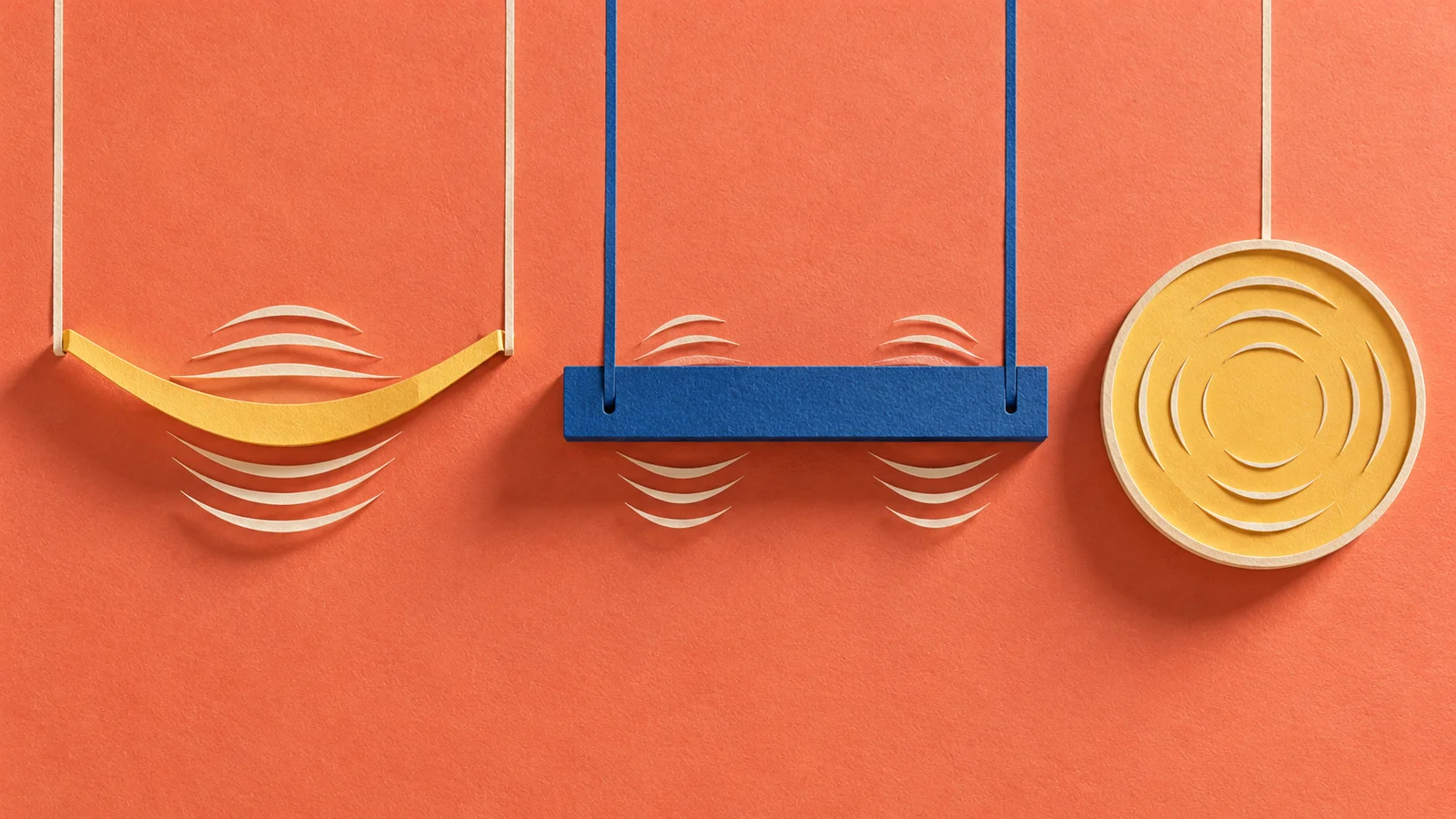
Each mode bends the bar into a different shape. And every shape has spots that barely move at all, called nodes. If you strike right on a node of a mode, you can't push that mode into motion: you're hitting a place where it doesn't want to move.
How a bar bends in its first two modes
Look at where the solid curve crosses zero: about 22% of the way in from each end. That's where mode 1, the note itself, has its nodes. It's also exactly where instrument makers drill the holes for the cord that suspends the bar, so the support doesn't damp the note. When you struck there, you hit the one place where the note couldn't be woken.
And the centre? That's a node of mode 2. Striking there wakes the note fully and leaves the first upper partial almost silent, which is why a centre strike sounds so round and pure.
A model, not a recording
Physical modeling makes sound by simulating how something vibrates, instead of playing back a recording of it. This one keeps a list of the bar's modes, their frequencies and how quickly each one dies away, and computes how strongly each mode gets excited by a strike at a given spot. That's why it can do what a sample can't: a sample of a centre strike is just a centre strike. A model can be struck anywhere.
Every physical model has the same three ingredients:
- an exciter, the energy going in: a mallet, a pluck, a bow, a breath;
- a resonator, the thing that rings: a bar, a string, a tube, a skin;
- damping, the losses that make it fade.
Real instruments are tuned with the same knowledge. Vibraphone and marimba bars are carved thinner underneath so their second mode lands exactly two octaves above the note. An untouched metal bar would ring with an upper partial that doesn't fit the note at all, which is why it sounds like a clang rather than a pitch.
Force is a different control
Now compare force with position. Put Position back at 0.5 and strike with Velocity low, then high. The hard strike isn't just louder; it's brighter. A soft mallet stroke keeps the mallet on the bar a little longer, and a long, gentle push can't excite the fast, high modes. A hard, quick strike can.
But notice: hitting harder never took away the fundamental the way the 0.22 strike did. Force tilts the balance between low and high modes. Position chooses which modes you can reach at all. Two different expressive dimensions, and players use both.
After your first strike, Size appears. It changes how big the object behaves, so how long it rings and how its upper partials spread, while keeping the note the same. A bigger bar rings longer and sounds more like a slab; a smaller one is short and bright.
Strings: another kind of model
Struck bars are one family. Plucked strings use a different trick, invented by Kevin Karplus and Alex Strong in 1983. Fill a short delay line with a burst of noise, the pluck, and feed it back into itself through a gentle filter. The loop's length sets the pitch, and each trip around the loop loses a little brightness and energy, exactly like a real string after it's plucked. It's astonishingly cheap to compute and astonishingly guitar-like.
Lower Brightness and shorten Sustain. When does it stop sounding like steel and start sounding like nylon, or a muted string?
A string made from a loop
On this string, every setting applies to the next pluck, just as you can't change a real string's material while it's ringing. Change a control, then pluck again. High Brightness with long Sustain sounds like a steel string. Pull Brightness down and shorten Sustain and it turns into nylon, then a palm-muted pluck. Body adds the resonance of a wooden instrument around the string.
In 1994, Yamaha's VL1 brought physical modeling of wind and string instruments to a commercial keyboard, aimed at players who wanted to bend and breathe into notes the way samples couldn't. Today, models like these live inside many instrument plugins, often blended with samples.
Where it breaks
Too clean. A model only knows what it was built with. Real instruments also rattle, buzz against their stands, resonate in their bodies and in the room, and none of that is in a simple bar model. Push a recipe to an extreme and it can sound glassy and sterile, like a perfect object in a vacuum. A little reverb and a little noise in the strike go a long way.
Only one object. A bar model is great at bars, and nothing else. It can't make a voice or a violin, because the exciter and resonator are fixed. Each family of instruments needs its own model.
Same idea, different place: a struck bar is a handful of resonances ringing and fading. A room is millions of them. A reverb is, in a sense, a very crowded bell, and a bell is a very sparse reverb. Strike the bar here with a long size and you can almost hear it becoming a space. See Reverb.
Make it yours
Back on the bar, find a sound you couldn't get by striking harder: a position and a size that give you something new. Maybe a very large bar struck slightly off-centre, which rings long with a shimmer of upper partials. Maybe a small bar struck near the end for a bright, toy-like ping.
Then open the full panel and switch Instrument to a gong, like Kempul or Gong Ageng. On a gong, Position runs from the raised centre boss to the rim, so the same number means a different place on a different shape. Strike at the boss and then toward the rim: the deep swell gives way to shimmer. Try Ombak Amt too. In Balinese gamelan, paired instruments are tuned slightly apart on purpose, so their notes beat against each other in a slow, living pulse called ombak, "wave".
When you find a sound worth keeping, open Gamelan from the link at the top of the lab, which carries your settings, and save it.
Quick check
- A percussionist says their marimba sounds thin and weak today. You notice they're striking right above the cord. What would you suggest, and why? Strike nearer the centre (or the very end) of the bar. The cord runs through the fundamental's nodes, so striking there barely excites the note itself.
- You want a struck sound that's brighter, but without losing the warm fundamental. Do you move the strike point, or strike harder? Strike harder (or raise velocity's effect on tone). Force tilts the balance toward the high modes; moving toward a node of the fundamental would take the warmth away.
- You change Brightness on the plucked string while a note is ringing, and nothing changes. Is it broken? No. Like a real string, the model sets its character at the moment of the pluck. Pluck again to hear the new setting.
Next steps
- Go deeper: Drum synthesis. A bar is easy to model. A drum skin with a beater, a shell and a snare wire is harder. Can you fake one with oscillators and noise?
- Explanation: Additive synthesis. A modal model is additive synthesis whose partials are chosen by physics.