Turn your loop into a piece
Take an unfinished idea through arrangement, groove, sound and a final balance. Make a contrasting section, shape the transition and give the return a reason to land.
18 lessons · Free guides · Learn at your own pace
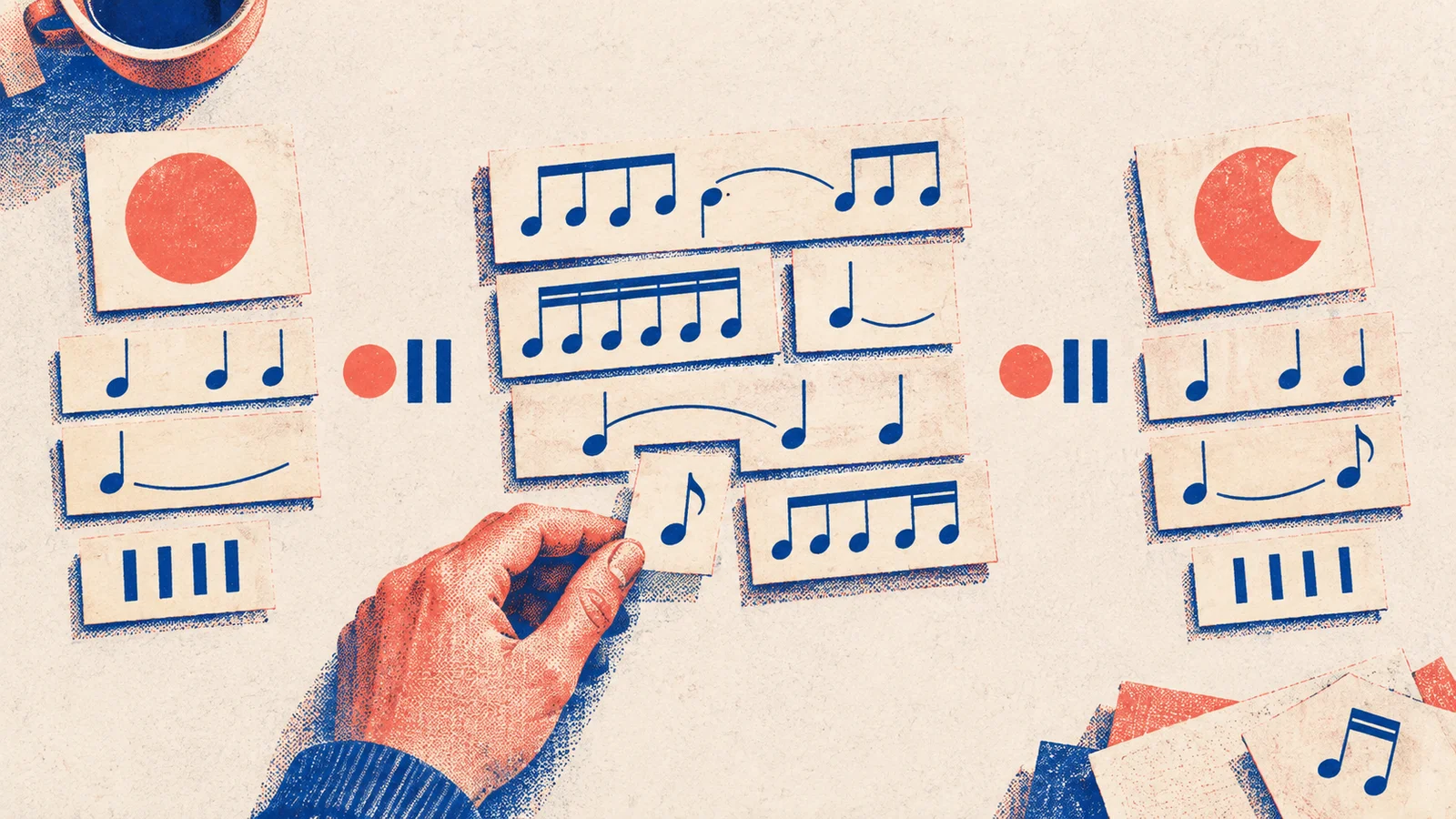
Your lessons
Bring an unfinished loop in your usual music setup. Start with arrangement, then use the lessons that address what your piece needs next.
Give the idea a shape
Sketch the sections first. Then choose what stays recognizable and what changes in the rhythm, melody, chords and bass.
Music theory and musical ideas Form and arrangementTurning a loop into a piece with sections, contrast and energy
 Melody and motifsContour, repetition and variation, and why some tunes stick
 Rhythm, meter and groovePulse, subdivision, swing, and why a grid alone doesn't groove
 Chords and voicingSame notes, different feelings: how spacing and order change a chord
 Progressions and harmonic movementCadences, borrowed chords and modulation, and how harmony creates motion
 Bass lines and counterlinesHow a second line supports a phrase without copying it
Write parts that move
Use accents, timing and pattern length to give a repeated part direction, and leave space for the next phrase.
Beats, MIDI and performance

Make sound support the phrase
Shape the attack and tail of each note, then add movement so the sound develops along with the music.
Synthesis and sound design

Use effects for contrast
Place effects deliberately. Echo and space can carry a transition or change the feeling of a section without adding another part.
Effects
Finish the arrangement
Decide what leads in each section, make room for it and compare the whole piece with a useful reference before calling it finished.
Mixing and finishing What mixing is forBalance, clarity, depth and emotion, before any plugin
 Making room with EQWhy every track sounds fine alone and muddy together
 Low endKick and bass that work together on big and small speakers
 Depth and space in a mixFront, back, wide and narrow with reverb, delay and level
 Finishing and referencesLoudness targets, reference tracks and knowing when to stop
What you can put into practice
Make a short arrangement whose sections differ in rhythm, sound and focus.
Use fewer parts more deliberately
Give the melody, bass and drums distinct jobs. Change a voicing or accent before adding another layer that competes with the hook.
Create a transition without a new loop
Try a shorter note tail, a moving filter or an echo into the next section. Hear how sound changes can carry the arrangement forward.
Finish with specific decisions
Choose what the listener should follow, fix the conflict that hides it and use a reference to decide which remaining changes matter.
Try it: a short piece from one loop
Keep a recognizable motif while changing its supporting rhythm, bass or harmony. Use those changes to sketch the shape of a piece.
1Name the idea worth keeping
Choose a short motif in your loop. Keep its rhythm or contour recognizable while listening for the elements that can change.
Melody and motifs2Build a contrasting section
Keep the motif but change its supporting bass or chord spacing. Compare the two sections and choose a contrast you can clearly hear.
Chords and voicing3Make the return count
Arrange a beginning, the contrasting section and a return. Decide what to remove or hold back so the return feels intentional.
Form and arrangement
Listen for this: The sections should feel related and different. Listen through without stopping: can you hear a reason to move forward and a reason to return?
Take the idea further
Hum to arrangement
Follow a short melodic idea toward an arrangement when your starting point is a tune rather than a drum loop.
A beat from scratch
Carry a rhythm through sound choices, bass and a larger shape when your idea starts with a beat.

Drum synthesis
Build a kick, snare or hat for the rhythm you have written when the sounds in your kit are getting in the way.
Common questions
- Do I need to know theory before I start?
- Bring the loop you already like. Use the motif, rhythm and harmony lessons to answer the decisions in front of you; take a foundations detour only when you need it.
- Do I need to finish a full-length song straight away?
- Aim first for a short piece with a clear contrast and return. Once that structure works, you can decide what deserves more development.
Free guides, no account needed. Pick the lessons that interest you.
Start learning for free