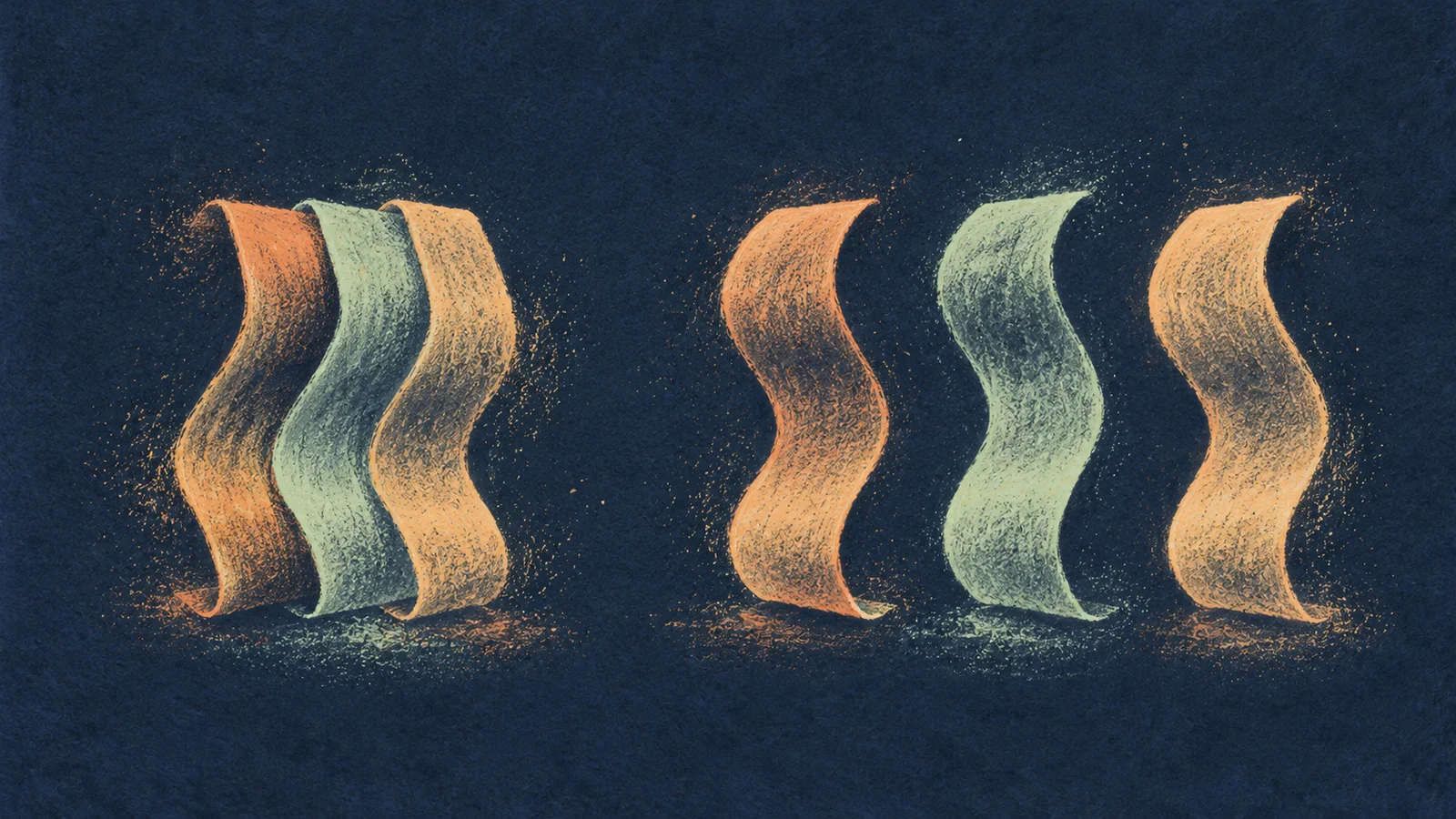
Four chords that could sit under half the lo-fi playlists on the internet: Cmaj7, Am7, Dm7, G7. Same four chord symbols, three different ways to play them. Press play and switch between them while it loops.
Switch between root position, voice-led and spread. Which version sounds like one smooth movement, and which notes barely move at all?
Same chords, three ways
Loading the phrase…
Before you switch: the chord names never change, so will the three versions sound almost the same, or like three different pianists? Listen to each for a full loop.
Same chord, different sound
Root position climbs and drops like someone lifting a box from shelf to shelf. Voice-led sounds like one hand barely moving, as if the harmony is breathing rather than changing. Spread sounds bigger and more open, almost orchestral. The symbols told you which notes to use. They didn't tell you where to put them.
That choice is voicing: which octave each note goes in, how far apart they sit, which note is on the bottom and which on top, and whether any are doubled or left out. A chord symbol is a shopping list. A voicing is the meal.
Two notes in every voicing deserve special attention:
- The bass, the lowest note, colours everything above it. Cmaj7 with C at the bottom sounds grounded; with E at the bottom it floats.
- The top note is the one people hear as a melody. Play a progression and the top notes form a tune whether you meant one or not.
One chord, four voicings
Cmaj7 four ways
Close packs the notes inside one octave: compact and a little dense.
Drop 2 takes the second note from the top (G) and drops it an octave, opening a gap in the middle. It's a staple of jazz guitar and big-band writing because it sounds full without crowding. Count from the top, not the bottom: that's the usual slip.
E in the bass is an inversion: the same chord standing on a different foot. Wide spreads the notes across two octaves, the way strings or a choir might.
None of these is the correct Cmaj7. They're four different moods for one chord name.
Every chord is a few small melodies
Switch the first lab back to voice-led and look at the piano roll. From Cmaj7 to Am7, only one note moves: B slides down to A. Everything else holds. That's why the change feels like a slow breath out instead of a jump.
This is voice leading: treating each note of a chord as a separate voice that walks to its nearest note in the next chord. Bach's chorales are the classic school for it. Each chord change in them is four singers, each taking a small step, and the harmony emerges from four good melodies sung at once.
Try it yourself by ear. In the voice-led version, follow just the top note across all four chords: B, A, A, G. It's a tiny falling tune, and it's part of why this loop sounds so gentle. Then follow the bottom: C, C, C, B. Hardly moving at all, like a held breath.
Root position isn't wrong, by the way. When every voice leaps together, you get a chunky, blocky movement that suits a punchy synth stab or a rock guitar part. Choose the motion that matches the music.
Why low chords turn to mud
Here are two seventh chords played low down. Raise them an octave at a time.
Start low, then move up an octave and then two. Where do the notes start to sound like separate notes instead of one thick blur?
Mud and air
Loading the phrase…
At the bottom, the chord sounds thick and growly, almost like one buzzing note. Two octaves up the same shape is clear and airy. Nothing about the chord changed except its height.
The reason is physics. Each note brings its own harmonics, and down low the notes are only a few hertz apart. C2 and E2 are about 65 and 82 Hz, so their harmonics crowd into the same region and rub against each other, producing beating and roughness. Up at C5 and E5 (about 523 and 659 Hz), there's plenty of room between them.
Arrangers have a rule of thumb for this: wide at the bottom, close at the top. Put octaves and fifths low, and save the thirds and sevenths for the middle and top. It's the same shape as the harmonic series inside a single note, where the overtones start far apart and get closer as they rise. Low density isn't always bad, though: it's exactly the growl you want from a doom-metal guitar or a dark synth pad.
Same idea, different place: the roughness in a low chord is the same beating you hear between two slightly out-of-tune strings, and some music tunes for it on purpose. See Tuning systems.
Let the top note sing
The top note is the most exposed. When a singer is carrying the melody, a voicing whose top note sits right on the melody can thicken it nicely, compete with it, or answer it, depending on the moment.
Pianists use this all the time. Bill Evans's voicing on Miles Davis's "So What" stacks three fourths with a third on top, and that one shape, slid up and down, became so famous it's known as the "So What chord". Its colour comes almost entirely from how the notes are spaced.
Where smooth stops helping
If every change moves each voice to the nearest note, a long progression can slowly drift too high or too low. Watch the range across the whole loop. Sometimes the best move is a deliberate leap, at the start of a chorus for example, to reset the register and announce a new section.
And check the voicing with everything else playing. A beautiful top line can crowd a vocal. You might keep the voice leading but drop a note, lower the top or play fewer notes.
From chord names to a musical part carries this into an arrangement: keep the harmony, then compare a held pad, a short stab and a strum.
Make it yours
Take Am, F, C, G. Start with A3, C4, E4 and move each note to the nearest one in the next chord. Then hum this melody over it, one note per chord: E5, F5, E5, D5. Does your top voice support the tune, or fight it?
Make one more version that's wider at the bottom. Keep the one you'd actually use, and write one sentence about why you rejected the other. If you want to hear how a tool voices chords, the voice-led setting in the first lab is a good second opinion, not a final answer.
Quick check
- Two Cmaj7 chords have different lowest notes. What changed, and what didn't? The bass, and possibly the spacing and top note. The ingredients (C, E, G, B) didn't. The chord symbol is the same, which is why it can't tell you how a voicing will sound.
- What is drop 2 of C4, E4, G4, B4? G3, C4, E4, B4. G is the second note from the top, so it drops an octave. It's tempting to count from the bottom and drop E, which gives a different, more crowded voicing.
- Your pad sounds muddy in the low end. Your first move? Spread the low notes wider, or move the thirds and sevenths up an octave. EQ can help afterwards, but the crowding comes from the notes themselves.
Next steps
- Go deeper: Progressions and harmonic movement. Smooth voicing makes chords flow. Why do some changes feel finished and others leave you hanging?
- Use it: Bass lines and counterlines. Turn the lowest voice into a line with its own purpose.