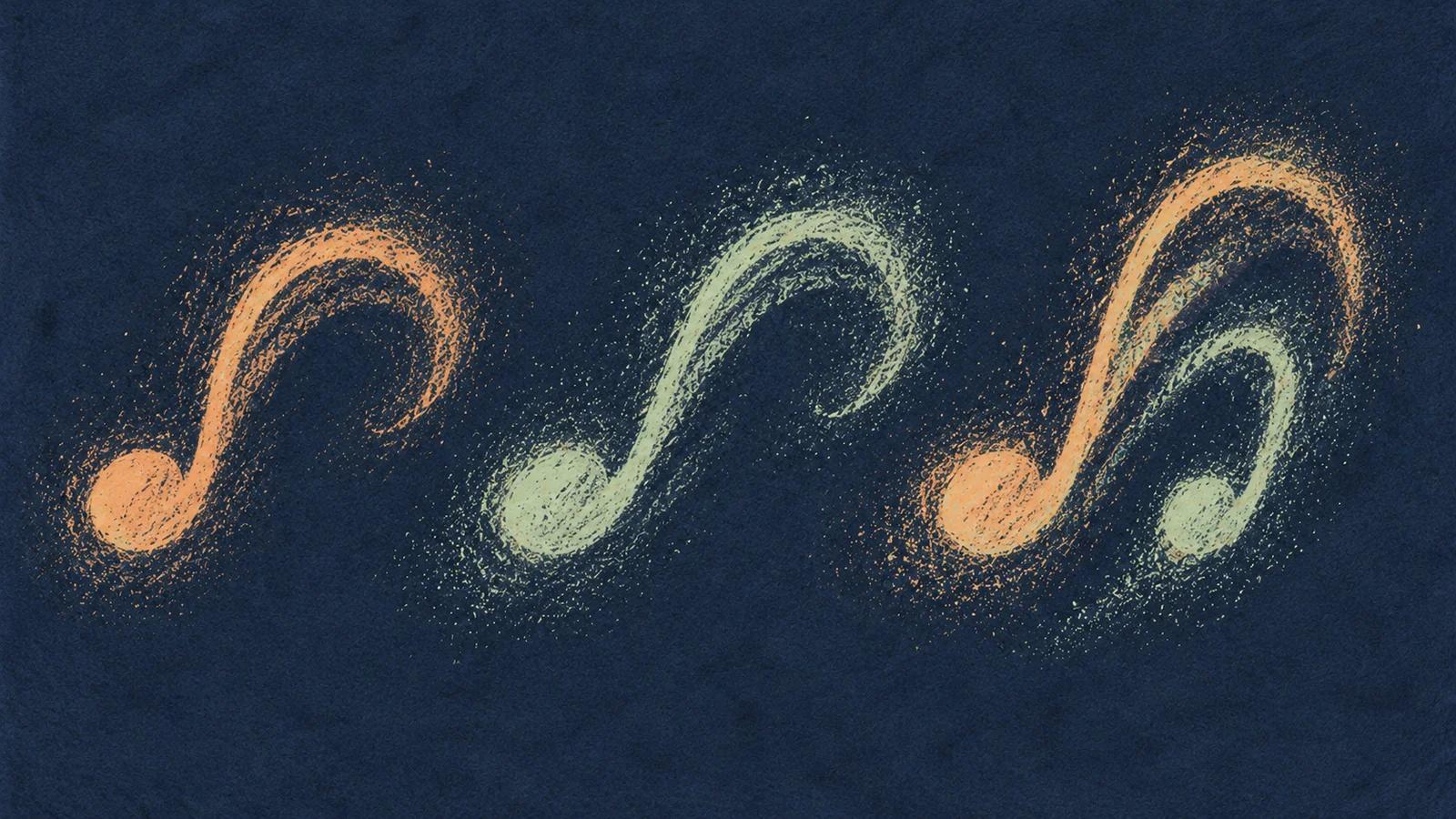
Da-da-da-DUM. Four notes, and a huge number of people know which symphony they open. Beethoven built the whole first movement of his Fifth out of that little rhythm: it's passed between instruments, moved up and down, piled on top of itself, and you never lose track of it. Most of the tunes that stick work the same way. They aren't a stream of new ideas. They're one small idea, changed just enough to stay interesting.
Here's a four-bar melody built that way. Listen to it a couple of times.
Every bar uses different notes, yet it sounds like one idea. Before you edit: what is staying the same? Then move note 12, the high C, down a few semitones and listen to what the phrase loses.
One idea, four bars
Loading the phrase…
The pitches change from bar to bar. So why does it sound like one thought rather than four? Is it the notes, the rhythm, the shape, or something else?
What a motif is made of
A motif is a short musical idea that keeps coming back. It has several features at once, and each one can be kept or changed separately:
| Feature | Bar 1 of the melody |
|---|---|
| Pitches | C4, D4, E4, G4 |
| Rhythm | short, short, long, longer (½, ½, 1, 2 beats) |
| Steps | +2, +2, +3 semitones |
| Contour | up, up, up |
Look at the next two bars with that table in mind. The pitches change every time. The rhythm never does. The contour stays "up, up, up". And the last step grows: +3 in bar 1, +4 in bar 2, +5 in bar 3. You're hearing the same gesture reach a little further each time, which is why the melody feels like it's building. Then bar 4 turns the shape over (down, down, down) and walks home to C.
Three climbs and a way home
That keep-some, change-some balance is the whole craft. Keep everything and you have repetition. Change everything and you have a new idea. In between is development, and that's where melodies get their sense of going somewhere.
Repeat, then nudge
Repetition gets a bad name, but it's how a listener learns your idea. The White Stripes' "Seven Nation Army" riff repeats so plainly that football crowds sing it. Hearing something twice is what lets you notice when the third time is different.
Once the idea is known, small changes start to mean something. Here are the classic moves, and what each one keeps:
- Sequence: repeat the motif starting on a different note. Bars 2 and 3 of our melody are sequences. Rhythm and contour survive; the exact steps can bend to stay in the scale.
- Transposition: move every note by the same amount. Everything about the shape survives, as in Pitch and intervals.
- Rhythmic variation: keep the pitches, change the durations. Try singing C, D, E, G as four even notes. It's the same notes, and yet it's a surprisingly different idea, because rhythm carries a lot of a melody's identity.
- Inversion: flip the directions. Up becomes down. Bar 4 does a loose version of this.
- Retrograde: play it backwards. Bach used inversion and reversal in fugues; twentieth-century twelve-tone composers made them a system.
- Extension: keep the start and let the end go further, the way bar 3 reaches the high C.
Find the breaking point
Back in the lab, pick note 12 (the high C, the peak of the whole phrase) and lower it a few semitones. The climb stops climbing. The rhythm and the first three notes of the bar are untouched, but the bar no longer reaches further than bar 2, so the sense of building flattens out.
Now restore it and move something else instead: note 4, the long G in bar 1. Lower it to E and bar 1 no longer leaps at the end, so bars 2 and 3 seem to be answering a question that was never quite asked. Every melody has a few notes that carry its identity and many that can bend. Finding which are which, by ear, is how you learn to develop your own ideas.
Melodies that answer each other
Ideas also develop in pairs. Call and response, a phrase followed by an answering phrase, runs through African-American music from work songs and gospel to blues, where a sung line is often answered by the guitar. Our melody does a small version: three bars ask, the last bar answers.
Other traditions lean on recognisable motifs too. In Hindustani music, each raga has a pakad, a short characteristic phrase that lets a listener identify the raga within a few notes. In film scores, a leitmotif ties a melody to a character or idea, an approach Wagner developed in opera and film composers like John Williams use to this day.
Same idea, different place: sequence, inversion and reversal are rules precise enough to write as code. Generative music is often just motif development done by a computer. See Algorithmic patterns.
Where variation loses the thread
Change the rhythm, the contour and the register all at once and the link to the original usually snaps. If a variation sounds unrelated, don't reach for cleverer notes. Put one feature back, usually the rhythm or the opening interval, and listen again.
The sound matters too. A motif played on a soft pad and then on a sharp pluck can feel like two different ideas because the attack changes how you hear the rhythm. And in a busy arrangement, a clear rhythm survives better than a subtle pitch pattern.
Make it yours
Write a motif of your own: three to five notes, with a rhythm you could tap on a table. Then make three variations, each changing exactly one feature: one with new pitches but the same rhythm, one with the same pitches but a new rhythm, and one upside down.
Arrange them into eight bars: the original twice, a variation twice, a different variation twice, then the original with a new ending. Sing or play it through. If the return in bar 7 makes you smile, you've done it. Keep the motif and the plan; that's a melody you can hand to any instrument.
Quick check
- You move every note of a motif up five semitones. What survives? Rhythm, contour and every step between notes. Only the pitch level changes. That's why transposed motifs are instantly recognisable.
- A friend sings your motif with the right notes but all equal lengths, and it sounds like a different tune. Why? Rhythm carries a large part of a motif's identity. Same pitches, different rhythm can feel more different than different pitches with the same rhythm, as bars 2 and 3 of our melody showed.
- Your variation sounds unrelated to the original. Do you need more notes? Usually fewer changes, not more notes. Restore one feature, such as the rhythm or the first interval, and compare. Each extra change makes the connection harder to hear.
Next steps
- Go deeper: Bass lines and counterlines. A melody rarely plays alone. How does a second line support it without copying it?
- Use it: Form and arrangement. Turn eight bars into a piece with a return that lands.