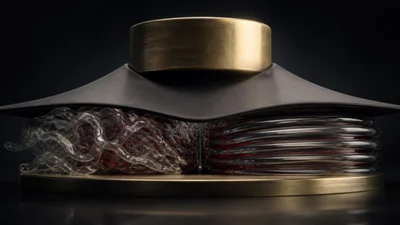
A groove-aware ducking effect. It listens for the kick and the clap, makes a little room for them in whatever it is inserted on, and gives that room back in time with the beat: the recovery follows a note division and a feel rather than a fixed release in milliseconds.
The idea
Classic sidechain ducking works best when it is subtle. Pushing past two or three decibels per hit starts to sound like pumping, and around six decibels the effect becomes obvious. Pocket is built around that: you set a reduction budget and it never exceeds it, even when several hits land at once.
Pocket is not a generic unmasker that compares spectra. It assumes the drums matter, detects when they hit, and schedules the recovery musically. Below a crossover point the low end is ducked as one mono band, so a bass stays full and centred between kicks. Higher up, with Glue raised, the reduction is shaped into a few narrow cuts instead of a broadband dip, so a pad keeps its density.
Controls
Three macros carry the effect:
- Space sets how much room Pocket makes. The first half of its travel covers the first 3 dB, where most useful settings live.
- Pocket sets the timing feel of the recovery, sweeping from a snappy Tight return through Pocket and Laid Back to a slow, Open one.
- Glue sets how the reduction is delivered, from a clean low-band duck to spectral cuts, and brings up a touch of bus compression and saturation.
The bottom rail holds Feel (Tight, Pocket, Laid Back, Swing or Open), Source, Audition, Tempo and Host sync. Audition lets you hear the key signal (Sidechain) or only what Pocket removes (Delta).
An Expert page opens every setting: note division from 1/32 to a whole bar, attack, hold, MPC-style swing from 50 to 75%, adaptation to the spacing between kicks, maximum reduction, the weight and frequency of each detector (Kick, Clap, Perc and Sustain), the mono crossover, transient protection, the cuts, the glue compressor, Mix and Output.
The Groove Scope draws the duck Pocket will apply on a beat grid, with the budget as a ceiling and a strip showing which detector triggered each cut. It is a prediction from the current settings, and the caption says so.
Getting started
Pocket is an audio effect. Put it on a bass, pad, keys or vocal part. Set Source to TestPulse to key it from Pocket's own built-in kick and clap pattern at the set tempo, and watch the scope show where the duck lands before you play anything. Start with Bass Under Kick for bass or Keys In The Gaps for pads and keys, then try Bounce, Sample Room, Vocal Sit, Pad Breathe, Tight Modern or Barely There.
Limits
Pocket cannot yet be keyed from another track. The External source falls back to Internal, which listens to Pocket's own input, and the face points this out. The scope and the per-detector readouts show predictions, not a live measurement of the reduction.