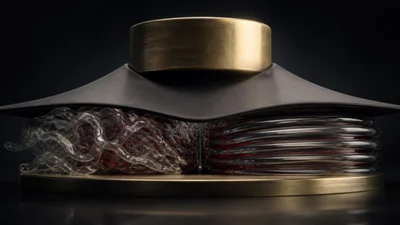
A stereo dynamics compressor with the controls a mixing compressor needs: peak or RMS detection, a soft knee, hold, automatic release, a ceiling on how much it may reduce, and a detector you can filter without touching the audio you hear.
The idea
Threshold, Ratio and Knee describe where the compressor is heading: how much quieter a signal above the threshold should become. Attack, Release and Hold decide how quickly it gets there and back. That is why a drum hit and a sustained chord react differently at identical settings.
The detector filters are the part worth learning. A high-pass on the detector stops a kick's low end from pulling the whole mix down, and a low-pass stops the compressor reacting to cymbals and sibilance. Neither filter changes the sound itself, only what the compressor listens to, and at the ends of their ranges they are switched off entirely.
Controls
- Threshold (−80 to 0 dB), Ratio (1:1 up to an infinite ratio that works as a limiter) and Knee (0 to 72 dB, from hard to very gradual).
- Attack, Release and Hold. Hold keeps the reduction in place for a moment before release starts; it never delays the attack.
- Auto Release sets the release time from the material: percussive sounds recover quickly, sustained ones slowly.
- Range is a hard limit on how much gain reduction can ever be applied.
- Makeup brings the level back up. Auto Makeup sets it for you from Threshold, Ratio and Knee, and the Makeup knob stays live as an offset.
- Mix blends the compressed signal with the dry one for parallel compression; at 0 it is exactly the dry signal.
- Detector chooses Peak or RMS (an average over 10 ms), and SC High-Pass and SC Low-Pass filter what the detector hears.
Threshold and Ratio lead the face, with Makeup, Attack, Release and Mix next to them. Advanced opens Knee, Hold, Range, Auto Release and the detector settings. The compressor adds no latency.
Getting started
Play a recording with clear transients through it, such as drums, a bass or a picked guitar. Start from a preset:
- Vocal Control: wide knee, short hold and a detector high-pass so plosives do not drive the gain.
- Drum Bus Glue: slow RMS detection with a very wide knee.
- Punch (parallel): hard 8:1 blended back under the dry signal.
- Pumping 1/8: instant attack and an eighth-note release at 120 BPM.
- Bass Tamer: RMS detection keyed on the fundamental only.
- Mastering Gentle: a 40 dB knee at 1.6:1 with a 4 dB ceiling.
- Brickwall Safety: the limiter setting, right under 0 dBFS.
On material with heavy low end, try raising SC High-Pass and listen to what stops pulling the whole signal down.
Limits
- The two channels are compressed independently. A hard-panned hit compresses one side and not the other, which can shift the stereo image.
- There is no gain-reduction meter yet. Rather than show a meter that would always read zero, the face shows none.
- There is no external sidechain input; the detector always listens to the signal being compressed.