Taper

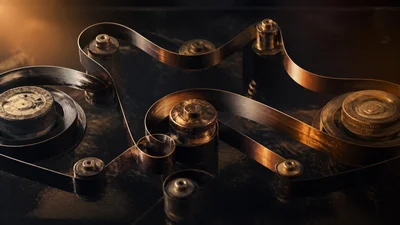
A complete open tape path for printing a signal.

@maruEffect
Demo

What it does

A complete tape machine path for printing a signal: drive into the tape, transport wobble, bias, the low-end head bump and a protective output stage. Nine controls follow the order the signal takes through the machine.

The idea

Taper is an algorithmic tape model rather than a capture of one machine. Its character comes from a chain of explicit stages. The signal is brightened on the way in and darkened by the same amount on the way out, so the tape stage in between saturates the detail before it is put back. A wandering stereo delay adds wow and flutter, a bias stage moves between sticky and slew-limited behaviour, and a pair of resonant filters adds the low lift that people often hear as "tape" before they notice the saturation.

Every control sits at a neutral middle by default, so you can start from a fair comparison and push one stage at a time.
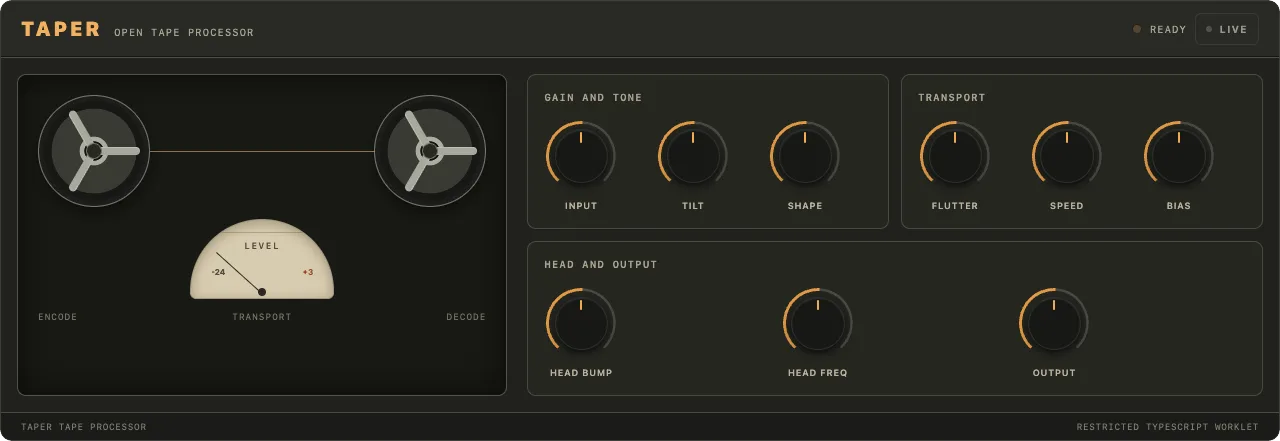

Taper interface

Built with

The 4 Maru DSP nodes it runs, by category.

Distortion

  • Taper@maru/distortion-taper

    Tape processor: nine-control cook, companding encode/decode, flutter fractional delay, bias slew, mid/sub split, head-bump resonators and stereo soft clip.

Math

  • Range@maru/math-range

    Audio SDK-compatible f64 range policy: signed zero follows ECMAScript Math.min/Math.max, reversed bounds select the maximum, clamp propagates NaN and bounds infinities…

Noise

  • Xorshift32@maru/noise-xorshift32

    Raw unsigned 32-bit xorshift32 transition without seed normalization, plus the canonical unrounded mapping from a raw u32 to [-1, 1).

Voices

  • Stages@maru/voices-stages

    Per-sample voice stage primitives: PolyBLEP residual and sine/saw/square/triangle oscillator samples, phase advance, one-pole envelope coefficient/step with shared stage…

See the diagram in DSP

Guide and controls

How it works.

The input first passes through a complementary high-frequency encode stage. Its level-dependent compression boosts detail before the nonlinear tape split, then the matching decode stage removes the contour after the tape has changed it. Tilt controls the relationship between those two halves rather than acting as a simple shelf EQ.

Flutter writes stereo samples into a circular delay and reads each side from an independently wandering fractional tap. The wander is seeded and deterministic in this port, which makes repeat renders testable while retaining the irregular motion of the original algorithm.

Bias is a bank of slew-history constraints. Below centre it can hold a sample near recent history; above centre it progressively limits fast changes. The stage bypasses at the centre detent, so a neutral comparison does not pay for a hidden approximation.

The tape core splits the signal around Shape, applies different nonlinear laws to the low and high portions, and optionally excites two closely spaced resonant head filters. Decode, output trim and a safety clipper finish the path. The processor holds all history across worklet blocks, which is essential for flutter, resonance, bias and clipping continuity.

What would you make with Taper?

Describe what you want to make. Build it with the Studio agent.

Goes well with.

Building block

Maru

Add harmonics with a waveshaper.

Guitarabin

$49 preorder

Maru

A fixed pedalboard for spacious guitar.

Prototype

Maru

Tube-style drive into a real cabinet.

Building block

Maru

Bit reduction and sample-rate reduction for digital grit.

Music tools on your computer.

Install and manage Maru and community plugins in one app, and play them in your DAW.

Chicken Synth, a cat keyboard, effects knobs and wavetable and MIDI panels