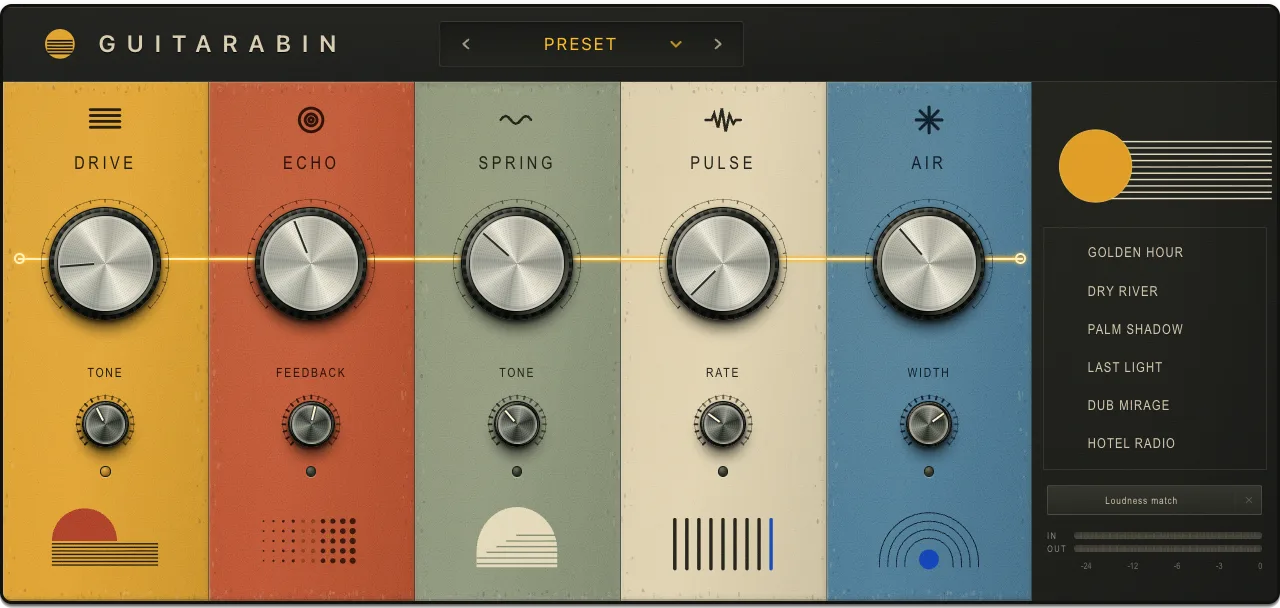
The pre-chain is fixed and conventional: a peaking biquad for the parked wah, a compressor, a waveshaper, then a shelf pair for tone, then the two modulation stages. The drive curve is a tanh capped at about 9x pre-gain, which is low - the stage is there to thicken and boost, and running it as a distortion is not a sound either reference rig makes.
The two modulation stages are genuinely different effects and are wired that way. Tremolo is an LFO summed with a DC offset into a gain, with the offset set to 1 minus half the depth so the effect swings around unity instead of only ducking. Vibrato is an LFO on a delay line's time, which is a real pitch shift; depth is specified in cents and converted through the delay-modulation relation (peak pitch deviation is 2*pi*rate*swing), then clamped under the centre tap so the line can never go negative.
The delay is a single tap with the feedback path damped and saturated before it returns, so repeats both darken and compress as they pile up - the tape behaviour, rather than a clean digital repeat that eventually clips. Tape Age moves the damping corner from 8 kHz down to 1.8 kHz and simultaneously opens a slow LFO on the delay time for wow and flutter, because on a real machine those are the same fact about the same worn transport.
The reverb is a small feedback-delay network - four short diffusion delays in series feeding four damped parallel combs - not a convolver. That is a deliberate split of responsibility with Space Mini, which does own a convolution reverb: an FDN gives a decay knob that actually re-tunes the tail, and comb feedback is derived from the target decay by the standard relation g = 10^(-3t/RT60). The tail is damped harder than the output, so highs die before lows.
The panel exposes ten knobs, not twenty. Several are macros that fan out to more than one engine value, because the pedals they stand in for do too: one Echo knob moves repeat spacing and wet level together, and Feedback carries tape age with it, since more passes over the head is what wear actually is. That expansion lives in one function in the plugin's schema, which both the plugin and this page call, so a knob means the same thing in a DAW as it does here.
Width is a mid/side matrix on the wet path only, fed by a decorrelated copy of the chain output - a mono pedal chain has no side component at all, and no amount of matrixing invents one. Below halfway the tail collapses toward the centre while the dry note keeps its own image untouched.