Multifx

Six effects. Your order.

@maruEffectExperimental
Demo

What it does

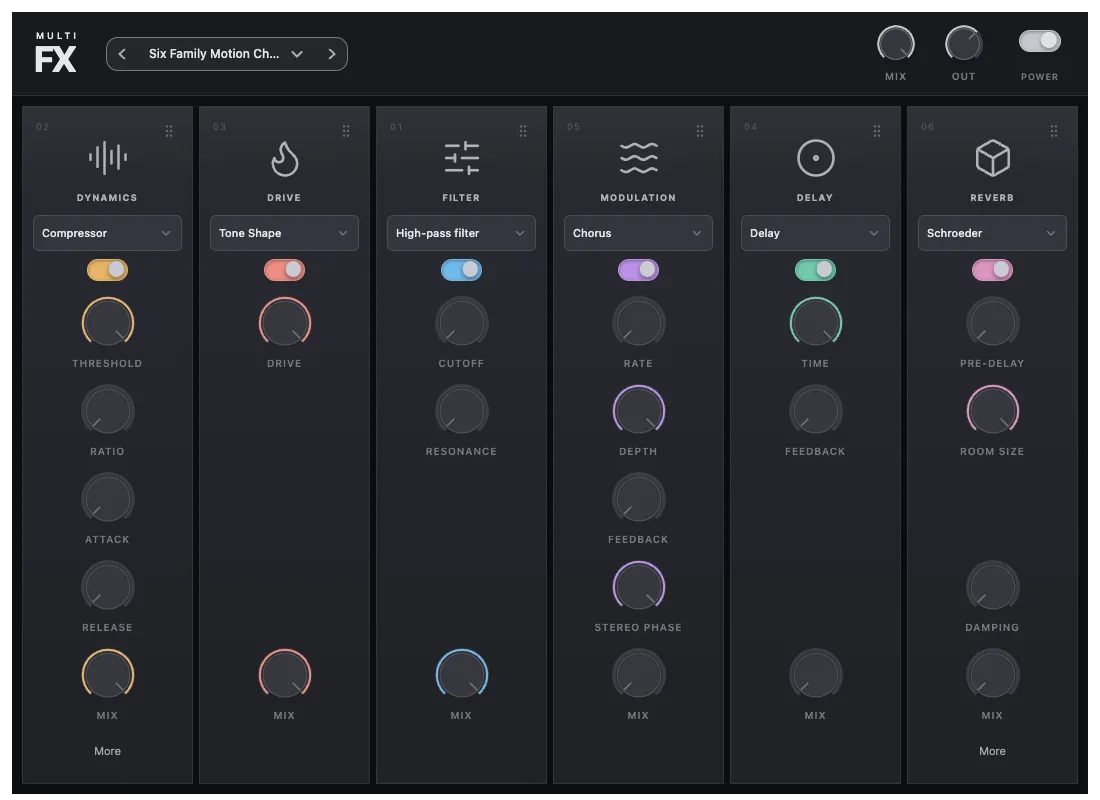
A stereo effect chain with six slots you can drag into any order: Filter, Dynamics, Drive, Delay, Modulation and Reverb. Pick an effect in each card, switch on the ones you want, and hear how the order changes the sound.

The idea

The same effects in a different order make a different sound. Drive into a delay gives clean repeats of a dirty signal; a delay into drive distorts the echoes too. Filtering before distortion is not the same as filtering after it. Multifx makes that easy to hear: drag a card by its header to a new position and the chain follows, while every knob keeps its settings and MIDI assignments.

Many of the factory presets come in pairs that use the same effects in opposite orders, such as Tone Shape into Delay and Delay into Tone Shape, so you can switch between them and compare.

What each card offers

Every card chooses one effect from its family, sixty in all, including:

  • Filter: low-, high- and band-pass, notch, four-band and parametric EQ, envelope and LFO filters, and a comb filter.
  • Dynamics: compressors, gates, an expander, a transient shaper and a de-esser.
  • Drive: overdrives, a triode stage, saturation, clipping, rectifying, wavefolding, bitcrushing, decimation and an octave divider, plus textures such as record crackle, dust and mains hum.
  • Delay: simple, ping-pong, cross-feed, saturated, multitap and reverse delays.
  • Modulation: chorus, phaser, flanger, tremolo, vibrato, auto-panner, ring modulator, frequency and pitch shifters, rotary speaker, stereo width and Haas widening, and mid/side tools.
  • Reverb: Schroeder and Dattorro reverbs, rooms, a hall and a spring.

Each card has up to four controls chosen for that effect and its own Mix knob; More opens extra settings where an effect has them. Choosing an effect switches its slot on, and the card's switch turns it off again. The header holds the overall Mix, the output level and a power switch for the whole chain.

One-knob presets

Presets named Knob: … turn the whole chain into one control. Knob: Dirt raises the drive, opens its mix, darkens the filter and trims the output as you turn it; Distance, Wobble, Squash and Throw do the same for space, movement, compression and echo. Knobs: Dirt, Space, Wobble gives three knobs at once. The face shows just the knob; Show the chain opens the effects it moves, so you can see and change them. Each knob is an ordinary parameter (Macro 1 … Macro 8), so it automates and maps to MIDI like any other.

Multifx interface

Built with

The 67 Maru DSP nodes it runs, by category.

Control

  • Param macros@maru/control-param-macros

    Parameter-macro table layout and value law: an f32 table of a version/row-count header row plus up to 32 [macroIndex, targetParamIndex, min, max, curveCode, reserved] rows that…

Delays

  • Cross feed@maru/delays-cross-feed

    Canonical cross-feeding stereo delay: two fractional lines with per-line times, split same-side/cross-side feedback, in-loop high-pass/low-pass tone, quadrature read-position…

  • Fractional@maru/delays-fractional

    Canonical bounded f32 linear-interpolation delay and feedback-delay state, read/write, tick and reset semantics.

  • Ping pong@maru/delays-ping-pong

    True ping-pong delay: two cross-feeding fixed lines producing structurally alternating L/R repeats, 100% wet.

  • Reverse delay@maru/delays-reverse-delay

    Windowed reverse delay over caller-owned stereo rings with edge fades.

  • Saturated feedback@maru/delays-saturated-feedback

    Canonical bounded tape-delay core: f32 damping pole, rational-tanh soft clip, bounded feedback write, dry/wet split and reset semantics.

  • Tap pattern@maru/delays-tap-pattern

    Four-tap, Haas and damped feedback-comb compositions over caller-owned stereo rings.

Distortion

  • Bitcrusher@maru/distortion-bitcrusher

    Sample-rate and bit-depth reducer: anti-alias one-pole before the sample hold, held-sample phase accumulator, quantization steps, boost and dry/wet with boost compensation.

See all 67 in DSP

Guide and controls

How it works.

One Processor runs the selected effects in the saved order. Empty, disabled and settled zero-mix slots skip their processing.

Changing order or effect type briefly fades the chain to dry, applies the change, and fades it back in. Controls and CC assignments follow the stable slot identities.

What would you make with Multifx?

Describe what you want to make. Build it with the Studio agent.

Goes well with.

Guitarabin

$49 preorder

Maru

A fixed pedalboard for spacious guitar.

Maru

A stereo delay that bounces across the stereo field, bringing sparkle to everything it touches.

Prototype

Maru

Drive, tone, and bounded feedback delay.

Music tools on your computer.

Install and manage Maru and community plugins in one app, and play them in your DAW.

Chicken Synth, a cat keyboard, effects knobs and wavetable and MIDI panels