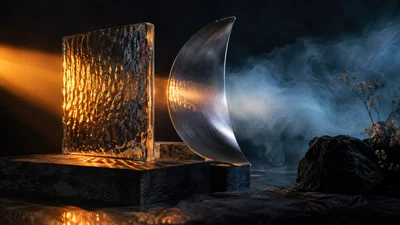
A mono space effect, echo into reverb into compression, played through a living glass prism. The prism is rendered in real time: a beam of light enters it and splits into a spectrum, and moving your pointer across the panel aims the lamp and turns the camera.
The idea
Triprism treats the interface as part of the instrument, while keeping the sound simple and honest. The seven controls are the whole signal path: a feedback delay feeds a reverb, and a compressor after them glues the tail together before the output. The prism does not analyse or modulate the audio; it is the module's visual identity. When you leave the pointer still for a few seconds, the scene drifts into a slow orbit of its own, and your next movement takes over again.
Controls
- Delay Time, Feedback and Mix: the spacing of the echoes, how many repeats come back, and how loud they are against the dry sound.
- Reverb Size and Mix: how large the room is and how much of its tail you hear.
- Compressor Amount: how firmly the echoes and tail are held together. One knob is enough; the rest of the compressor is preset.
- Level: the output volume.
Getting started
Send Triprism a voice, a guitar or a synth line. Start with Glass Hall, the default, then try Tight Prism for short, close repeats, Long Ray for long echoes in a big space, or Split Beam for many repeats that build into a wash.
The prism needs a browser with WebGPU. Without it, the panel says so and the effect and its controls still work as usual.
The prism scene is adapted from Vercel Labs' open-source vgpu prism-light example; see THIRDPARTYNOTICES.md.