Controls
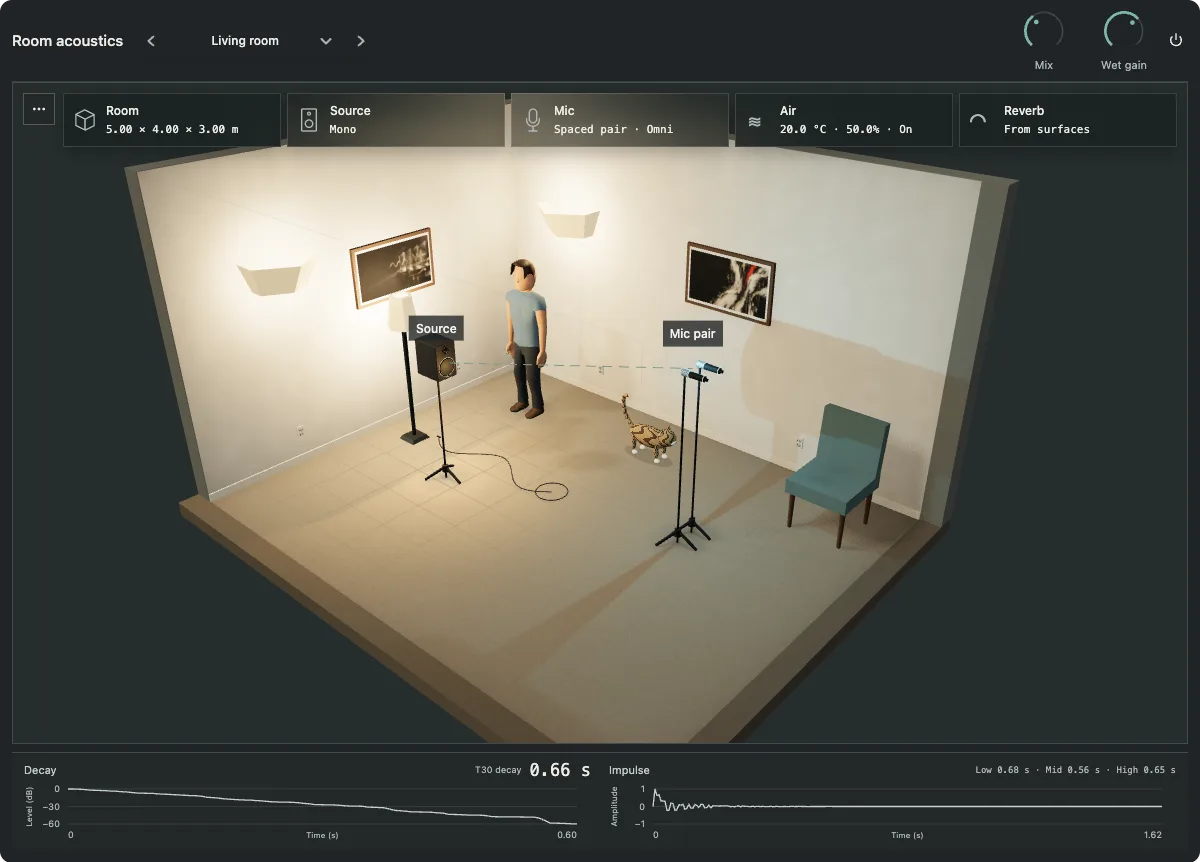
The settings chips above the scene hold the details:
- Room: width, depth and height in metres.
- Source: position and height, and Mono or Stereo. Stereo places two speakers, Source L and Source R, with their own spacing and angle.
- Mic: position, height, arrangement (Mono, Spaced pair, XY or ORTF), pickup pattern (Omni, Subcardioid, Cardioid, Hypercardioid or Figure eight), spacing and aim.
- Air: air absorption, temperature and humidity.
Below the scene, the sound controls choose between setting Surfaces, with a material for the floor, walls and ceiling (brick, concrete, plasterboard, ceiling board, carpet, curtains, wood or glass), or a Decay time you want the room to have. Reflection order sets how many bounces are traced exactly, Late reverb adds or removes the diffuse tail and Diffusion sets how much the walls scatter. Direct path includes or removes the sound that travels straight from source to microphone. Mix blends the room with your original signal and Wet gain sets the level of the room.
Drag the source or microphones in the 3D, plan or side view; Shift-drag changes height. The panel shows the measured decay, the impulse response and predicted decay times per frequency band. The finished response can be exported as an impulse-response WAV where the host supports it.
Getting started
Play a dry recording through it, start with Living room, then try Small booth, Classroom, Concert hall, Stairwell and Car interior. Move the microphones closer to and further from the source to hear the balance between direct sound and room change.
Honest limits: rooms are rectangular boxes, the response is capped at three seconds, and the speakers radiate equally in every direction. Moving things does not produce a Doppler effect, and reflective rooms or the Fine quality setting take longer to recalculate. Predicted decay times are estimates; the measured decay of the actual response is shown alongside them.