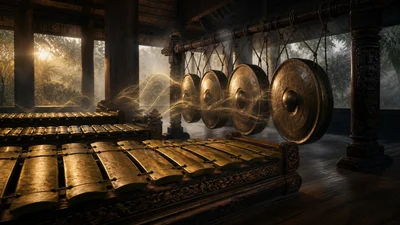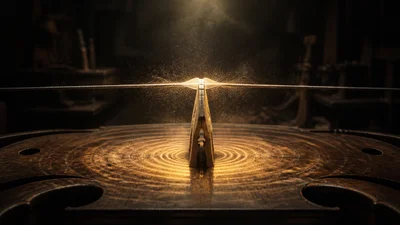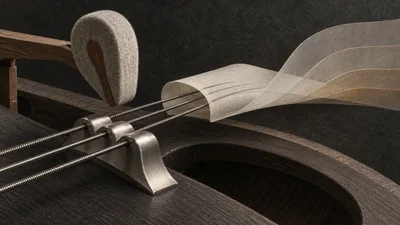
An experimental physical-model piano. Instead of playing back recordings, it simulates struck strings: three slightly detuned strings per note, a felt hammer, dampers, a pedal, a body and a lid, and every part of that model is a control you can change.
The idea
Tricorda is a reduced model for exploring the parts of a piano that are fun to play with: how stiff the strings are, how the hammer meets them, how three unison strings beat against each other, how the open strings ring along when the pedal is down, and how the lid, body and room colour the result. It is an eight-note experiment, not a reproduction of a particular grand piano.
Two string models sit side by side:
- Waveguide, the default, sends each strike around a dispersive string loop.
- Modal builds each string from its partials. Independent lets the three strings move on their own; Shared load couples them through a common bridge, so their shared motion settles while the differences between them keep beating.
Controls
The controls are grouped by the part of the piano they shape:
- Tuning: A4 reference, global tune, and bass and treble stretch.
- Strings: the offset of each of the three strings in a unison, stiffness, decay, loss of the high partials and, for Shared load, the bridge loss.
- Hammer: hardness, mass, contact time, strike position, felt behaviour and how contact changes from bass to treble.
- Damper and pedals: damper decay time, sustain pedal (half pedal included) and soft pedal.
- Body, Resonance and Mechanics: body amount and size, string spread across the stereo field, pedal resonance from the undamped strings, duplex colour, lid opening, and the small sounds of the hammer and damper mechanisms.
- Ambience: Off, Room or Plate, with send, length, damping and pre-delay.
Deeper groups refine the keyboard. Key response sets gain and velocity response for each register from A0 to A7. Register scale, once enabled, adds per-register tuning, stiffness and decay. Radiation readout shapes the overall tone with a low cut, a band and a shelf.
Most string, tuning, hammer and body settings apply to the next note you play. Sustain, pedal resonance, lid and level act on notes already ringing.
Getting started
Tricorda is an instrument: play it from the on-screen keyboard or a MIDI controller. For a restrained sound start with Velvet Close or Parlor Wood, try Clear Oak for a clearer attack, and Close Action or Muted Mono for short notes. Long Bloom and Half-Pedal Wood show off the pedal and the ringing strings. Glass Chamber, Hammered Wire and Crooked Unisons are deliberately bright, metallic experiments.
The Salamander presets at the top of the bank were fitted against recordings of a real grand piano. They are studies of how close the model can get, not calibrated copies of that piano. The other presets are designed starting points, not emulations of named instruments.
Limits
Polyphony is eight notes. To use a sustain pedal, map it to the Sustain pedal control in your host. The model is a simplification: it does not simulate a full soundboard, and tone and loudness across the keyboard are still being refined.