← All modules

@maru shared this instrument so you can build on it and use it in your DAW.

AvailableInstrument

Kalimba

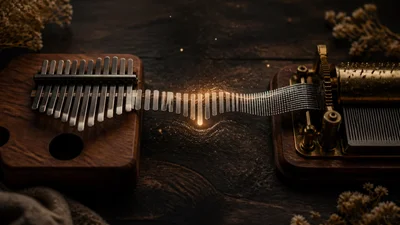
Two modelled tine instruments: kalimba and music box.

About

Two tuned-tine instruments on one modelled core: a kalimba, the thumb piano, and a music box with its comb. Play it from a keyboard or MIDI and switch between the two families with one control.

The idea

A kalimba key and a music box tooth are the same object: a short steel bar clamped at one end and free at the other, played by bending the free end aside and letting it go. A bar like that vibrates at 1, 6.27 and 17.55 times its fundamental, nothing like the even overtones of a string, so the attack of a plucked tine is a bright metallic cluster. Those upper partials die within tens of milliseconds, and what is left a moment later is very nearly a pure tone. That decay order is the sound, and the model is built around it.

What separates the two instruments is one ingredient each. The kalimba gets its buzz. The music box gets its comb: each tooth shares a root with its neighbours, so a struck tooth speaks as a slightly detuned pair and beats slowly.

Neither instrument has a chromatic keyboard. A 17-key kalimba has seventeen tines and nothing in between, which is exactly why a beginner can improvise on one. On the real boards, keys with no tine behind them stay silent rather than being rounded to a neighbouring note. A Chromatic board is included for playing it as a keyboard instrument; nobody builds one, and it is labelled that way.

Controls

  • Family switches between Kalimba and Music Box.
  • Board picks which notes have tines: Chromatic, Kalimba 17, Kalimba 8 or Music Box 18.
  • Pluck is how cleanly the tine is released: low is the soft pad of a thumb, high is a nail or a steel pin, with more of the bright attack.
  • Decay sets how long the tine rings, relative to the instrument's own decay. It stretches the fundamental more than the metallic attack, so long settings stay chime-like instead of turning into a bell.
  • Buzz adds the rattle of the kalimba's buzzers.
  • Mechanism is meant for the music box's pin-and-gear tick. It is not yet active in the current sound engine.
  • Body sets how much of the instrument's box you hear, and Width its stereo spread.
  • Release sets how quickly a note fades when you let go, like a thumb laid back on the tine. Level is the output.

Getting started

Play a few notes on the default Kalimba 17 board, then try the presets: Classic Kalimba, Buzzy Mbira, Soft Thumb, Deep Marimbula-ish and Wide Lullaby for the kalimba, Dream Box, Antique Music Box and Toy Ballerina for the music box. If a key makes no sound, that board simply has no tine for that note; switch to Chromatic to play every key.

Up to twelve notes can ring at once.

How it works.

Each note is a pluck burst convolved with an impulse response synthesised for that exact pitch. The burst is half a millisecond to three and a half of low-passed noise, dominated by a leading impulse, much shorter and brighter than any mallet in this roster, because a release is not a contact: the tine leaves the nail, and the only thing limiting the bandwidth is how cleanly it slips off. The impulse response is a bank of exponentially-decaying sinusoids at the clamped-free beam ratios 1, 6.267, 17.55 and 34.39, with the upper modes down 10 to 26 dB and gone within tens of milliseconds. Convolving one with the other is what excites them, which is why the Pluck control changes the balance of partials rather than only the brightness.

The music box's twin is a second, detuned copy of the whole bank at 1.0035 times each mode, about six cents, a beat every second or so at C6. Rendering both and letting them interfere is real interference between two detuned partials rather than a chorus applied afterwards, the same mechanism the handpan's ding uses for its octave shoulder and modal-ir.ts uses for a gamelan's ombak. It is added at every mode rather than only at the fundamental, because the shared comb root answers the tooth's whole bank.

The buzz layer is rendered from the note's own decay rather than mixed in beside it. Bounce rate and bounce amplitude both follow the fundamental's exponential, so a loud board throws the bead further and sooner and a fading one stops throwing it at all, the rattle dies at twelve per cent of the initial swing, well before the note does. Each bounce is a short ping at a pitch tied to the note, roughened with seeded noise so no two are the same object hitting the same spot. The layer rides the note's own amp gain, so damping the tine stops the rattle exactly as a thumb on the board does. At exactly zero no buffer is rendered, no PRNG draw is taken and no node is built.

The mechanism tick is the one thing here that precedes its note. A cylinder pin drags a tooth aside and then lets go, so the drag, the release click and the gear-train clatter belong twelve milliseconds before the pitch, which is why raising the Mechanism control delays the note rather than adding noise on top of it, and why setting it to exactly zero removes that delay along with the sound. A kalimba has no mechanism at all, so the control is inert on that family by construction rather than by taste.

Which note a key plays is decided before any of that, by the board's tine list. A MIDI note either has a tine or does not; there is no nearest-note substitution, because substituting would turn a seventeen-note diatonic instrument into a chromatic one with duplicates, which is precisely what a kalimba is not. An unmapped key allocates nothing and reports that it made no sound, and the face acknowledges the strike so a silent key reads as a board with no tine there rather than as a bug.

Every random sample in the path, the pluck burst, the rattle, the mechanism, comes from the SDK's seeded generator, forked by the cache key that asked for it, so a given setting always produces the same buffer and a cache hit is the same audio as a fresh render. Impulse responses are cached per family, note and the parameters that change the samples, and dropped wholesale when one of those moves. Voices are capped at twelve with oldest-first stealing, and a voice's nodes are freed on an eight-second tail cap with a short fade, or as soon as a note-off's release has run, whichever comes first.

What would you make with Kalimba?

Describe what you want to make. Build it with the Studio agent.

Goes well with.

Prototype

Nine tuned steel notes, with no extra tenth note.

Prototype

Modelled bronze instruments with flexible tuning.

Prototype

A pickup-position model for tuned tine voices.