In August, Felix joined a wonderful group of musicians, researchers, and makers at the Montreal Music Hackspace hackathon. The plan was ambitious: bring two experimental instruments into Maru, a MIDI loop generator and a beatbox whose drum sounds could morph together. We also wanted to try taking them onto two different hardware pedals.
Two generative models, two instruments, and two pedal targets in one weekend was a lot to take on. By Sunday, we had an early version working. It was rougher and less complete than we had hoped, but we had something to play, plenty of questions to take further, and a great experience meeting people who cared about making new musical tools.
A loop generator you could keep working with
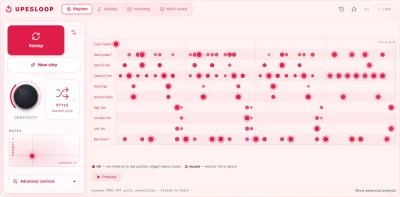
The first experiment was to bring MIDI-GPT into a loop-generating instrument. The model produces note patterns, giving you a phrase to start from and variations to explore.
We wanted the next interaction to matter as much as the first result. When a phrase catches your ear, you might want to develop it rather than replace it. The prototype let us explore generating a new pattern and requesting a variation from the one already on screen.
Because the output is MIDI, you can change the instrument playing it, move a note, or take the phrase into a DAW. That leaves the musician room to arrange what the model suggests. Our Learn guide to audio generation explores why editable notes and a generated recording give you different ways to continue working.
A beatbox that moves between sounds
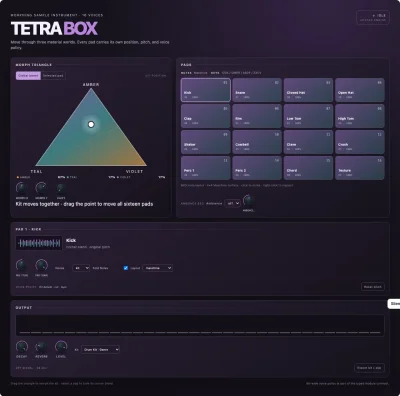
The second experiment focused on latent morphing for a drum machine. A latent is a model's compact representation of sound. Moving between those representations lets us generate intermediate sounds to explore, instead of choosing only one endpoint or another. How models see audio explains that idea in more depth.
The musical invitation was simple: keep a beat playing and move its sound through a shared triangle. Each corner represents a different character for the kit. The kick, snare, and hats move toward that character together, so one gesture can reshape the whole beat.
Imagine taking a familiar rhythm from tight, dry hits toward a softer, roomier texture. You keep the rhythm while exploring what a different set of sounds does to it. That was the experience we wanted to make convincing, both to play and to explain to people trying the prototype.
The weekend version used prepared generated sounds alongside synthesized material, and some planned kits still had stand-in sounds. We had the beginnings of the interaction, with more work ahead on the sounds themselves.
A big plan for a small weekend
Getting both generative ideas into playable instruments was already a substantial project. We also wanted to explore how they would feel on two hardware pedals: something you could reach for or control under your foot while playing.
That part remained unfinished. We left with early software prototypes, not two tested pedals. The weekend gave us a clearer sense of what needed attention next: stronger sound collections, easier access to the models, and time playing on the physical devices.
You can explore the instruments together in the weekend rack, with effects to shape the result. Try keeping the pattern steady while changing the beatbox's sound, then keeping the sound steady while asking for a pattern variation. The two instruments give you different ways to develop the same musical starting point.
The people made the weekend
The hackathon brought Felix together with Jacinthe Carlier, Kris Grant, Keon-Ju Maverick Lee, and Michael Zajner. Thank you to them and to everyone we met, shared ideas with, and talked music with over the weekend.
We aimed further than two days could take us. Still, getting an early version working and meeting so many people made the experience worthwhile. We came away wanting to keep developing the instruments and to do more of this kind of exploration with others.