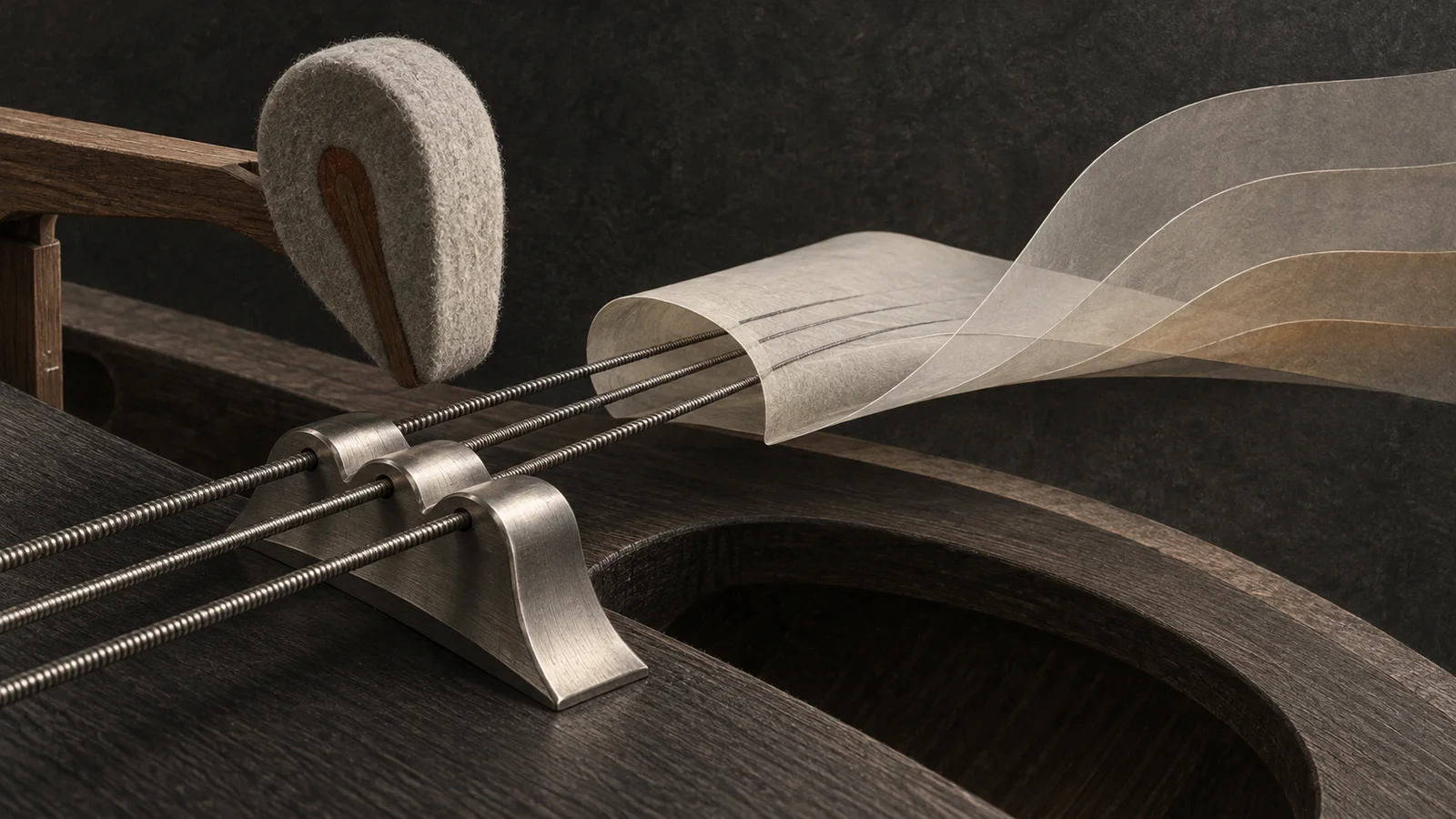
Strike a metal bar and listen past the attack. Several ringing components emerge and fade at different speeds. The pitch is only one part of the sound; the way those components sit together helps give the bar its character.
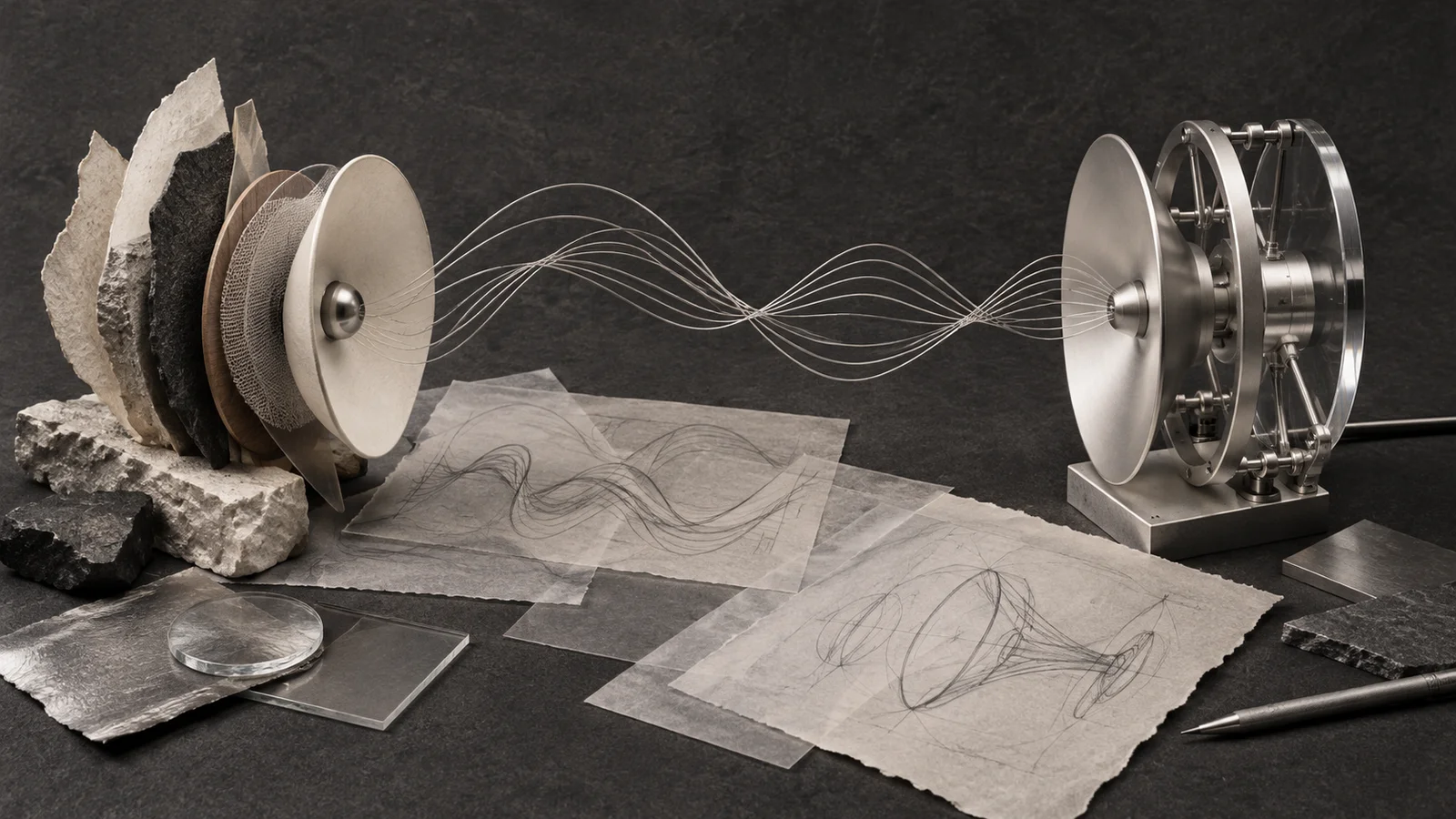
Our Gamelan instrument explores that character through a model of resonances, the vibrations that continue after the strike. You can change the strike, the ringing body, and the tuning. That opens a different kind of sound design: imagining how an instrument might behave.
Play the same note with a soft strike and a harder one in the example below. Listen beyond the initial hit: does the change alter the way the tail occupies the silence? Keep the listening level similar as you compare.
Hear the strike and the ringing tail
Gamelan
Start with Gong Ageng. Change Hardness and repeat the same note, leaving room for it to ring.
- Hardness 0.25
Brightness is more than a tone knob
A dark gong and a bright metallophone both ring, but turning down the treble on one will not turn it into the other. Their character also comes from the relationships between the ringing components.
Many familiar pitched sounds have overtones, tones above the main pitch, arranged near whole-number multiples of it. Metal instruments can have more irregular relationships between their resonances. Those relationships help explain why a gong or metallophone sounds different from a string playing the same note.
For a listening introduction to these relationships, see Timbre and harmonics in Learn. It explores how the components of a sound give the same note different characters.
A filter can make a sound darker, but it cannot by itself give an ordinary oscillator the ringing relationships of a bronze body. To explore that character, the model needs to describe which resonances appear and how they decay.
This gives the player several distinct decisions. A harder strike emphasizes a different balance of ringing components. A different strike position changes which components stand out. A larger modeled body can ring longer without simply moving every note down the keyboard.
That distinction matters in an arrangement. A harder strike may give a note a more prominent entrance; the ringing tail determines how much room you want to leave after it. Choosing the attack and choosing the space are related decisions.
Tuning belongs to the instrument
Gamelan traditions include slendro, with five scale degrees, and pelog, with seven. Their tunings vary between ensembles; these names do not describe one universal set of frequencies. A model with a fixed set of choices is an introduction to some relationships, rather than a substitute for the instruments and practices they come from.
The module makes tuning visible because it changes how you play. In its slendro and pelog settings, some keys on a chromatic keyboard remain silent: they have no corresponding scale degree in the mapping. The marked keys show where the available notes are.
That changes the invitation. Instead of searching through twelve familiar pitch classes, you work with a smaller set and begin hearing the spaces between them. Spend a minute playing a short phrase, then changing its rhythm while keeping the notes. A different note layout can encourage different habits without generating a phrase for you.
The motion between paired tones
Two tones close in frequency can create beating: a rise and fall in intensity as their vibrations interact. Deliberate tuning differences between paired instruments contribute to the shimmering character associated with some gamelan ensembles, though the practice varies across traditions.
The model's Ombak controls let you explore this motion. Increasing the beating rate changes how quickly the sound pulses; changing its depth changes how prominent the motion becomes. A slow shimmer leaves a different space around a phrase from a fast one.
Listen to a long note and notice how the motion sits inside its ringing texture. You can explore the same interaction between nearby frequency components in Oscillo's interval comparisons. There, a tuning change alters the motion inside a sustained pair of notes.
What modeling makes possible
A recording preserves a particular performance. A model lets you explore relationships that can be difficult to separate in that recording: the contact of the mallet, the size of the body, the decay, and the tuning.
A model of ringing bodies is one doorway into these sounds. Gamelan ensemble music also depends on the relationships between players, instruments, rhythm, and form. Exploring the controls can lead you toward that music; the instrument is not a complete account of its practice.
For Maru, the next question is how a modeled instrument can encourage a different way of writing. A long decay might invite fewer notes. A different strike can make the same phrase feel more insistent. We want the controls to open those choices to a player.
Listen to the space after a note
Return to the example and make a short phrase from three strikes. First leave room for each tail; then let the notes overlap. Choose a rhythm around the decay you want to hear. In the full Gamelan instrument, you can also explore the marked notes in a slendro setting.
Leave enough silence to hear what the instrument is doing. You may find that the ringing tail, rather than the next note, becomes the material you want to arrange around.