PreorderEffect

Pocket

Sidechain that gives the room back in the groove.

Play

Includes beta access today and the finished release at launch.

The demo is a beta preview of what you are preordering.

How to use Pocket

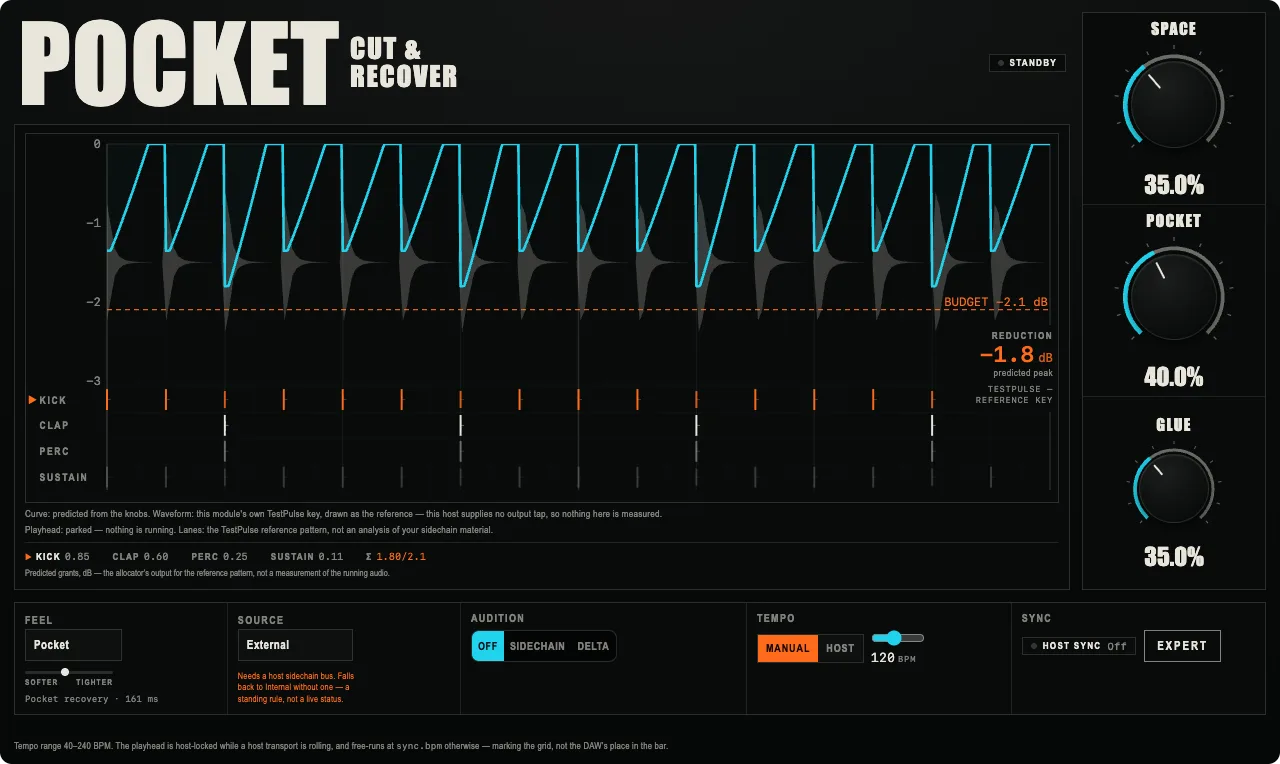
Pocket interface

What it does

A groove-aware ducking effect. It listens for the kick and the clap, makes a little room for them in whatever it is inserted on, and gives that room back in time with the beat: the recovery follows a note division and a feel rather than a fixed release in milliseconds.

The idea

Classic sidechain ducking works best when it is subtle. Pushing past two or three decibels per hit starts to sound like pumping, and around six decibels the effect becomes obvious. Pocket is built around that: you set a reduction budget and it never exceeds it, even when several hits land at once.

Pocket is not a generic unmasker that compares spectra. It assumes the drums matter, detects when they hit, and schedules the recovery musically. Below a crossover point the low end is ducked as one mono band, so a bass stays full and centred between kicks. Higher up, with Glue raised, the reduction is shaped into a few narrow cuts instead of a broadband dip, so a pad keeps its density.


Works with

  • Your browser: it plays on this page, with nothing to install.
  • Planned for the finished release: VST3, CLAP, Standalone app.

What you get

  • A playable browser preview
  • Sidechain dynamics shaped for musical movement
  • Native plugin formats planned for release

Preorder pricing is discounted and increases at launch. Your feedback during beta helps shape the finished release.

Perpetual license. One-time acquisition. Keep using the major version you acquire, with no subscription required. Future major versions and online services may be offered separately.

Guide and controls

How it works.

Four detector lanes listen to the sidechain in their own bands - kick, clap and snare, high percussion, and sustained energy - and each one asks for a share of the reduction. The lanes are level-independent by design, so the depth you get does not change when the drum bus gets louder.

Those requests are not simply added together. A weighted soft-knee allocator grants them against a single budget set by the Space macro, so simultaneous hits cannot accumulate into a hole. The budget is never exceeded, and the face draws its ceiling as a hard line because that is a product claim rather than an implementation detail.

Recovery is the part that makes it musical. Instead of a fixed millisecond release, the duck recovers over a note division shaped by feel - Tight snaps, Laid Back hangs, Open moves continuously - with MPC swing displacing alternate recoveries and an adaptation term that follows the detected spacing between kicks when the passage changes tempo feel.

The low end is handled separately. An LR2 crossover splits off a mono band below the crossover point and the broadband duck is applied there, which is what keeps a bass full and centred between kicks; above it, when Glue is high, the reduction is delivered through block-rate bells instead, so a pad's density survives what would otherwise be a hole.

The Groove Scope is a prediction, not a measurement, and it says so. It is computed from the same parameters the audio runs on, so it is correct the instant the page paints - and where no host supplies an output tap the caption states plainly that nothing on screen is measured, rather than drawing a convincing trace.

What would you make with Pocket?

Describe what you want to make. Build it with the Studio agent.

Goes well with.

Prototype

A full dynamics compressor with a filterable detector.

Prototype

Six bands, a curve you can drag, and a bit-exact bypass.

Building block

A compressor with visible gain reduction.

Sparklizer

$39 preorder

A stereo delay that bounces, with the bounce drawn.