A granular instrument: it cuts a recording into tiny grains and replays them as a cloud you play from a keyboard. Pick a guitar take, a piano, a voice or a field recording, choose where in it the grains come from, and shape the cloud with size, density, pitch and direction.
The idea
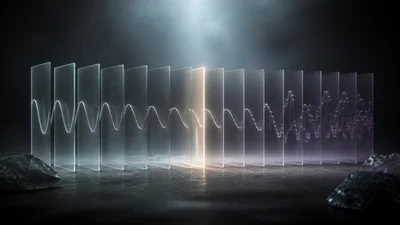
Granular synthesis treats a recording as material rather than a timeline. Each grain is a short slice, a fraction of a second, wrapped in a smooth envelope. Launch a few per second and you hear a rhythm of fragments; launch many and they blur into a continuous tone. Short grains turn pitch into timbre, long grains keep the source recognisable.
There are two ways to choose which grains play:
- Time picks grains from a position in the recording. Position sets where, Spray scatters grains around it, and Scan drifts through the recording while a note sounds, forwards or backwards. You can also drag the waveform directly.
- Similarity lays every slice of the recording out on a map by how it sounds, so neighbouring points are grains that sound alike. Move the circle and set its Radius to play from one region of sound rather than one moment in time.
Pitch Match
Tuned finds grains that hold a clear note and shifts each one to the key you play, so a guitar take becomes a playable instrument. With Keytrack off, every key plays at C4. Original plays grains at the interval from C4, which suits chords, attacks and textures. Tuned works best on sources with clear single notes: the source picker shows how much of each recording is tonal, and sources with none switch to Original automatically.