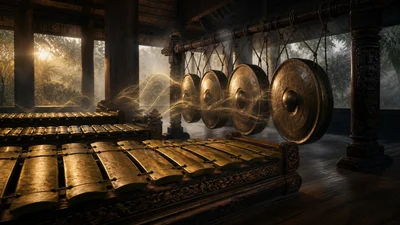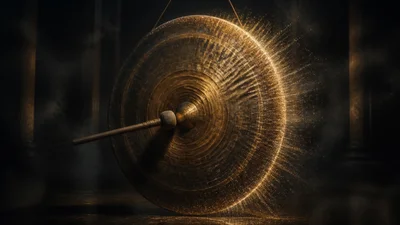
A rack of modelled gongs, built around the two behaviours that make a gong sound like a gong: the tam-tam's shimmer that swells in after the strike, and the Chinese opera gong's pitch that slides as the note decays. Six plates, four beaters, and a strike position from the centre to the rim.
The idea
A gong is not a big bell. Two of its most recognisable sounds depend on how hard you hit it, so a simple model of ringing partials cannot produce them at any setting.
The first is bloom. A tam-tam beater puts its energy into the low modes, and the hammered metal then passes that energy upward into the high modes over hundreds of milliseconds to seconds. The shimmer grows while the low end decays: the gong gets brighter after the attack. A quiet strike barely blooms; a hard one with a soft beater blooms most of all.
The second is pitch glide. A large, flat-centred opera gong, the daluo, gets stiffer when it is struck hard, so it starts sharp and sags down to pitch as it decays. The small, domed xiaoluo does the opposite: it starts flat and slides up. The harder you hit, the further it moves.
The gongs
- Tam-Tam: the big orchestral wash, with the strongest bloom and a long ring.
- Wind Gong: a thin, flat plate with a fast splash.
- Daluo and Xiaoluo: the opera pair, gliding down and up.
- Gong Ageng: the Balinese great gong, with near-harmonic low partials and a slow beating shimmer called ombak. Its lowest partials follow published measurements; the other plates are designed from the research.
- Symphonic: an orchestral gong with a clear fundamental under the shimmer.
Controls
- Mallet: Yarn, Felt, Wood or Metal. Each changes the contact time, the brightness of the strike and how much bloom it sets off. Yarn is almost all swell and no impact; Metal is all impact and no swell.
- Position moves the strike from the boss, the raised centre, at 0 to the rim at 1. Near the rim the fundamental drops away and the upper modes carry the sound.
- Size, Decay and Damping set how big the plate is and how long and freely it rings. Width spreads it in stereo.
- Vel Tone sets how much playing harder brightens the strike. Roughness adds a little surface scrape to the contact.
- Bloom and Bloom Time set how much of the high shimmer arrives late and how long it takes. Glide, Glide Depth and Glide Time scale the pitch slide; the plate decides its direction.
- Ombak and Ombak Rate set the beating between paired copies of each mode.
- Stiffness / Curvature, Nonlinear Coupling, Edge Loss and Radiation Tilt reshape the plate's modes for sound design.
- Ring sets how much the player damps the gong while the key is held, and Damp Time how gently it is damped at key-up. At the top of the Ring range the gong simply rings out, the normal way to play it.
- Base Pitch sets the frequency of A2. Every key sounds, in equal temperament, so the keyboard works as a continuum of gong sizes rather than a scale.
- Fixed Velocity and Velocity pin strikes from the panel to one repeatable force.
- Level sets the output.
Getting started
Play it from a keyboard or MIDI. Start with Tam-Tam Yarn and a hard strike, and listen for the shimmer arriving after the hit. Then compare Tam-Tam Rim Shimmer, Daluo Theater and Xiaoluo Rising, played hard and then soft. Gong Ageng Wadon, Great Tam, Wind Gong Splash, Table Gong, Symphonic Swell and Metal Beater Clang cover the rest of the rack. Up to six gongs ring at once.