Behringer KICK is an MPC-style standalone music workstation, and Music Tribe has put its software source on GitHub. The familiar part is the box: pads, sampling, sequencing and a touchscreen. The interesting part is the invitation to build on the software inside it.
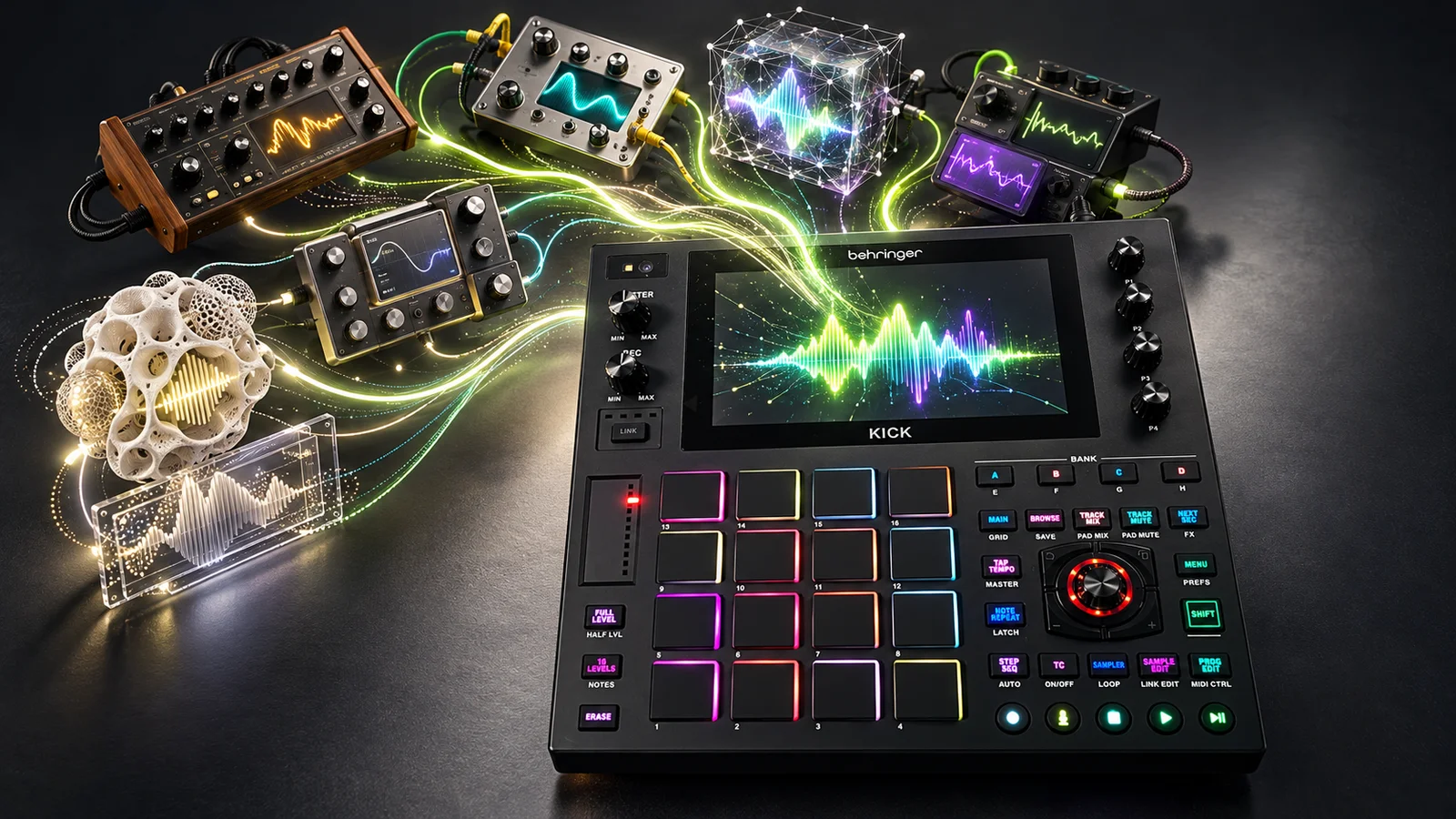
Concept artwork imagining custom instruments, community plugins and AI audio models flowing into KICK. These are possibilities we are exploring, not released features. Device reference: Music Tribe.
We are still at the first-look stage. The source release gives us something concrete to explore, rather than a finished Maru export target. But it is an exciting time for people interested in making software for musical hardware.
The MPC influence is hard to miss
KICK follows the MPC-style layout closely: a 4×4 pad grid below the screen, four knobs down the right, a jog wheel, bank buttons, note repeat and transport controls. It looks like a machine for chopping samples, playing drums and putting a track together without reaching for a computer.
That familiarity is part of the appeal. A new instrument or effect could use a layout that beatmakers already understand. The question is what developers will be able to add, and how well those additions will fit into the sampling and sequencing workflow.
A different starting point for custom software
Publishing the software gives people a way to explore how KICK could change over time. New instruments, different effects, a sequencer that works another way: these become things a community can investigate, rather than requests that only the manufacturer can act on.
There is work ahead before those possibilities become software you can install. But the prospect is exciting: a familiar workstation could become a home for ideas from many different musicians and developers.
What we are exploring at Maru
We are looking at where Maru could be most useful: effects for sampled loops, drum and bass instruments, or MIDI tools for chords and rhythm. We have not settled on the best first project yet. We want to understand what fits the hardware and what people would actually want to use.
One idea that sounds particularly fun is an expressive synth played across the sixteen pads. Hold a chord, then use polyphonic aftertouch to brighten one note, add movement to another, or bring out a melody while the others keep sounding. We would love to explore an MPE synth around that kind of interaction. The expression handling and the feel of the pads would still need to be developed and tested on KICK.
Prototype before you have the device
You do not need a KICK on your desk to start working on the sound. With the Maru Engine, you can develop an instrument or effect, audition it in the browser, play it from a MIDI controller, and keep changing the sound and controls. That makes for a quick loop: try an idea, play it, change what does not work, and try again.
For the pad synth, we could develop the voices and sound controls this way before bringing them to KICK. Browser prototyping will not tell us how its pads feel or how much processing the device can handle, but it lets us make progress on the instrument while the hardware integration catches up.
We are working toward an easy way to export Maru creations to KICK. Early compilation tests are encouraging, but we have not run our software on the device yet. There is no Maru KICK download or export option available today.
From the FM-1 to KICK
The M-VAVE FM-1 firmware community already shows why this is worth exploring. A pocket keyboard can become a different instrument when someone writes new software for it. Our directory brings together community projects and their demos, while our own FM-1 firmware and export work remains experimental.
KICK offers a different format: more room for a sample-based workflow, a larger screen and a pad grid. We are interested in both kinds of device. A small keyboard might suit a portable synth; a workstation might suit a performance instrument or a collection of effects.
Our hardware direction is to help more people build those tools without starting a whole firmware project from scratch. Develop the musical idea in Maru, adapt its controls to the device, and test it where people will actually play it. Each device still needs its own integration, but creators should be able to spend more time on the instrument they want to make.
The physical controls matter too. Our article What changes when an instrument becomes a pedal? looks at how the same musical idea changes when you put it into a different kind of box.
For now, we have opened a KICK software directory. It starts with the official source release; we will add custom software as projects appear and their availability becomes clear.
If you are working on something for KICK, or have a specific idea you would like to try, tell us about it. We are interested in hearing what would make this kind of workstation more useful to you.
Maru is not affiliated with or endorsed by Behringer or Music Tribe.