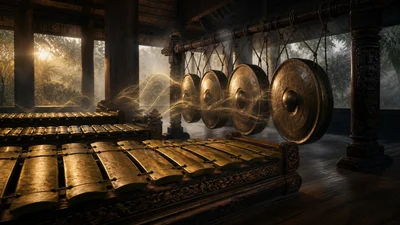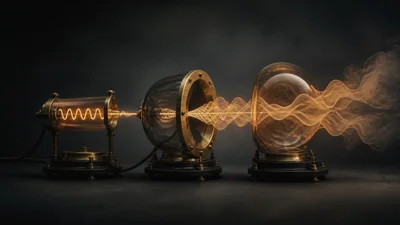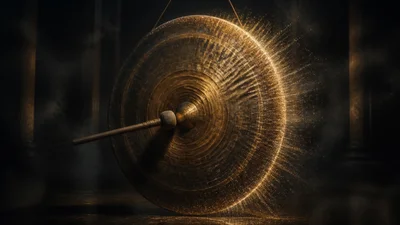
A rack of modelled gongs, built around the two behaviours that make a gong sound like a gong: the tam-tam's shimmer that swells in after the strike, and the Chinese opera gong's pitch that slides as the note decays. Six plates, four beaters, and a strike position from the centre to the rim.
The idea
A gong is not a big bell. Two of its most recognisable sounds depend on how hard you hit it, so a simple model of ringing partials cannot produce them at any setting.
The first is bloom. A tam-tam beater puts its energy into the low modes, and the hammered metal then passes that energy upward into the high modes over hundreds of milliseconds to seconds. The shimmer grows while the low end decays: the gong gets brighter after the attack. A quiet strike barely blooms; a hard one with a soft beater blooms most of all.
The second is pitch glide. A large, flat-centred opera gong, the daluo, gets stiffer when it is struck hard, so it starts sharp and sags down to pitch as it decays. The small, domed xiaoluo does the opposite: it starts flat and slides up. The harder you hit, the further it moves.
The gongs
- Tam-Tam: the big orchestral wash, with the strongest bloom and a long ring.
- Wind Gong: a thin, flat plate with a fast splash.
- Daluo and Xiaoluo: the opera pair, gliding down and up.
- Gong Ageng: the Balinese great gong, with near-harmonic low partials and a slow beating shimmer called ombak. Its lowest partials follow published measurements; the other plates are designed from the research.
- Symphonic: an orchestral gong with a clear fundamental under the shimmer.