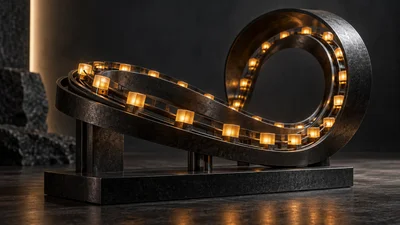
A physics sequencer: balls fall from a hose, bounce down a set of tuned planks, and every contact plays a note. Arrange the planks and the falling balls write the score. It needs no audio or MIDI input; press Play and it plays itself.
The idea
Each plank is tuned to a pitch, and each strike sounds an electric-piano tone from Maru's four-operator FM Keys synth. A ball's position when it hits sets where the note sits in the stereo field, and how hard it hits shapes the note. Move a plank and the path changes; change its slope and the balls roll off toward a different neighbour. The result is a melody that follows the physics rather than a grid.
Controls
- Hose position and Drop rate set where balls fall from and how many drop each second.
- Gravity and Bounce change how fast balls fall and how much energy they keep after each contact.
- Six planks, the first three switched on to start. Select one to set its horizontal position, height, length, slope and pitch.
- Brightness, Decay and Level shape the notes.
- Rolling strikes, off by default, adds extra notes while a ball rolls along a plank.
Getting started
Press Play on the transport and listen to the default three-plank scene. Then switch on a fourth plank, tune it, and move it under the path of the falling balls. Lower the drop rate for a sparse, clear line, or raise gravity and bounce for a busier pattern.
Physics Playground's stereo output is an ordinary audio output, so you can send it through another module, such as Room Acoustics, to place the impacts in a space.
Saving a preset saves the scene and sound settings, not the current ball positions. Up to twelve balls are in play at once; if the arena fills, new drops wait until a ball settles, and some plank layouts can trap balls. Move a plank or restart to clear a blocked scene.