@maruSparklizer
Early accessEffect

Sparklizer

A stereo delay that bounces, with the bounce drawn.

Made with Jazz Calls Home

This is an early-access release. You can use the plugin today, but some bugs or compatibility issues may remain.

How to use Sparklizer

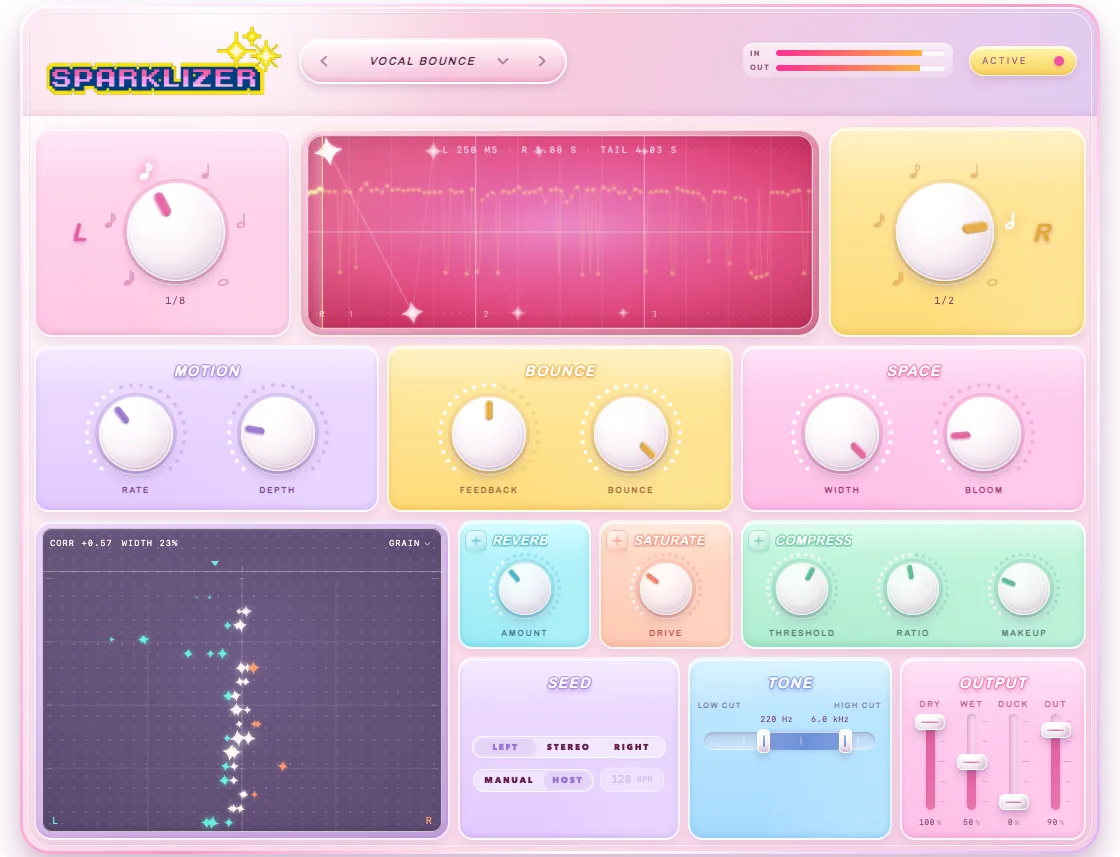
Sparklizer interface

What it does

A bouncing stereo delay for vocals, percussion and melodic phrases, developed with Jazz Calls Home. Give the left and right echoes different rhythmic divisions, then let them feed each other across the stereo field.

The idea

Sparklizer runs two tempo-synced delay lines, one per side, each on its own note division of the same tempo. Bounce feeds each line into the other, so a repeat born on the left comes back on the right and then on the left again, instead of simply alternating. Because the two sides use different divisions, the pattern is deliberately not symmetric.

Tone filters sit inside the feedback loop, so every repeat comes back a little thinner and darker than the last and recedes behind the lead instead of piling up under it. Duck keeps the echoes out of the way while you sing and lets them bloom in the gaps.

Made with

Jazz Calls Home, the artist behind this collaboration

Jazz Calls Home

Spanish-Colombian experimental pop artist and sound sculptor

“I wanted one plugin that would recreate this effect for me every time, without a whole plugin chain or multiple tracks to get there.”

Works with

  • Your browser: it plays on this page, with nothing to install.
  • Plug-in formats in development: VST3, CLAP, Standalone app.

What you get

  • Two delay lines on two note divisions of one tempo, cross-feeding into each other
  • Bounce Scope: the repeat train drawn on a beat grid before you hear it
  • Tone shaping inside the loop, so repeats thin and darken as they age
  • Width, bloom and a duck from the dry input, on the wet path only
  • A post-delay chain in the same plugin: reverb and saturation with one amount each, and a compressor with Threshold, Ratio and Makeup
  • The compressor runs last, where its makeup gain brings the delay feedback up in volume
  • The factory bank Jazz voiced, including the settings from her own sessions

This plugin is available in early access. Your feedback helps us improve the release.

Perpetual license. One-time acquisition. Keep using the major version you acquire, with no subscription required. Future major versions and online services may be offered separately.

Part of

Bundle

The Sparklizer bundle

Get Sparklizer, the whole vocal delay chain in one plugin, together with Bounce Room for less than buying them separately.

$45 preorder

Drum and MIDI bank

Bounce Room

Dry drums and flexible MIDI loops made to leave room for repeats.

$19 preorder

Guide and controls

How it works.

Both lines are cut from one grid. `sync.left` and `sync.right` select sixteen divisions, shortest first: six straight-note major marks with triplet and dotted minor steps between them. Times are the beat times the division. Six-second delay lines preserve literal timing across the full tempo range, including a whole note at 40 BPM.

Feedback and Bounce are two different questions about one number. Feedback is the gain per pass, capped at 0.95 because with the loop filter in the path this module rains rather than self-oscillates. Bounce splits that gain between re-entering the same line and crossing to the other one, and the split is level-preserving, so moving it changes where the tail travels without changing how long it lasts.

Tone is inside the loop, not after it. A second-order high-pass and low-pass sit before each line, so every pass thins and darkens a little more and the repeats recede behind the lead instead of accumulating under it. The 220 Hz default low cut is the interview's own setting, chosen so repeats never mud the mix.

Motion is a sine LFO on each line's read position, the two sides in quadrature, mapping depth onto up to six milliseconds of swing. Because it modulates inside the loop, a repeat swirls further the longer it has been alive - which is the phaser-like behaviour the producer described, rather than a static chorus on the output.

Width and bloom touch the wet path only, so the dry lead's image is never smeared, and Duck is a sidechain from the dry input onto the wet level - up to 18 dB down with a 220 ms release, so repeats step aside while the vocal is singing and come back up in the gaps. Quadrature phase, bloom-after-width order, the duck timing and the feedback ceiling are fixed by design and are not knobs.

The chain stages sit after the dry and wet paths are summed and before the output trim, in one fixed order: reverb, then saturation, then compression. Reverb and saturation are a toggle and a single amount; compression is a toggle with Threshold, Ratio and Makeup, and it runs last because its makeup gain brings the delay feedback up in volume rather than pushing the lead down. Off skips a stage entirely rather than running it at unity, so with all three off the render is sample-for-sample the one the module produced before the chain existed.

Every derivation - seconds, hertz, linear gains, the feedback split - lives in one `expandParams` function in the plugin's schema, which this page, the panel's scope and the compiled kernel all agree on, so a knob means the same thing in a DAW as it does here and as the scope draws it.

What would you make with Sparklizer?

Describe what you want to make. Build it with the Studio agent.

Goes well with.

Guitarabin

$49 preorder

A fixed pedalboard for spacious guitar.

Building block

Adjust stereo width without changing the dry signal.

Building block

A bounded feedback delay for repeats and ambience.