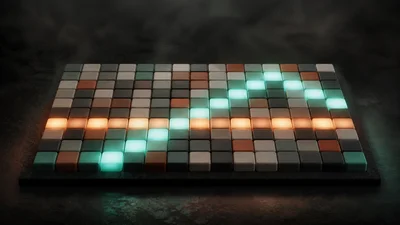
A 32-step MIDI pattern sequencer in the mould of Reason's Matrix. It writes its own lines, with note, velocity, gate and curve lanes, per-step ties and ratchets, and 32 patterns in four banks, and plays them on its own clock. Pair it with an instrument to hear it.
The idea
An arpeggiator rearranges the notes you hold, and stops when you let go. Stepper is a generator: it plays its pattern whether or not a key is down. A held key can instead transpose the whole pattern, relative to C3, when Key follow is on.
Each step carries a pitch, a velocity (zero is a rest), a gate length, a tie to the next step, a curve value and a ratchet of one to eight quick repeats. The curve lane is sent as a MIDI CC of your choice, so it can sweep a filter or any other mapped control, and it only sends when the value changes.
Controls
- Run starts and stops the sequencer; Tempo runs from 20 to 300 BPM.
- Resolution sets the step length, from 1/2 to 1/64, including triplet and dotted values. Shuffle delays every other step, MPC style.
- Pattern picks one of 32 patterns, banks A to D with eight each, and Length sets how many of its 32 steps loop.
- Chain plays a range of patterns one after another.
- Direction: forward, reverse, pendulum, pendulum with repeated end steps, random, or a brownian walk that wanders one step at a time. Random and brownian follow a Seed, so the same seed plays the same walk.
- Transpose, Octave range (1 to 5), Gate scale and Velocity scale reshape the whole pattern at once.
- Key root and the scale lane quantize the notes into a key, from chromatic to major, minor, modes, pentatonics, blues and whole tone, so a written line can move into a new key without editing every step.
- Curve CC and Curve bipolar set where the curve lane goes and whether it is centred.
Pattern contents are edited in the grid and saved with the module. The loop length and the 32 velocities of the selected pattern are also exposed as ordinary parameters, so they can be automated from a host.
Getting started
Stepper produces MIDI only: route it into an instrument. The first pattern is a rising minor-pentatonic line in A with a couple of ties and ratchets, so pressing Run plays something right away. Try changing Direction, then set a key and scale and watch the line fold into it. The other 31 patterns start empty and ready to fill.