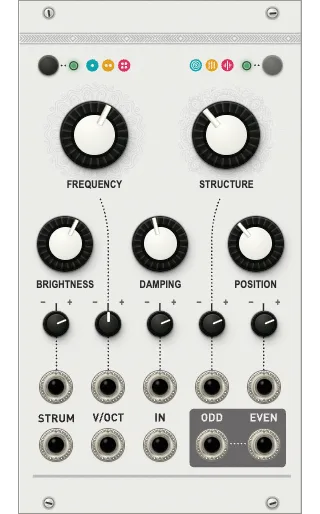
A macro-oscillator voice for the modular rack, adapted from Mutable Instruments' Plaits, designed by Emilie Gillet. It currently offers two of the original sound engines, virtual analog and additive, on a 12 HP panel with a built-in low-pass gate. It is an independent adaptation, not an official Mutable Instruments product.
The idea
Plaits gives every sound engine the same three macro controls, Harmonics, Timbre and Morph, and their meaning changes with the engine. Each engine also has two outputs: OUT for the main sound and AUX for a related variant.
- Virtual analog pairs two classic oscillators. Harmonics detunes them against each other, gliding through musical intervals such as fifths and octaves, and Timbre and Morph reshape their waves. AUX carries a hard-synced version of the sound.
- Additive builds the sound from a spectrum of sine partials. Harmonics sets how many peaks the spectrum has, Timbre moves them up and down the harmonic series, and Morph tilts the balance between them. AUX plays a sparser, organ-like spectrum.
The model button switches between the two engines.
Controls
- Frequency sets the pitch, with V/OCT for note control from a sequencer or keyboard module.
- Harmonics, Timbre and Morph are the macro controls above, each with its own CV input.
- FM amount, Timbre amount and Morph amount set how strongly their CV inputs move frequency, timbre and morph.
- TRIG strikes the internal envelope and low-pass gate, for plucked and percussive notes, and LEVEL controls the gate directly from a CV. The small settings button exposes Decay and LPG colour.
Getting started
Patch a gate or trigger into TRIG and a pitch source into V/OCT, then take OUT or AUX to the rest of your rack. Start from Default for virtual analog, or Harmonic spectrum for the additive engine, then sweep Harmonics, Timbre and Morph to hear how each engine responds.
The original module has many more engines. Here, selecting any engine other than virtual analog or additive, for example through Model CV, gives silence until you return to a supported one.