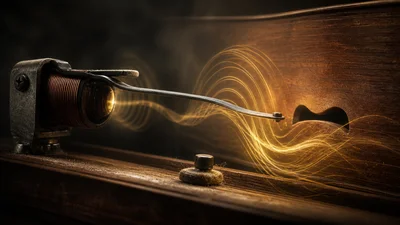
A modelled electric piano built around the part that gives one its voice: the magnetic pickup beside each tine. Where that pickup sits decides whether a note is a clean bell or a growling bark, and how hard you play moves you between the two.
The idea
In an electric piano a hammer strikes a stiff steel tine, and a heavier tonebar tuned to the same note keeps ringing after the attack fades. The sound people talk about comes from the third part, the pickup a few millimetres from the tine's free end.
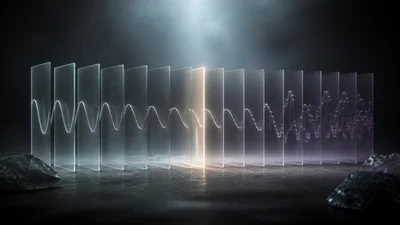
A pickup does not respond to the tine's motion in a straight line. Set it close and the swing covers a strongly bent stretch of its response, and the note growls. Back it off and the same swing stays in an almost straight stretch, and the note is a bell. Line it up with the tine's rest position and it produces odd harmonics; set it off-centre and even harmonics come in, which is the bark.
That is also why velocity here is more than volume. A quiet note swings the tine a little and stays in the gentle middle of the curve; a hard note reaches the bent ends and barks. Same key, same settings, a different place on the same curve. The plot on the panel shows which stretch of the curve the note you just played is using. As on the real instrument, the curve also compresses: a loud chord comes out proportionally quieter than it went in.
Controls
Tine
- Hammer: how hard the hammer tip is. A soft tip gives a round note with no tick; a hard one lights up the metallic attack. Playing harder hardens the tip as well.
- Decay: stretches or shortens the ring of tine and tonebar.
- Tonebar: how much of the tonebar's sustaining body is in the sound. At zero you hear the bare, glassy tine. The bar is tuned a hair sharp, so a slow beat sits under every held note.
Pickup
- Distance: close for growl, far for bell.
- Symmetry: aligned for odd harmonics and a bell; offset for the even harmonics of the bark.
- Drive: the preamp behind the pickup, pushed. It thickens the growl rather than creating it, and is level-compensated.
Tremolo and output
- Tremolo Rate and Tremolo Depth: the cabinet tremolo, which is really a stereo auto-pan between two amplifiers, so it swirls rather than pulses. At zero depth it is off.
- Level: the final output level.
Getting started
Play Tines from a MIDI keyboard or the on-screen keys; it plays up to eight notes at once. Start with Mellow for the ballad sound, then try Bark and play softly and then hard to hear the pickup take over. Other presets: Glassy, Suitcase (deep stereo tremolo), Driven, Modded Bright, Ballad Bell and Short Tine, a damped plink for playing lines.