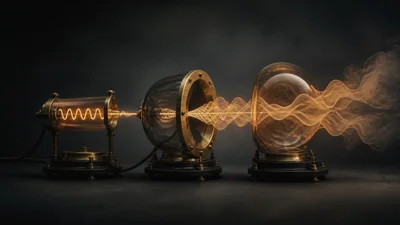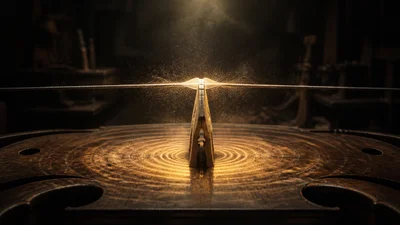
A plucked string, modelled rather than sampled. Each note is a pick striking a virtual string that rings, loses its brightness and fades the way a real one does, from nylon guitar and harp to koto, bass and buzzing sitar wire.
The idea
Pluck uses extended Karplus-Strong synthesis: a short burst of energy, the pick, sent into a delay line one period of the note long, with filters in the loop for loss and stiffness. Because the sound comes from a model of the string, every control is a physical property rather than an effect added afterwards. Pluck position is not an EQ, damping is not a fade, and stiffness is not a detune.
Pluck position shows this best. Where you pluck decides which harmonics can exist at all: pluck a fifth of the way along and the 5th, 10th and 15th harmonics are not quieter, they are gone. The panel plots that pattern from the same maths the string uses.
Low notes behave differently from high ones, as on a real instrument. A bass string is thick for its length, so Stiffness stretches its partials audibly at the bottom of the keyboard and barely at all at the top, and low strings lose more of their upper partials on every trip along the string.
Controls
- Hardness is the pick: a hard plectrum gives a sharp, bright attack, a soft fingertip a rounder one. Playing harder also makes the note brighter, not just louder.
- Pick Noise adds the scrape of a nail or pick.
- Position is where along the string you pluck, from near the bridge to the middle.
- Brightness sets where the string starts losing its upper partials, and Damping how strongly. Together they decide how quickly the tone darkens as it rings.
- Stiffness stretches the partials, from a soft gut string to wire.
- Sustain is how long the string rings, up to eight seconds.
- Body adds the resonance of an instrument body.
- Width spreads the sound across the stereo field, and Level sets the output.
Each note takes its settings at the moment it is plucked, as a real string does: changing a control affects the next notes, not the ones already ringing. Pluck plays up to twelve notes at once.
Getting started
Play Pluck from your computer keyboard or a MIDI controller. Start with Nylon, then try Steel, Harp, Koto, Muted or Bass. Glass Harp plucks dead centre, so every even harmonic disappears, and Sitar Wire turns Stiffness all the way up until the partials buzz.