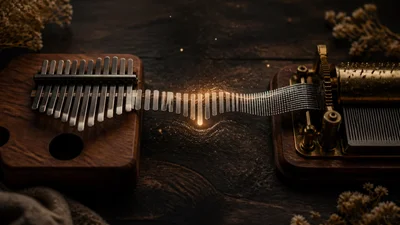
Two tuned-tine instruments on one modelled core: a kalimba, the thumb piano, and a music box with its comb. Play it from a keyboard or MIDI and switch between the two families with one control.
The idea
A kalimba key and a music box tooth are the same object: a short steel bar clamped at one end and free at the other, played by bending the free end aside and letting it go. A bar like that vibrates at 1, 6.27 and 17.55 times its fundamental, nothing like the even overtones of a string, so the attack of a plucked tine is a bright metallic cluster. Those upper partials die within tens of milliseconds, and what is left a moment later is very nearly a pure tone. That decay order is the sound, and the model is built around it.
What separates the two instruments is one ingredient each. The kalimba gets its buzz. The music box gets its comb: each tooth shares a root with its neighbours, so a struck tooth speaks as a slightly detuned pair and beats slowly.
Neither instrument has a chromatic keyboard. A 17-key kalimba has seventeen tines and nothing in between, which is exactly why a beginner can improvise on one. On the real boards, keys with no tine behind them stay silent rather than being rounded to a neighbouring note. A Chromatic board is included for playing it as a keyboard instrument; nobody builds one, and it is labelled that way.
Controls
- Family switches between Kalimba and Music Box.
- Board picks which notes have tines: Chromatic, Kalimba 17, Kalimba 8 or Music Box 18.
- Pluck is how cleanly the tine is released: low is the soft pad of a thumb, high is a nail or a steel pin, with more of the bright attack.
- Decay sets how long the tine rings, relative to the instrument's own decay. It stretches the fundamental more than the metallic attack, so long settings stay chime-like instead of turning into a bell.
- Buzz adds the rattle of the kalimba's buzzers.
- Mechanism is meant for the music box's pin-and-gear tick. It is not yet active in the current sound engine.
- Body sets how much of the instrument's box you hear, and Width its stereo spread.
- Release sets how quickly a note fades when you let go, like a thumb laid back on the tine. Level is the output.
Getting started
Play a few notes on the default Kalimba 17 board, then try the presets: Classic Kalimba, Buzzy Mbira, Soft Thumb, Deep Marimbula-ish and Wide Lullaby for the kalimba, Dream Box, Antique Music Box and Toy Ballerina for the music box. If a key makes no sound, that board simply has no tine for that note; switch to Chromatic to play every key.
Up to twelve notes can ring at once.