← All modules

@maru shared this instrument so you can build on it and use it in your DAW.

AvailableInstrument

Bells

A bell voice whose chord stays minor in any key.

About

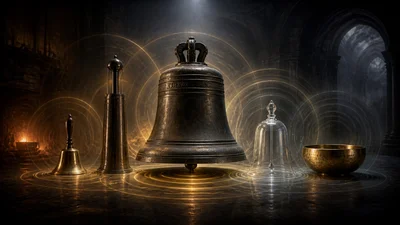
A playable bell instrument with five families: carillon, tubular bells, handbells, glass and a singing bowl. Each family is its own set of partials, so switching between them changes the instrument rather than the tone colour.

The idea

A church bell sounds like a church bell because of one interval. A founder tunes five partials by name, hum, prime, tierce, quint and nominal, and the tierce is a minor third. So a carillon rings a minor chord over whatever note it is pitched at, in a major piece as readily as a minor one. Bells repeats that idea with different tables: change the ratios and you change the instrument.

  • Carillon is the tower bell, with the minor-third chord and a long hum.
  • Tubular Bells are orchestral chimes. Their pitch is one the ear infers from the upper partials; the tube's own low modes sit below the note you played and read as the knock under the attack.
  • Handbells are tuned to the twelfth instead of the octave, with no tierce and no hum, so they are consonant and die away quickly.
  • Glass is near-harmonic, thin and short.
  • Singing Bowl splits every mode into a pair a fraction apart, so the two halves beat against each other in the slow warble a bowl is known for.

Controls

  • Bell picks the family.
  • Position is where the clapper lands: the soundbow wakes the whole chord, higher up the waist leaves a thinner, brighter clang. It changes the timbre, not just the brightness.
  • Clapper runs from muffled leather or felt to bronze or steel. Harder clappers reach further up the partials. Playing harder also makes the strike harder, so quiet notes are genuinely duller, not only quieter.
  • Contact adds the metallic tick of the clapper before the bell answers.
  • Ring sets how long the bell sounds, from a hand on the bell to a bell hung free in a tower. Damping sets how fast the partials lose energy.
  • Casting is the size of the bell. A bigger bell rings longer and its partials sit closer to the harmonic series; the played pitch stays put.
  • Width spreads the resonance in stereo.
  • Release is how quickly a note fades when you let go. Left alone, a note rings out on its own.
  • Level sets the output.

Getting started

Bells is played from a keyboard or MIDI. Start with Cathedral Carillon, then try Evening Chimes for tubular bells, Choir of Handbells, Glass Hour, Toy Glockenspiel or Meditation Bowl. Deep Bourdon is the biggest bell in the tower, with a hum that will not stop.

Tuning is twelve-tone equal temperament at A4 = 440 Hz.
How it works.

Each note is a clapper strike convolved with an impulse response synthesised for that exact note: one and a half to twelve milliseconds of low-passed noise with a leading tick, driving a bank of exponentially-decaying sinusoids placed at the selected family's measured partial ratios. Convolving the strike with those modes is what excites them, which is why the Clapper control changes the balance of partials rather than only the brightness, a wider excitation spectrum reaches further up the bank.

The five datasets are the module. A carillon gets ten partials with the founder's five tuned ones at the bottom (0.5, 1, 1.2, 1.5, 2) and a hum whose decay is the slowest in the bank, so it outlasts everything above it. A tubular bell gets the thin-tube series normalised so that ratio 1.0 is the virtual strike note an octave below its fourth mode. A handbell gets four partials with the twelfth on top of the fundamental. Glass gets a near-harmonic series with a small stiffness stretch and very fast upper decays. A bowl gets three shell modes, each split into a doublet a fraction of a percent apart so the halves beat against each other in both channels.

Strike position is applied to the modes before the impulse response is rendered, so it changes which partials exist rather than filtering the ones that do. Two lobes are blended across the bank: at the soundbow the low partials are full and the top of the bank sits at about a third of its weight, and up the waist that inverts. Nothing is ever weighted to zero, because a clapper has width and never lands on a mathematical point, a bell struck off its soundbow is thinner, not absent.

Casting size is applied to the partial ratios about the played pitch rather than about the lowest mode in the bank. That distinction is load-bearing here in a way it is not for the sibling instruments: a carillon's lowest mode is the hum, half an octave below the note, so pivoting there would drag the prime, and therefore the pitch you hear, every time the knob moved. Pivoting on the note itself leaves the pitch immovable at every size and lets only the inharmonicity breathe, which is the real difference between a small bell and a large one.

Velocity does two things, both physical. Level follows velocity squared, the repo's own perceptual curve. And a harder swing is a shorter contact, which is a wider excitation spectrum, so velocity is coupled into the clapper's effective hardness, a quiet strike is genuinely duller and not merely quieter. There is no knob to defeat that coupling, because a clapper cannot be chosen independently of the stroke that swings it. The exciter burst is drawn from a seeded generator forked by the clapper setting, so a given touch always produces the same burst; Math.random has no place in this path.

Rendering an impulse response is millions of sine evaluations, so they are cached per family and note and dropped wholesale whenever a parameter that changes the samples moves, family, ring, damping, casting, width or position. Voices are capped at eight with oldest-first stealing, and a voice's nodes are freed on a nine-second tail cap with a short fade, or as soon as a note-off's release has run, whichever comes first. Tuning is twelve-tone equal temperament with A4 at 440 and nothing else: a founder casts to concert pitch, and every key on the keyboard has a bell behind it.

What would you make with Bells?

Describe what you want to make. Build it with the Studio agent.

Goes well with.

Prototype

Modelled bronze instruments with flexible tuning.

Prototype

Nine tuned steel notes, with no extra tenth note.

Prototype

A struck gong voice with a late shimmer.