@maru/Screaming Chicken Synth

Best viewed on desktop

This instrument is built for larger screens.

Open this page on a desktop to play Screaming Chicken Synth. Email yourself a link and pick it up there.

Taking longer than usual

Screaming Chicken Synth

Squeeze a flock of expressive rubber reeds.

@maruInstrumentExperimental

What it does

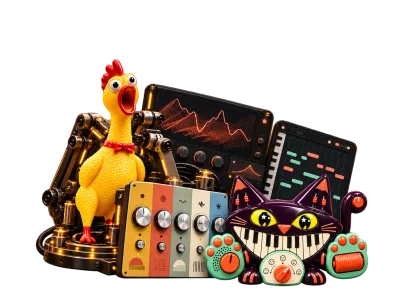
Screaming Chicken Synth plays the rubber squeaky chicken as an instrument. Each note squeezes air through a choir of little reeds, so the sound swells, rasps, sags in pitch and runs out of breath the way the real toy does.

The sound comes from a model of air pressure and vibrating reeds: squeeze harder and the chicken gets louder, brighter and rougher; let the air run out and it softens and drops slightly in pitch.

How to play it

Play notes from MIDI, the on-screen keyboard or the host's Play button. The mod wheel (or the on-screen MOD fader) is the squeeze: push it up for a louder, brighter, more desperate scream; pull it down for a softer, smoother sound that empties more slowly.

Start with Squeeze Study, the default, which follows the shape of a real hand squeezing the toy. Then try:

  • Coupled Scream for the most pressure-driven, reedy scream;
  • Reed Chicken for a stable, harmonica-like tone;
  • Staccato Clucks for quick taps;
  • Slow Deflate for a held key that slowly runs out of air;
  • Breathy Sustain for continuous air;
  • Flock Reeds for a wider ensemble.

The panel shapes the choir, how air is pushed and lost, the breath noise and how far the pitch sags. Human adds irregular wobble to pressure and pitch. Settings choose the reed model, an optional squeeze contour and an extra attack reed for a sharper onset.


Built with

The 10 Maru DSP nodes it runs, by category.

Distortion

  • Rational soft clip@maru/distortion-rational-soft-clip

    DaisySP/stmlib rational SoftLimit x(27 + x^2)/(27 + 9x^2) and its +/-3-bounded SoftClip in the source's f32 operation order, as the CHOMPI firmware uses them.

Filters

  • Biquad@maru/filters-biquad

    Canonical f32 RBJ biquad state, coefficient design, tick and reset semantics for the seven kernel filter types.

  • DC block@maru/filters-dc-block

    DaisySP DcBlock leaky differentiator with exact f32 semantics and a fixed per-sample 0.99 pole, as the CHOMPI firmware uses it.

  • One pole@maru/filters-one-pole

    One-pole low-pass tone-control primitives shared by the FX-1 chain and the addressable tone unit: the bounded cutoff-to-coefficient mapping and the stateful per-sample update…

Math

  • Decibels@maru/math-decibels

    Canonical f64 decibel-to-linear gain and RBJ amplitude conversions with ECMAScript edge behavior.

  • Range@maru/math-range

    Audio SDK-compatible f64 range policy: signed zero follows ECMAScript Math.min/Math.max, reversed bounds select the maximum, clamp propagates NaN and bounds infinities…

Modulation

  • Slew@maru/modulation-slew

    Shared one-pole parameter smoothing and bounded scalar slew limiter for click-sensitive controls such as delay read positions.

Noise

  • Xorshift32@maru/noise-xorshift32

    Raw unsigned 32-bit xorshift32 transition without seed normalization, plus the canonical unrounded mapping from a raw u32 to [-1, 1).

See all 10 in DSP

Guide and controls

Limits

An experimental instrument: it is tuned against recordings of real toys and still sounds different from them, especially in the highest screams. There are no built-in effects or sequencer yet.

What would you make with Screaming Chicken Synth?

Describe what you want to make. Build it with the Studio agent.

Goes well with.

Prototype

Mouth Synth

Maru

A vocal tract you play like a synth.

Prototype

Bells

Maru

A bell voice whose chord stays minor in any key.

Music tools on your computer.

Install and manage Maru and community plugins in one app, and play them in your DAW.

Get the desktop appBrowse plugins
Chicken Synth, a cat keyboard, effects knobs and wavetable and MIDI panels