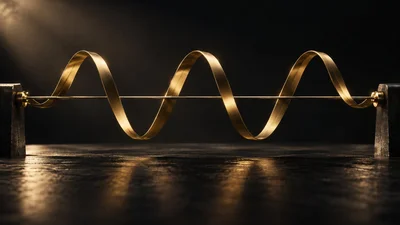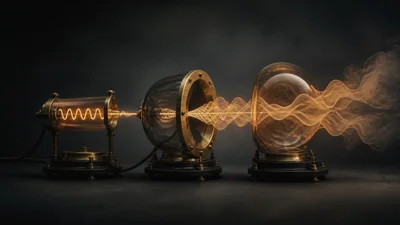
A two-oscillator wavetable synth. Each oscillator plays a stack of single-cycle waveforms and morphs smoothly through it, so one knob can turn a sound from soft to bright, hollow to vocal, or plain to metallic while you play.
The idea
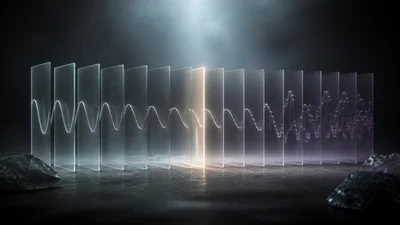
A wavetable is a series of waveforms, called frames, arranged like the pages of a flip book. Position chooses where in the stack you are, and the synth blends continuously between neighbouring frames, so sweeping it changes the timbre without steps. Each oscillator shows its stack as a large display: drag across it to sweep, or use the arrow keys to step frame by frame.
Each oscillator picks its own stack from the Bank browser. There are original formula waves, from classic sine, saw, square and pulse shapes to evolving harmonic, formant and hard-sync stacks; seven sampled basic shapes; and tables cut from audio, including four public-domain guitar recordings whose cycles become dense, unusual timbres rather than guitar playback. Playback is band-limited, so high notes stay clean.
Controls
- Oscillators 1 and 2: bank, Position, octave and tuning, Gain, and a power switch each. Turning one off fades it out but keeps its settings.
- Unison: up to eight stacked voices per oscillator, with Uni Detune to spread them in pitch and Width to spread them in stereo. More voices sound wider and use more processing.
- Filter: a resonant low-pass with Cutoff and Resonance.
- Chorus: a stereo chorus with Rate, Depth and Mix.
- Amplitude: an attack, decay, sustain and release envelope you can also drag directly.
- Voicing: up to sixteen notes in Polyphonic mode, or Mono with optional Legato, plus note priority and glide.
- Master: Level and Pan, with a peak meter.
Filter and Chorus start switched off. Master Level does not limit the output, so when the meter shows overload on your loudest chords, turn Level down.
Getting started
Play Wavetable from a keyboard or a MIDI clip. The default patch blends a formant morph with a sine; move Position on Oscillator 1 to hear the stack change. Then try the presets: Glass Pad, Hollow Pluck, Sub Bass and Saw Lead for the basics, Vowel Choir and Metallic Stab for character, String Scan to scrub through a guitar recording with Position, Wide Saw and Unison Cloud for unison, and Silk Chorus and Resonant Keys for the filter and chorus.
Credits
The seven sampled basic shapes come from the Apache-2.0 qvantor/waveform project; see THIRD-PARTY-NOTICES.md.