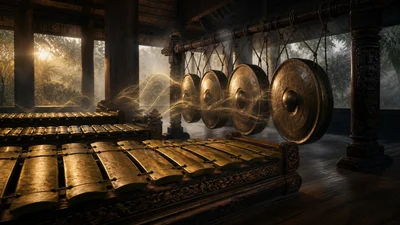
A modelled handpan: a ring of tuned steel tone fields around a central ding, in seven real layouts from D Kurd to F Pygmy. Play it from the on-screen disc, a keyboard or MIDI.
The idea
A handpan note is a deliberately tuned object. The maker hammers each field until three partials line up at once: the fundamental, the octave and the compound fifth above that. That clean 1 : 2 : 3 stack is why a handpan sounds warm and sung rather than clangy. The shell's own higher modes, which nobody tunes, ring briefly at the attack and fade first, leaving the tuned core.
The ding in the centre is a dome, not a dimple. Its octave is a pair of partials a few cents apart, so a struck ding shimmers where a tone field does not.
Controls
- Scale picks the layout: D Kurd 9, D Celtic Minor, D Hijaz, E Integral, F Pygmy, D Sabye or B Kurd 9.
- Root Note transposes the whole layout; Base Pitch is the reference A the maker tuned to.
- Note Map decides what happens to notes outside the layout. Snap to steel moves every key to the nearest field, like the real instrument. Free play lets each key ring at its own pitch.
- Position is where the hand lands: the centre of the field gives the round fundamental, the shoulder brings the octave, fifth and shell forward.
- Hardness runs from the pad of a thumb to a fingertip or nail. Playing harder also makes the strike harder, so quiet notes are genuinely softer in tone.
- Strike Noise adds the scrape of skin on steel.
- Ring, Damping and Body Size set how long and how freely the shell sounds, from a pan damped on the lap to one on a stand in a stairwell.
- Width spreads the resonance in stereo; Release sets how gently a note is damped when you let go.
- Fixed Velocity and Velocity pin strikes from the disc to one repeatable level.
- Level sets the output.
Getting started
Start with D Kurd Steel, the default instrument. Celtic Dusk is soft and ambient, Hijaz Bazaar is struck out at the shoulder, Pygmy Lap is short and damped, Deep B Kurd is the low build, and Fingertip Rhythm plays the pan as a drum.